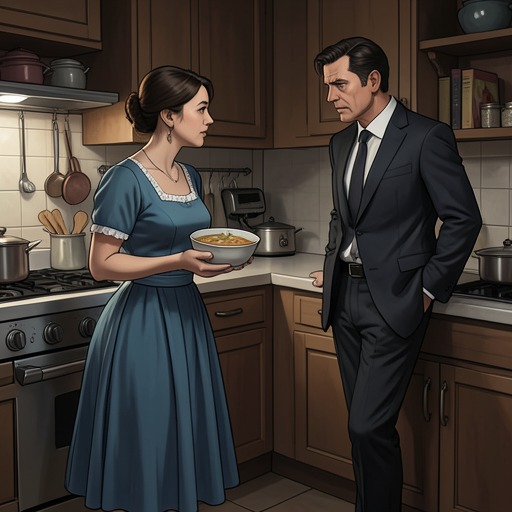
Peter Kavinsky's father
Always and Forever, Lara JeanPeter Kavinsky’s father is an estranged parent whose story is defined by the gap between affection and reliability. He remains proud of Peter and longs to see him play, but keeps his first return to the sidelines secret; when he later attempts to reconnect through a family dinner, the relationship remains difficult, and his last-minute absence from graduation renews the hurt.
Identity and First Appearance
Peter’s father enters the story not through a conversation with his son but through Lara Jean’s startled recognition at a lacrosse game. Standing apart from the crowd with his arms crossed, he has nut-brown hair and a profile Lara Jean immediately identifies as Peter’s. The resemblance becomes unmistakable when he turns: the same chin and eyes make his presence feel like an eerie glimpse of Peter’s future. Yet the man himself is a stranger to her, and she must approach to confirm who he is.
Their introduction is tentative but civil. He smiles when he catches Lara Jean watching, asks whether she is Peter’s friend, and laughs when she remarks on how much Peter resembles him. The exchange establishes both their physical likeness and the awkwardness surrounding their connection: the father is present at his son’s game, but not beside him.
Watching from a Distance
After the initial pleasantries, an awkward silence settles between them. Peter’s father breaks it by asking how Peter is. Lara Jean tells him that Peter is doing well and has earned a lacrosse scholarship to the University of Virginia. His response combines pride with an acknowledgment of estrangement: he says that he cannot take credit for Peter’s achievement, but is proud of him all the same.
His gaze returns to the field, where Peter is playing. He explains that he wanted to see his son play again and has missed it. The admission gives the visit its emotional weight: this is not a casual spectator but a father returning to an activity he once shared with his son, now watching from the margins. He asks Lara Jean not to tell Peter he was there. The request turns her into the keeper of a secret and makes the tenderness of his pride inseparable from his unwillingness—or inability—to approach Peter directly.
An Attempt at Contact
The secrecy does not last as a pattern without interruption. On another morning, Peter tells Lara Jean that his father showed up and wanted to come with them. Peter declined, answering with a blunt refusal and offering no elaboration. His father’s wish to join the outing thus meets a boundary that Peter is not ready to relax. The moment reverses the first game encounter: then the father watched without being seen by Peter; now he makes himself known and asks to be included, but Peter says no.
Later, Peter reveals that he went to his father’s house for dinner. The invitation was extended to Peter and his brother, Owen. Peter had not intended to go, but Owen asked him to come, and Peter could not refuse his brother. The circumstances matter: the dinner is a step toward contact, but it happens through Owen’s appeal rather than through a straightforward reconciliation between father and son. The account confirms that Peter does visit, without suggesting that one meal resolves the estrangement.
Pride, Absence, and Consequence
Peter’s father’s final consequential appearance is an absence. After the graduation ceremony, Peter finds Lara Jean in the crowd; despite smiling and greeting people, he seems blank. When she asks whether his father sat with the family and whether she should go over to them, Peter says his father could not come at the last minute. He gives only a vague explanation of an emergency, leaving the cause unresolved.
The missed ceremony sharpens the contradiction already present in his earlier appearances. At the lacrosse game, Peter’s father says he is proud and has missed watching him play; at graduation, when Peter’s achievement is being publicly celebrated, he is not there. The book offers no explanation that would make the absence disappear, and Peter’s subdued expression carries its immediate emotional consequence. His father’s arc therefore stops short of a repaired relationship: there are signs of longing and an attempted dinner, but also Peter’s refusal and a failure to appear at a defining moment.
Narrative Significance
Peter’s father is portrayed through a sequence of partial encounters rather than through sustained access to his private life. Lara Jean first sees him at a distance, learns his feelings in a brief conversation, and carries his request for secrecy; Peter later supplies the accounts of the invitation and dinner. This restricted perspective keeps the reader close to the uncertainty that shapes Peter’s relationship with him. His pride is real, but pride alone cannot supply the consistent presence Peter needs.
The repeated contrast between showing up and being available gives the character’s appearances their force. He physically returns to the lacrosse field, but watches from the sidelines; he asks to join an outing, but Peter declines; he invites his sons to dinner, which Peter attends at Owen’s urging; and he ultimately misses graduation. These moments do not establish that he feels nothing for Peter. Instead, they leave affection and disappointment side by side, making the father’s absence an ongoing condition of Peter’s family life rather than a conflict neatly settled by a single gesture.