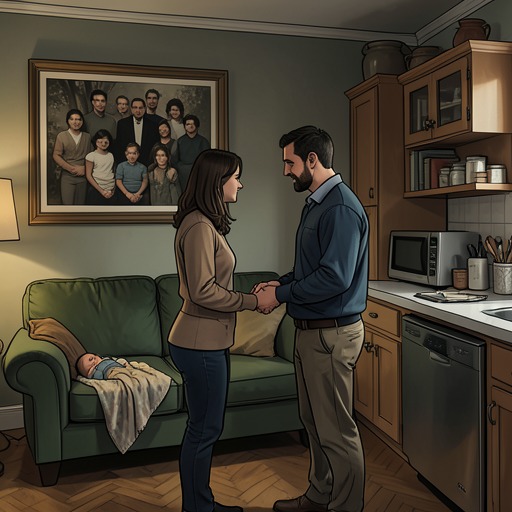
Trina moves into the Covey home
Always and Forever, Lara JeanTrina moves into the Covey home after her engagement to Dan, transforming their relationship from a future promise into a daily presence in the family’s shared rooms. The move is swift and materially unmistakable: boxes, clothes, shoes, exercise equipment, furniture, and a huge velvet headboard arrive in a house that the Covey sisters still associate with their mother. Its consequences unfold not as a single welcome but through awkward adjustments, changed surroundings, and the sisters’ different experiences of belonging.
Engagement and the Decision to Move
A couple of weeks after Dan and Trina get engaged, Trina puts her house on the market. Kristen, who works as a real-estate agent, advises her that spring is a good time to sell, and a couple makes an offer in the very week the house goes up for sale. Dan and Trina had expected it to remain on the market for at least a month. Instead, the sale accelerates the next stage of their lives, and movers soon begin unloading boxes at the Covey home.
There is no major family discussion about who will move where. It is simply understood that Trina will come to them: the Covey house is larger, and moving one person seems easier than moving four. The apparent simplicity of that decision is immediately qualified by the scale of Trina’s possessions. Her many boxes of clothing and shoes, exercise equipment, assorted furniture, and enormous velvet-upholstered headboard make the arrival of one person feel like a substantial reshaping of the house.
The move also makes a change already underway in the family tangible. Earlier, Dan tells his daughters over dinner that he wants to ask Trina to marry him; when Trina later arrives at the house with Ravi, Margot announces that Ravi will stay in her room rather than the guest room Lara Jean prepared. The family’s expectations about domestic space are being renegotiated even before Trina’s belongings take over the Covey rooms. The engagement has created a future household, but the move makes its new arrangements immediate.
A New Presence in Familiar Rooms
Lara Jean sees the move through practical details: movers taking direction from Trina, furniture coming through the door, and belongings finding places in the house. Chris, who stops by to borrow shoes, watches Trina direct the movers from Lara Jean’s window and remarks that she would not want to move into another woman’s house. The comment gives voice to the unease contained in the situation: Trina is not entering an empty home but a family space formed around the memory of Lara Jean’s mother.
The house’s new composition becomes particularly clear when Margot returns from school for the first time since Trina moved in. Lara Jean has prepared food and made up Margot’s bed, but Margot’s attention goes first to the changed living room. On the mantel is an abstract shoreline painting Trina brought from her old home; elsewhere are Trina’s embroidered throw pillows, a framed photograph of her and Dan on the day he proposed, and an armchair that has replaced the previous one. Lara Jean had moved her parents’ wedding portrait into her own room the day before Trina arrived. Seen through Margot’s eyes, the new objects make the room feel cluttered, and they also register how much has changed in her absence.
The shoe closet supplies a smaller but pointed version of the same adjustment. Trina’s many shoes have crowded the space, and Margot has to shove Trina’s cycling shoes aside to make room for her own booties. She responds by declaring that she will sort through her old shoes immediately. The closet is not merely storage: it is one of the first places where the returning sister and the newcomer must negotiate how their things can coexist.
Friction, Welcome, and Family Position
The move does not make Dan and Trina’s relationship frictionless. Lara Jean notices a new side of her father: he bickers and loses his patience, though only slightly. Trina takes a long time to get ready, which irritates him, and she teases him about his hobbies, including bird-watching and documentaries. Rather than treating those small clashes as evidence that they do not fit, Lara Jean is glad to see them. The household gains the lively irritation of two people in love, in contrast with the pleasant, even life Dan had been living before. Their compatibility includes the ordinary friction of sharing a life.
That change is harder for Margot, whose return exposes the difference between being told she still belongs and finding that home has continued to change without her. She tells Lara Jean that it feels as if she has come back to a whole new family that she was not part of. Lara Jean recognizes the truth in this rather than simply reassuring her that nothing has changed: life at home continued while Margot was away, just as it will continue when Lara Jean leaves for college. Margot cries and says that she misses their mother. Trina’s arrival is not presented as replacing that loss; instead, it makes the altered family more visible, while the sisters’ grief remains part of their home life.
Kitty voices a different fear about family change. When Lara Jean speculates about Dan and Trina having a baby, Kitty says she does not want another child because then she would be in the middle and no longer the youngest. Her worry clarifies how a family’s expansion can feel not only like welcome but also like a threat to a child’s place within it. The move therefore belongs to a larger adjustment: the sisters must accommodate Trina as a new household member while finding reassurance that their own bonds and identities still count.
From Moving In to Becoming Family
Over time, Trina’s presence is incorporated into the family’s ceremonies as well as its rooms. At Lara Jean’s high-school graduation, Trina sits with the family in a wide-brimmed Kentucky Derby hat. Margot exercises restraint instead of rolling her eyes, while Kitty calls the hat a bit much; Lara Jean tells Trina she likes it and means it. The moment preserves their differences in temperament while showing Trina already participating in the sisters’ milestone.
At Dan and Trina’s backyard wedding, under Christmas lights and white paper lanterns, the girls stand with Dan as Trina walks toward them. They cry during the vows, including Margot, who rarely cries. The wedding confirms the marriage, but Trina’s choice for the father-daughter dance gives the new family its own particular shape: she says she has already had her turn and that it would mean more for the girls to dance with Dan. The dance begins with Margot, then Lara Jean cuts in, and Kitty is due to take her turn next. The sequence makes room for Trina’s role without asking her to take the daughters’ place.
The move is thus a threshold rather than a clean substitution. Trina’s furniture and keepsakes alter a familiar home; her relationship with Dan brings both affection and everyday friction; and her arrival draws out the sisters’ distinct anxieties about belonging, change, and the mother they miss. By the wedding, the family’s adjustment is expressed not through the disappearance of those differences but through shared rooms, shared milestones, and a dance in which each daughter has a place.