Dan Covey
Always and Forever, Lara JeanDan Covey is the widowed father of Lara Jean, Margot, and Kitty, and his story in the family’s final year of high school is one of learning to love again without asking his daughters to forget their mother. His relationship with Trina Rothschild brings companionship and a larger shared future, but also unsettles the home the family built after loss. As his daughters prepare to leave, Dan’s care takes the form of practical support, emotional reassurance, and sometimes anxious rules that he must learn to loosen.
Identity and Family Life
After the death of his wife, Dan has spent eight years raising his daughters. The household’s routines have made his solitude seem ordinary to Lara Jean; only when Trina enters his life does Lara Jean recognize how lonely he may have been. Their relationship gives Dan a fuller social world: he and Trina hike before dawn, go to dinner and wineries, and meet her friends. He still enjoys staying home with a documentary, but now his life includes outings and companionship as well as family dinners.
The change is visible at the kitchen table. Trina eats with the family several times a week, and her laughter and glass of white wine beside Dan’s beer become familiar enough that her absence would feel strange. The romance does not depend on the two being alike: Lara Jean sees them as a surprisingly good couple despite their differences, and connects their growing closeness to the simple fact of living near one another. Kitty claims credit for bringing them together, as she also claims credit for helping Lara Jean and Peter reconcile.
Choosing a Future With Trina
Dan’s growing commitment becomes apparent in a late-night conversation with Lara Jean while they are preparing chocolate. He asks whether she likes Trina, then reassures her that no one will ever take her mother’s place. Lara Jean tells him she likes Trina and may even love her; she is glad that Dan has found a real partner after being alone for so long. His repeated relief at her answer conveys how much he wants his daughters’ acceptance, while his assurance makes clear that welcoming Trina does not require replacing their mother.
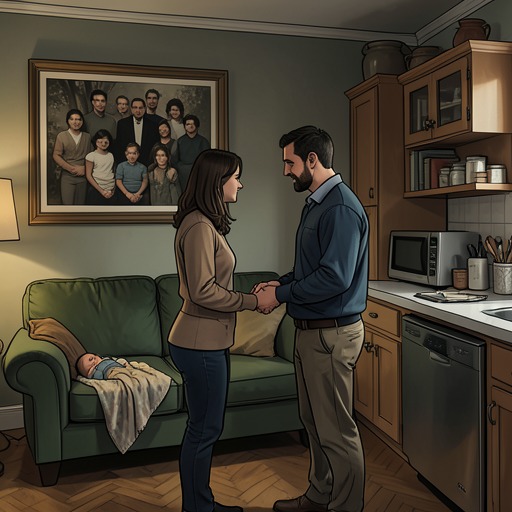
The engagement turns private affection into a family decision. On a rainy evening, with the girls in pajamas and pizza on the living-room couch, Dan clears his throat and announces that he wants to ask Trina to marry him. Kitty shrieks and launches herself at him; Lara Jean hugs him from behind. The spontaneous excitement is real, but the proposal also begins a period of rapid practical change. A couple buys Trina’s house the same week it goes on the market, much sooner than Dan and Trina expected, and the movers soon arrive at the Covey home.
There is no extended debate over which house should become the shared home. Trina moves into Dan’s larger house, a choice that makes logistical sense but brings a substantial amount of her life with her: boxes of clothes and shoes, exercise equipment, furniture, and a large velvet headboard. Dan’s daughters can see the material signs of a new household taking shape, even as their father’s happiness gives the change its hopeful meaning.
Fatherhood, Boundaries, and Change
Dan’s care is not limited to emotional reassurance. When Margot brings Ravi home, Dan has prepared the guest room with a robe and slippers, an arrangement Lara Jean has helped make. Margot’s announcement that Ravi will stay in her room catches Dan unprepared; he turns red and struggles to respond, looking to Trina for support as the family waits. The awkward pause shows a father encountering his adult daughter’s choices in real time, rather than a settled rulebook for how the changed family should work.
As Lara Jean’s graduation approaches, Dan’s protectiveness meets her growing independence. When she comes home late after her phone battery dies, he is still in his work clothes, and his anger is immediate: he demands to know where she has been and why she did not answer. Later, when she plans to stay in a house with friends after graduation, he questions the lack of adult supervision. Trina reminds him that Lara Jean is nearly an adult and will soon be living on her own; Dan accepts the point while admitting that he does not have to like it. Trina then offers Lara Jean practical advice about using a buddy system at Beach Week and college, turning the disagreement into a moment of guidance rather than simply a parental veto.
Dan’s family also has to reckon with what his new marriage changes for the daughters. When Kitty worries that a baby would leave her with no distinct place among her sisters, Lara Jean objects that she is already the middle child. Kitty answers by assigning Margot the role of oldest and smartest and Lara Jean that of prettiest, then insists that being the youngest is the one place she fears losing. Her fear gives the family’s expansion a different emotional register: a new marriage can promise more belonging while making a child anxious about her place within it.
Marriage, Memory, and Belonging
Trina’s move changes the rooms as well as the relationships. When Margot returns home for the first time since Trina moved in, she silently takes in the shoreline painting on the mantel, embroidered pillows, the framed photograph of Trina and Dan on the day he proposed, and an armchair exchanged for Trina’s. Lara Jean had moved her parents’ wedding portrait into her own room before Trina arrived, a small act that preserves the old marriage’s image while making space for the new one. Seen through Margot’s eyes, the living room seems cluttered, and the shoe closet is packed with Trina’s cycling shoes beside Margot’s booties. The domestic details register a change that family members may support without experiencing it in the same way.
That difficulty comes into focus when Margot admits that returning feels like finding a whole new family she is not part of. Lara Jean cannot honestly tell her nothing has changed: life at home continued while Margot was away, just as it will continue after Lara Jean leaves. Margot cries and says she misses their mother. Dan’s new partnership has not erased the daughters’ grief, and a more crowded, lively household cannot make every absence disappear. The family’s adjustment therefore involves holding old attachment and new affection together, rather than treating one as a replacement for the other.
Dan’s response to the past is also expressed through pride in his daughters’ futures. On Lara Jean’s graduation day, he tells her that her mother would have been proud and reminds her how much education mattered to her. When Lara Jean wonders whether her mother regretted not completing her master’s degree, Dan explains that she had planned to return to school once Kitty was in preschool full-time; Kitty was a happy surprise, not a reason she had abandoned that hope. His answer preserves the mother’s ambitions as part of the family’s memory and affirms the opportunities she wanted her daughter to have.
The graduation gift Dan announces is a trip to Korea for the three sisters with their grandmother. The sisters have talked about going for years, and their mother had wanted to take them. Dan’s gift thus joins celebration of Lara Jean’s milestone to an inherited family wish: the girls can travel together toward a place tied to their mother’s hopes. Through such gestures, Dan’s fatherhood connects practical care, remembered history, and the changing shape of home. His arc is not a resolution in which loss vanishes, but an effort to let the family grow while keeping its earlier bonds present.