Grief and remembrance
Always and Forever, Lara JeanGrief and remembrance are recurring practices through which Lara Jean lives with loss rather than leaving it behind. Her mother’s death shapes intimate memories and family milestones; Stormy’s death brings that older grief back into the present, prompting Lara Jean to gather others around the story of a woman they loved. Remembering becomes at once private, shared, and unfinished: a feeling held in small details, a story spoken aloud, and a place kept open for the people who cannot be there.
Memory as an Intimate Inheritance
Lara Jean’s memories of her mother are vivid in their tenderness but indistinct in their edges. After baths, she sat cross-legged while her mother combed tangles from her hair; unlike Margot, she did not mind sitting still. She recalls these scenes less as sharply bounded incidents than as a soft, blended feeling, a memory’s hum. Another such recollection comes from the trips to Margot’s piano lessons: mother and daughter would share secret sundaes in a McDonald’s parking lot, with caramel and strawberry sauce. Her mother gave Lara Jean her peanuts, explaining that she liked them too but knew Lara Jean loved them. The small exchange makes affection legible through an ordinary preference freely given.
That intimate inheritance complicates the thought of what a parent’s absence means. Lara Jean knows that even if her mother had been a “dirtbag,” she would still rather have her alive. She hopes Peter may someday feel similarly about his father, though their losses differ: Lara Jean has loving memories of a mother who died, while Peter has few memories of a living father. The comparison does not erase that difference; it gives Lara Jean a way to speak to Peter about the possibility of regret without pretending his relationship is the same as hers.
Loss Returning in the Present
When John Ambrose McClaren texts that Stormy died in her sleep, the news arrives abruptly, while Lara Jean is in bed looking through her welcome packet from William and Mary. She is stunned because Stormy had seemed fine the last time she saw her, and because the larger-than-life woman who taught her how to apply red lipstick seems impossible to reconcile with the word gone. Lara Jean cries until she can hardly breathe or see. She begins to write a message to John, then deletes it, unable to decide what she could do for him in the face of his grandmother’s death.
Stormy’s death also reopens the memory of Lara Jean’s mother’s funeral. Lara Jean was nine, Margot eleven, and Kitty two. Her clearest recollection is not a formal detail of the service but her father’s body shaking as he silently cried beside her, with Kitty in his arms and tears on Kitty’s cheeks. Kitty kept telling him not to cry, understanding only that he was sad. The image remains bound to Lara Jean’s first sense that nothing was safe and might never be safe again. Now, as she cries for Stormy, she finds herself crying for her mother and for everything the two losses touch. Grief returns by association, making the present death carry the weight of an earlier one.
The Unfinished Story and the Memorial
Lara Jean’s mourning includes concern for what will not be recorded. Stormy had wanted her to transcribe her memoirs, to be titled Stormy Weather, but they never got around to doing it. Lara Jean wonders how people will know Stormy’s story now. The regret is not only that Stormy is gone; it is that a particular form of telling, intended to preserve her life in her own account, was never completed.
The next day, Lara Jean calls Margot, and they cry together. Margot proposes a memorial at Belleview, where Stormy’s friends could share memories even though they could not travel to the funeral in Rhode Island. Lara Jean agrees that Stormy would like it and begins to turn grief into a gathering: words, cookies, and the recollections of people who knew her. This act does not replace the missed funeral or the unwritten memoir. It gives the community a way to speak and listen in the place where Lara Jean knew Stormy.
At Belleview, the gathering is small and marked by change. Mrs. Armbruster, who has dementia, is wheeled in; Mr. Perelli, Alicia, Shanice, and Janette are among those present. Lara Jean notices that fewer residents and staff are familiar to her than before: some residents have moved in with their children, others have died, and the place has changed while she was away. In this setting, remembrance is also an encounter with time passing beyond the death being commemorated. John Ambrose arrives in a pressed button-down shirt and khakis, takes a seat beside Alicia, and gives Lara Jean an encouraging smile as she prepares to speak.
Public Telling and Continuing Love
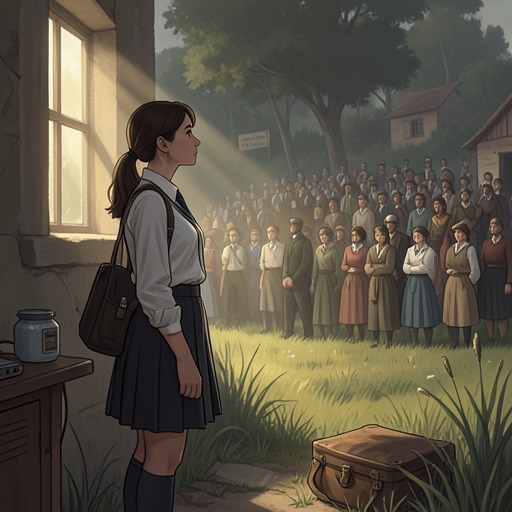
Lara Jean begins her memorial speech with a scene from 1952. Stormy was eighteen, in the marching band, voted Best Legs, and had a Saturday-night date with a boy named Walt. On a dare, she went skinny-dipping in the town lake. When a farmer called the police and their lights reached the water, Stormy told them to turn around before she would come out; she rode home in a police car. Mr. Perelli and others affirm that she never could turn down a dare, and their laughter eases Lara Jean’s nervousness. The gathering becomes more than an audience for a eulogy: those present recognize the story and participate in its telling.
From that comic episode, Lara Jean turns to what Stormy taught her: love means making brave choices every day, and Stormy repeatedly chose both love and adventure as if they were inseparable. Lara Jean imagines Stormy embarking on a new adventure and wishes her well. The speech makes remembrance an act of interpretation, but one grounded in the specific life the room recalls—not an attempt to reduce Stormy to a solemn lesson. John wipes his eyes with his sleeve. Janette plays “Stormy Weather,” and the song gives the gathering a shared ending after Lara Jean’s words.
Grief Within Family Milestones
Lara Jean’s understanding of loss shapes how she speaks to Peter about his estranged father. Remembering the pride and love she saw in his father as he watched Peter play lacrosse, she urges Peter to consider giving him a chance. Peter objects that his father acts only for himself and may hurt him again if allowed back into his life. Lara Jean does not claim that her own family history is equivalent. Instead, after Stormy’s death, she draws on the knowledge that people may not be present forever and asks Peter to consider the regret he might carry. She frames the decision as something Peter must make for himself, not simply as a favor to his father. Her grief thus becomes a reason to speak, though Peter asks to stop discussing the subject.
At high-school graduation, remembrance takes another form: absence within a family celebration. Lara Jean smooths her dress and keeps her cap in her bag as she rides with Trina, Margot, and Kitty; her father drives separately to pick up Grandma. Nana cannot attend because she is in Florida with her boyfriend, but Lara Jean’s most painful absence is her mother’s. She hopes her mother somehow knows and sees the milestone, while also wishing for the direct comfort of a hug. The scene holds belief and longing together rather than resolving one into the other.
On the drive home, her father tells Lara Jean that her mother would have been proud of her and had cared deeply about her education and opportunities. Lara Jean asks whether her mother regretted not earning a master’s degree. Her father explains that Kitty was a happy surprise, that their mother had planned to return to school once Kitty was in preschool full-time, and that she still intended to pursue the degree. She had planned to take a class that fall, but ran out of time. He says they had eighteen years together—the same number of years Lara Jean has been alive. The information gives Lara Jean a more particular account of her mother’s unrealized plan, while making the measure of their time together newly stark. She responds by asking to stop at a drugstore for photo paper: she wants to add a picture of herself and Peter in their caps and gowns to his scrapbook, the last page of their high-school chapter. A family memory of the dead and a keepsake for the living meet at the edge of a new transition.
A Practice, Not a Cure
Across these moments, remembrance moves between forms: the soft texture of a childhood ritual, the bodily shock of receiving news, the remembered scene of a father weeping, an unfinished memoir, a public speech, a song, and a photograph intended for a scrapbook. None makes loss disappear. Instead, each gives it a shape that can be carried or shared. Lara Jean’s memorial for Stormy allows her community to add its own voices to the story; her father’s account lets her understand more fully what her mother had planned; and her memories of her mother remain loving precisely because they are incomplete, ordinary, and still emotionally present.