Rebuilding family after loss
Always and Forever, Lara JeanRebuilding family after loss in the Covey household does not mean replacing the dead or returning to an earlier version of home. It means carrying the memory of Lara Jean’s mother while making space for Trina, and recognizing that the same changes can bring happiness to one family member and unsettle another. The family grows, but growth does not erase grief or guarantee that everyone feels equally included.
Memory and the Unreplaceable
Lara Jean’s understanding of loss is shaped by a contrast with Peter Kavinsky. Each has one parent: he has a mother, while Lara Jean has a father. Peter believes she had the better end of the bargain because her mother loved her, whereas his father is alive but, in Peter’s judgment, a dirtbag. Lara Jean partly agrees, not because her father’s absence would be preferable, but because her own memories of her mother are full of affection and Peter has few memories of his father. She hopes that one day Peter will feel that, despite the hurt, he would rather have his father present.
The memories Lara Jean treasures are ordinary rather than monumental. After a bath, she sat cross-legged while her mother combed the tangles from her hair; unlike Margot, she did not mind sitting still. She also remembers being taken to McDonald’s while Margot had piano lessons, where she and her mother shared secret ice-cream sundaes. Her mother gave Lara Jean her peanuts, explaining that she liked them too but knew her daughter loved them. These recollections are blurred, more a feeling than a sharply preserved scene, yet their very ordinariness gives them force: love survives in small acts of attention that no new family arrangement can reproduce.
When Dan asks whether anyone will take her mother’s place, Lara Jean assures him that no one will. His question registers the seriousness of his new relationship, but her answer does not oppose his happiness to her mother’s memory. She is glad that Dan has found a real partner after years alone, and says she is glad for him. Trina’s presence has already become imaginable as part of the household; accepting that place does not require surrendering the place her mother holds in Lara Jean’s life.
A Household Expands
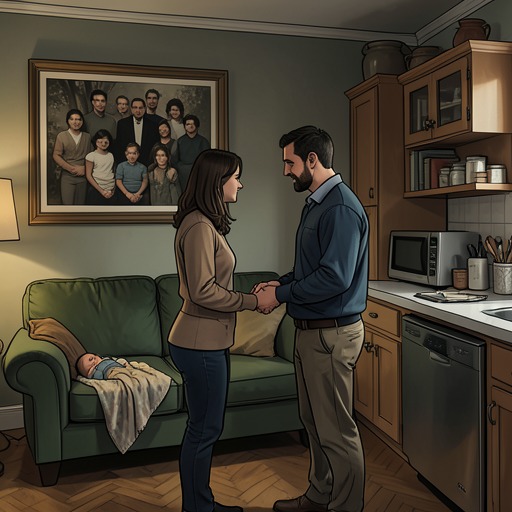
Dan announces his intention to ask Trina to marry him over dinner on a rainy evening, while the girls are in their pajamas on the living-room couch with two large pizzas: plain cheese for Kitty and a supreme pizza for the others. Nervous, he clears his throat before telling his daughters what he wants to do. Their immediate excitement—Kitty shrieking and launching herself at him, Lara Jean hugging him from behind—makes the engagement a family occasion rather than a private romance. Lara Jean asks whether he is happy; with tears in his eyes, Dan nods and holds her tighter. The moment is summed up in the sense that their small family has grown bigger.
That expansion is visible in practical preparations as well as declarations. At the first dinner with everyone together since the engagement, Lara Jean presents Trina with a wedding mood board she has worked on for a week. Its references include the film Pride and Prejudice, a wall of roses for the photo booth, The Virgin Suicides, and wine-bottle floral centerpieces nodding to Charlottesville wineries. Lara Jean has even skipped Peter’s lacrosse game and a movie night at Pammy’s to work on it. The project is an earnest offer of participation, although Trina’s mild alarm at first glance suggests that Lara Jean’s carefully formed vision may not automatically be Trina’s own.
The changed household also appears in a moment of awkward negotiation. When Ravi visits, Dan has prepared the guest room, with towels, a robe, and slippers Lara Jean selected. Margot then says Ravi will stay in her room. Kitty and Lara Jean exchange startled looks; Dan is flustered, and Trina quietly supports him with a hand on his back. The scene exposes how a home’s rules and expectations must be worked out anew as relationships change. Good intentions and hospitality do not prevent surprise, discomfort, or the need to negotiate boundaries.
The Unevenness of Belonging
Margot’s return home makes the material signs of change newly visible. It is her first visit since Trina moved in. The living room now contains Trina’s abstract shoreline painting, embroidered pillows, wedding-proposal photograph, and armchair, as well as her many small ornaments. Lara Jean had moved her parents’ wedding portrait into her own room the day before Trina moved in; arriving with Margot, she sees the altered room through her sister’s eyes and recognizes how cluttered it looks. Even the shoe closet is fuller, with Trina’s cycling shoes taking space beside Margot’s booties. The objects are ordinary, but together they make clear that home has continued to change in Margot’s absence.
Margot eventually names the deeper hurt: she came back to what felt like a whole new family of which she was not a part. Lara Jean wants to reassure her that nothing has changed, but knows that would not be true. Life at home carried on while Margot was away, just as it will carry on when Lara Jean leaves for college in the fall. Margot’s tearful admission that she misses their mother connects the present displacement to the older loss beneath it. The family’s expansion has not simply added a new member; it has changed the familiar arrangements through which the sisters understood their place.
Kitty voices a related fear when Lara Jean speculates that Dan and Trina might have a baby. Lara Jean imagines the pleasure of buying a little brother clothes, but Kitty blushes and says she does not want another baby: she fears that she would become the middle child and then “nothing,” losing even the distinction of being the youngest. Lara Jean objects that she is already in the middle. Kitty counters by assigning her sisters valued identities—Margot is the oldest and smartest, Lara Jean the prettiest—while worrying that she herself has only her position as the youngest. The exchange reveals that family change is experienced through questions of place and recognition, not just through affection for the new partner.
Grief, Story, and Continuity
Lara Jean’s response to the death of Stormy shows another way a family-like bond can persist after loss. Stormy’s funeral is too far away, in Rhode Island, for Lara Jean to attend. The prospect brings back the last funeral she remembers: her mother’s, when Lara Jean was nine, Margot eleven, and Kitty two. She recalls sitting beside Dan as he silently shook with grief, with Kitty in his arms and his tears on Kitty’s cheeks. Kitty kept telling him not to cry, while he tried to smile. For Lara Jean, that memory carries the frightening realization that nothing felt safe anymore. Her grief for Stormy therefore returns alongside grief for her mother, joining distinct losses rather than replacing one with another.
Stormy had wanted Lara Jean to transcribe her memoir, which she planned to call Stormy Weather; they never got around to it. Lara Jean worries that without the memoir, people will not know Stormy’s story. At the memorial she organizes at Belleview, she answers that worry by telling one aloud. She describes Stormy at eighteen in the summer of 1952: in the marching band, voted Best Legs, and on a Saturday-night date with Walt when a dare sent her skinny-dipping in the town lake. A farmer called the police; when officers shone their lights on the water, Stormy insisted they turn around before she came out, and she rode home in a police car. Familiar listeners confirm that defying a dare was characteristic of her, turning the remembered episode into shared testimony rather than a private recollection.
Lara Jean’s tribute makes Stormy’s adventurous life a lesson in choosing love bravely, and the gathering ends with “Stormy Weather” playing. The public telling cannot undo death or recover the unwritten memoir, just as welcoming Trina cannot restore the family exactly as it was before Lara Jean’s mother died. Instead, remembrance and change coexist: the family makes room for new attachments, keeps telling the stories of those who are gone, and learns that belonging may feel secure to one person while remaining unsettled for another.