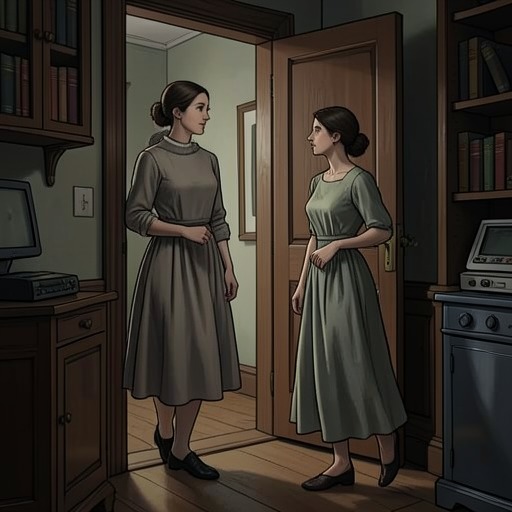
The relationship between Lara Jean Covey and Trina Rothschild
Always and Forever, Lara JeanLara Jean Covey and Trina Rothschild grow from neighbors who are dating Lara Jean’s father into a family relationship marked by ordinary companionship, teasing intimacy, and deliberate inclusion. Their connection is not immediate or effortless: Lara Jean continues to think of Trina as Ms. Rothschild even as the household makes room for her, while Trina offers Lara Jean both practical encouragement and a place in the family she is building with Dan Covey.
From Neighbor to Familiar Presence
Trina and Dan have been officially a couple since the previous September, and Lara Jean sees their compatibility in the life they make together despite having little in common. Their closeness begins in proximity: two neighbors sharing Netflix, dogs, and wine. Trina brings Dan into a fuller social life. They hike before the rest of the family wakes, watch the sunrise, go out to dinner and wineries, and meet Trina’s friends. Lara Jean recognizes that her father seems energized and less lonely than he had been in the eight years since her mother died.
That change is also visible at the dinner table. Trina joins the family for meals several times a week, and her absence begins to feel unusual. Lara Jean associates her with the sound of her rich laugh and the glass of white wine beside Dan’s beer. Familiarity accumulates in repeated domestic scenes rather than in a single declaration: Trina is becoming part of the household because she keeps showing up within it.
Support and Everyday Intimacy
Trina’s advice to Lara Jean respects her growing independence. When Lara Jean considers her future at the University of Virginia, Trina says she trusts her to know what is best, then encourages her to make her own friends rather than relying on Peter Kavinsky’s lacrosse circle. She urges Lara Jean to find her people at a large university and to join the Asian association, explaining that studying in another country left her wishing she had found an Asian-American group. Her counsel links practical advice about college to the importance of finding community around racial identity.
Their closeness also takes shape through shared activities and small acts of care. For Halloween, Trina lends Lara Jean clothes from her own wardrobe for a Marla Singer costume, including a black slip dress and a fake mohair jacket; she also brings out high black platform heels from her collection of costume pieces. Trina helps her get ready before work, while Kitty Song fusses with Lara Jean’s wig. The scene makes Trina a participant in Lara Jean’s imaginative life, not merely her father’s partner.
At home, Trina’s warmth is often playful rather than solemn. Kitty has begun calling her Tree, while Lara Jean still slips into calling her Ms. Rothschild, though she tries to use Trina’s name. When Kitty asks what bat wings are, Trina demonstrates by stretching out her arm and then tickling her. The joke ends with Kitty laughing and Dan looking as happy as Lara Jean has ever seen him. Trina’s teasing allows the prospective stepmother relationship to be approached without stiffness: the family can joke about the new role while affection grows in practice.
Engagement and the Question of Family
Dan’s proposal changes the stakes of Lara Jean and Trina’s connection. One rainy evening, after the girls have changed into pajamas and the family is eating pizza on the living-room couch, Dan nervously clears his throat and says he wants to ask Trina to marry him. Lara Jean claps her hands over her mouth; Kitty flings aside her pizza and leaps at their father. Their immediate excitement shows that Trina’s place in the family has already become emotionally meaningful before the marriage is formalized.
Lara Jean responds to the engagement by putting sustained effort into the wedding. She spends a week making a mood board, combining references to the film Pride and Prejudice, a wall of roses for a photo booth, The Virgin Suicides, and wine-bottle floral centerpieces nodding to Charlottesville wineries. She has skipped Peter’s lacrosse game and a movie night at Pammy’s to work on it. Trina admires the result but explains that she and Dan have both been married before and do not want a large, elaborate wedding; she may simply wear a dress she already owns. Lara Jean, by contrast, wants the couple to celebrate, arguing that Dan’s finding someone who will eat his cooking and watch documentaries deserves a fuss. Their different ideas about the wedding reveal different instincts, not a lack of care: Trina prefers a small occasion, while Lara Jean expresses welcome by planning a celebration.
That planning also makes the question of belonging explicit. Trina asks Lara Jean to stop calling her Ms. Rothschild and offers Trina or Tree instead, saying that Lara Jean should use whichever feels right now that she is going to be her stepmother. Lara Jean jokes that Stepmother feels right, and Trina swats at her in mock threat. Their joking exchange recognizes the change in status without requiring Lara Jean to perform instant emotional certainty. Trina invites closeness; Lara Jean answers in the language of teasing that has become their shared idiom.
Inclusion, Difference, and a New Family
Trina’s effort to include Lara Jean and her sisters becomes visible when Kitty asks whether she and Lara Jean can be bridesmaids. Trina agrees, then directly checks whether Lara Jean is comfortable with the arrangement. The invitation matters because it gives the girls a place in the wedding rather than treating it as an event belonging only to the adults. Trina’s attention to Lara Jean’s consent makes inclusion an active gesture, not an assumption.
The question of cultural representation complicates that effort. When the family discusses acknowledging Asian culture at the wedding, Margot Song objects that Trina is not Asian and should not appropriate Asian culture merely because her future stepdaughters are. Lara Jean counters that Trina wants them to feel included and has suggested acknowledging their mother. The difference between Margot’s objection and Lara Jean’s defense shows that inclusion can be well meant yet contested: Trina’s wish to honor the family does not erase the fact that she did not know Lara Jean’s mother. Lara Jean’s response makes room for the intention while recognizing the significance of that absence.
At the wedding, the relationship is pictured in a single close family photograph. The three Song girls gather tightly around Trina: Margot dabs at her eyes with a tissue, Kitty stands on a footstool to fuss with her hair, and Trina puts an arm around Lara Jean. They are smiling broadly. Lara Jean sees the moment as both an ending and a beginning, an image in which the new family is not a replacement for the past but a form that has grown alongside it. Across meals, advice, costumes, jokes, wedding plans, and the wedding itself, Trina and Lara Jean move toward kinship through repeated acts of attention and welcome.