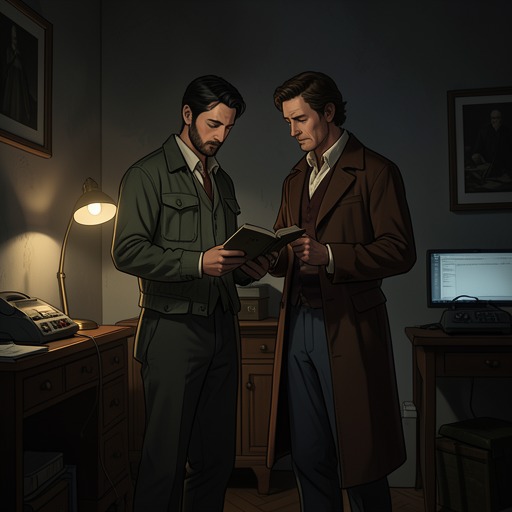
Gillian Bradley's psychic-gift limitations
AlwaysGillian Bradley’s psychic-gift limitations shape her work as a missing-person finder: she can tune in to impressions about people who are gone, but she cannot command those impressions or treat them as answers. The gift supplies leads, not certainty, so its use depends on patience, intuition, and practical investigation—and even then, it may yield nothing.
Nature of the Gift
Gillian does not think of herself simply as a psychic. She describes an ability to tune in to missing persons, receiving sensations and feelings that are not sufficient on their own. Their value emerges when family members answer questions and Jake Donovan researches the information she receives; Linc Granger says their combined approach has a 99 percent success rate. The figure belongs to that collaborative method, not to an assurance that Gillian’s impressions independently identify a person or explain a disappearance.
The gift is not a general power to know whatever she wants. Gillian rejects the public assumption that psychics can answer any question, including questions about their own lives. She cannot use her ability for personal benefit or to predict events. Words, pictures, and sounds sometimes enter her mind, but their arrival is unpredictable; after leaving Indiana, she has not experienced them again. Her account makes both the reach and the boundary of the ability explicit: it is receptive and intermittent, not an instrument she can operate on demand.
Practice and Uncertainty
When Emma Henderson brings Paige Trent’s belongings, Gillian closes her eyes and holds them, but she does not claim an immediate reading. She asks to keep the objects for about a week, handle them, and record her sensations in a journal. If something specific emerges, she will contact Emma; if not, she may request a photograph album or permission to walk through Paige’s room. Gillian warns directly that nothing may come of the attempt. The objects may help focus attention, but they do not guarantee a revelation, and time is part of the process.
Gillian also explains that impressions do not arrive in a straightforward sequence. In her account, energy has no past, present, or future, so sensations can become mixed up and produce messages that make little sense. The warning places interpretation at the center of her practice: an impression can be meaningful without being clear, and cannot safely be mistaken for a complete account of events. Her journal, follow-up questions, and willingness to wait acknowledge that ambiguity rather than concealing it.
Investigation and Corroboration
The search for Paige shows how Gillian’s impressions intersect with ordinary investigative work. She speaks with Craig Jamison and the detective assigned to Paige’s case, learning that the detective had considered whether Barrett Henderson’s death and Paige’s disappearance were connected, though the police found no link. Gillian does not treat that official conclusion as proof that no connection exists, but neither does she claim a psychic answer. While looking at Paige’s picture and necklace during the conversation, she feels strongly that San Diego matters and asks Emma whether Paige had any connection to the city.
Jake’s work supplies a different kind of lead. He asks whether Paige used a computer or social-networking sites and accesses her phone records; he finds that use stopped on the day she disappeared and identifies no unusual calls, while suggesting interviews with some of her friends. Gillian explicitly brings Jake into the case because his skills differ from hers. The contrast is central to the gift’s practical limits: impressions may direct attention, while records, interviews, and research test what can be established outside the impression itself.
Boundaries and Significance
Gillian’s limitations are not only technical. When Nathan Bradley asks her to help find his daughters, she refuses, despite his appeal and assurances that he can protect her privacy. Her earlier search for Brian Reston’s son had awakened hopes of a future with Brian and the boy, and the memory still hurts. She says she is not ready for Nathan’s search and resists the idea that helping is as simple as closing her eyes and producing answers. Her refusal establishes that the gift does not erase personal history or obligate her to undertake every case.
Taken together, these boundaries keep Gillian’s ability from functioning as an effortless solution to the novel’s missing-person mystery. It can suggest a direction, as San Diego does, but its messages may be delayed, mixed, or absent; human inquiry must still supply context and verification. The 99 percent success rate coexists with Gillian’s warning that a particular effort may fail. Her insistence on uncertainty makes the search a collaboration between intuition and evidence, rather than a promise of supernatural certainty.