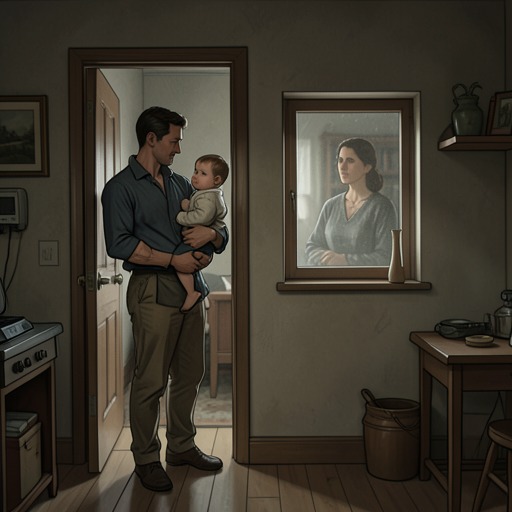
Sara and Jake’s childless-marriage agreement
AlwaysSara and Jake’s childless-marriage agreement begins as an expression of devotion and becomes the fault line that ends their engagement. Sara agrees to a future without children because she loves Jake and hopes his grief may soften; Jake’s refusal is rooted in the loss of Davie and a fear that parenthood would expose him to that devastation again. When Sara becomes pregnant and tells him that she cannot keep their agreement, the difference between their hopes becomes impossible to set aside, and she calls off the wedding.
Origins and Terms
Jake’s resistance to having children comes from the loss of his former wife, Mary Beth, and their son, Davie. He remembers Mary Beth’s screams during the car bombing that killed Davie, and later learned that the bombing was an act of revenge by a man he had arrested. Jake felt responsible; Mary Beth blamed him, and the marriage fell apart. He says he will never recover from losing Davie and cannot put himself through the possibility of such a loss again. The agreement is thus not a casual preference but a boundary shaped by bereavement, guilt, and fear.
Sara enters the pact with a different relationship to parenthood. She loves children and has worked at a day-care center for three years, believing that the experience will make her a better teacher when she finishes college. She nevertheless agrees to a childless marriage because she loves Jake so much that she is willing to accept almost anything. Her acceptance is conditional in hope, if not in the agreement’s stated terms: she prays that Jake may change his mind as he comes to trust the love he has to give.
The couple’s understanding is sustained by tenderness as well as avoidance. Jake rarely expresses his feelings directly, but he brings Sara a yellow rose every Friday night. Each flower marks another week together and gives them a reason to talk about their successes and failures. The two most recent roses, kept in a vase on Sara’s bedroom desk, remind her of their commitment. That ritual makes their bond tangible, but it does not resolve their opposing visions of a family.
The Conflict Comes Into the Open
Two days before the planned wedding, Sara approaches the house where she has lived all her life, carrying the news of her pregnancy and hoping Jake will welcome the child. Her hope is set against what she already knows: he has described the pain of losing his wife and son and said that he does not want children. Their disagreement is no longer an abstract question about a possible future; a child is now part of the decision they must face.
Before Sara arrives, her mother, Jennie Standish, asks Jake directly whether he wants children. He confirms that he does not. Jennie reminds him that Sara loves children and has chosen to keep working with them even though she could have gone to college full time. She argues that the couple’s love should extend beyond the two of them. Jake answers that Jennie does not understand. The exchange exposes the competing meanings of their pact: Jennie sees family as something love should make room for, while Jake sees parenthood as a risk he cannot bear to take.
When Sara asks Jake whether he might ever change his mind, she places her hand on her stomach. She tells him that she wants his children and needs to have a baby to feel fulfilled in their marriage and as a woman. His response returns them to the agreement: they had made a promise not to have children. Sara acknowledges that promise, then tells him she cannot keep it. The declaration turns the pact from a private reassurance into a direct choice between their incompatible needs.
The Wedding Is Called Off
Jake’s reaction makes the emotional cost of the agreement plain. Sara sees his distress and understands that the old wound remains active, not healed by their relationship. She does not want to trap him in a marriage and future he has said he cannot accept. She tells him that she needs children and cannot marry him if he truly does not want them. He asks whether she is calling off the wedding; she says she has to think about the future.
Jake explains that he cannot imagine the anxieties of pregnancy, caring for an infant, or raising a child he might be unable to protect. Most painfully, he cannot imagine looking at a child and missing Davie even more. He says the pain is sometimes unbearable already and that if Sara needs children in her life, she is right to cancel the wedding. His words do not erase his love for Sara, but they confirm that he cannot promise the future she wants.
Jake leaves rather than stay for dinner with Sara and her mother. Sara has not disclosed her pregnancy in this exchange, but her decision is already shaped by it: she refuses to marry on the assumption that the child she needs can be excluded from their shared future. The agreement ends the engagement because neither can accept the other’s necessary condition—Sara cannot give up motherhood, and Jake cannot accept the prospect of becoming a parent again.
Later Consequences and Significance
The later revelation of Christopher’s existence gives the conflict a further consequence. Sara introduces her three-year-old son to Jake as his father. Jake discovers that Sara kept the child from him and that he has missed three years of his son’s life. He struggles with anger toward Sara while trying not to let it affect Christopher, and feels the sudden weight of responsibility: he is a father again, and this time he wants to keep his son safe. The earlier agreement, formed around Jake’s fear of renewed loss, has not prevented parenthood; instead, the separation that followed it has cost him time with a child.
The pact also clarifies the difference between loving someone and being able to share the same future. Sara’s original willingness to agree is real, as is Jake’s grief; neither makes their disagreement disappear. The yellow roses stand for their weekly practice of connection and candor, yet when the question of children becomes immediate, affection cannot substitute for an answer. The story makes the agreement’s failure consequential rather than merely symbolic: the wedding is called off, and Sara’s hidden pregnancy becomes a later, painful disclosure about the family the pact could not contain.