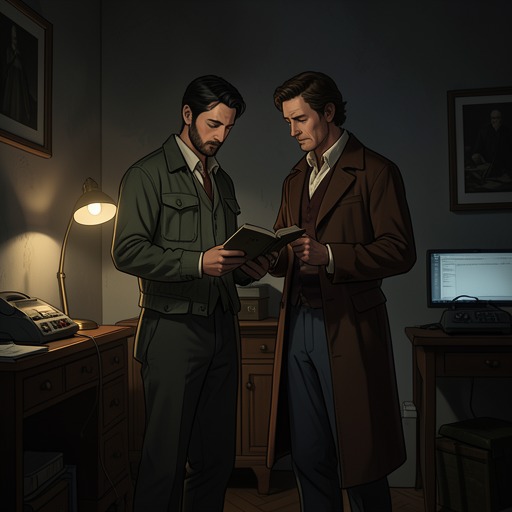
Gillian’s gift
AlwaysGillian’s gift is an intuitive ability to tune in to missing people, central to how Gillian Bradley and Jake Donovan’s work complements conventional investigation. It gives the search for Paige Trent a new direction, but not a ready-made solution: Gillian receives sensations and feelings whose meaning must be tested against interviews and research, and she makes clear that her impressions can be confused or come to nothing.
Origin and Character
As Linc Granger explains it to Emma Henderson, Gillian was struck by lightning when she was ten; her sensations began afterward. The narrative supplies no fuller account of how the lightning caused the ability, but establishes the sequence as the origin of a sensitivity that later becomes part of Gillian’s work with missing people.
The gift is described less as a general power to see the future or know the past than as an ability to tune in to people who are missing. Gillian does not think of herself as a psychic, despite the label others might use. She receives sensations and feelings, but these impressions are not sufficient on their own to identify or locate someone. Her work depends on interpreting them alongside information gathered from the people closest to the missing person and Jake’s research.
A Collaborative Method
Gillian and Jake find missing persons, especially lost children, and have established a foundation for that purpose. Their work draws on different forms of knowledge: Gillian’s impressions can suggest a lead, while Jake, a former police officer turned private investigator, follows up with research and investigative skills. When Nathan Bradley’s ex-wife disappeared with his daughters, Jake recommended Gillian to Nathan; Gillian found the girls, and Jake became a believer in her ability after seeing the result.
The partnership’s reported 99% success rate belongs to this combined process. The number is tied not to impressions alone but to questioning family members and Jake’s tracking down information Gillian receives. The arrangement makes the gift operational without presenting it as infallible: intuition generates material to investigate, and other people’s accounts and research help determine what that material can mean.
Working with Paige’s Belongings
When Emma brings Gillian a royal-blue flannel jacket with a hood, Gillian stops her from explaining it. She holds the jacket, closes her eyes, and after a few seconds identifies a detail about Paige: she had dark brown hair, unlike Emma’s blond-brown hair. The moment demonstrates the gift through an encounter with an object associated with the missing person, before Gillian has been given the information verbally.
Emma also gives Gillian a necklace. Gillian holds it with her eyes closed, but this contact does not immediately produce a clear answer. Instead, she asks to keep the items and spend about a week thinking about Paige, handling her belongings, and recording her sensations in a journal. If something specific emerges, she will call Emma; if not, she may request a photograph album or permission to walk through Paige’s room. Gillian warns Emma directly that nothing might come of the process. Her caution is part of the gift’s limits, not a retreat from helping: the objects may prompt impressions, but those impressions need time and may remain inconclusive.
Leads, Limits, and Narrative Significance
Gillian’s impressions also direct the investigation beyond the belongings. After speaking with the detective assigned to Paige’s case, she senses that he has not told her everything. While carrying Paige’s photograph and necklace, she gets a strong impression that San Diego is important and asks Emma whether Paige had a connection there. Emma cannot recall one. The impression thus supplies a lead rather than proof, leaving its significance to be pursued through further inquiry.
That inquiry uses methods distinct from Gillian’s. She contacts Craig Jamison, assesses his account of his relationship with Paige, and speaks with the detective, who confirms that investigators had examined whether Barrett Henderson’s death and Paige’s disappearance were connected. Jake checks Paige’s phone records, notes that their use stopped on the day she disappeared, and proposes speaking with her friends; Gillian says she has brought him in because his skill set differs from hers. The contrast clarifies the gift’s place in the search: it works alongside records, interviews, and investigative follow-up, not in place of them.
A later plan again depends on information outside the gift. Linc asks Jake to tail Tim Levine, whose posts on Branches suggest that he frequents private clubs, so Linc can approach him when he is out alone. Levine eventually reveals that Paige had told him she could not keep facing Emma. The investigation then discloses the reason for her disappearance: Paige had slept with Barrett and could no longer bear her guilt. Gillian’s San Diego impression helped focus the search, but the account of Paige’s motive comes through human testimony and confrontation, not a supernatural revelation. The gift’s narrative force lies in opening a route through uncertainty while preserving the need for evidence, interpretation, and the painful explanations that intuition alone cannot supply.