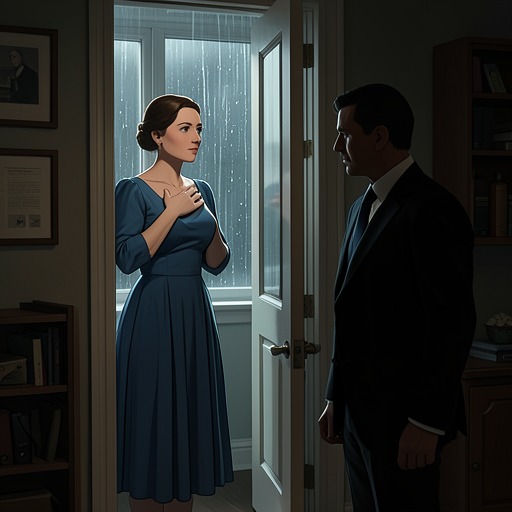
Jake Donovan—Davie
AlwaysJake Donovan’s relationship with Davie, his six-year-old son, is loving, intimate, and violently interrupted by a car bombing. Davie’s death leaves Jake with enduring grief and a conviction that fatherhood exposes a child to suffering he cannot prevent. When Jake later becomes a father to Christopher, memories of Davie return in the boy’s face, voice, and touch: the relationship is at once a bereavement that cannot be repaired and the measure by which Jake tries to do fatherhood differently.
Identity and Family Background
Davie is Jake’s son from his marriage to Mary Beth. Jake remembers him as six years old, full of life and fun. The novel offers few details of their everyday life together, but the remembered scenes make clear that Davie was not an abstraction in Jake’s grief: he was a small child with routines, gestures, and a place in a family that Jake expected to protect.
Before the loss, Jake was already working as a police officer, a profession he had chosen because he hoped to make a difference in the city. His account to Sara connects that public role with the private family life it could not safeguard. The loss of Davie does not remain a single past event; it becomes the central circumstance through which Jake understands being a husband and a father.
The Bombing and Its Consequences
One night, while Jake was working the night shift, Mary Beth and Davie went to a video store to get a movie. Jake’s car was parked behind hers. Davie ran ahead of his mother and opened the driver’s door so he could climb in beside her. The car exploded. Jake was not at the scene, but he remembers hearing Mary Beth’s screams; he says that he still hears them.
The bomb was an act of revenge by a man Jake had arrested. It killed the wrong person: Davie, rather than the officer the attacker meant to punish. Jake nevertheless felt responsible, and Mary Beth blamed him as well. Their marriage fell apart after the loss, extending the bombing’s consequences beyond the death itself. For Jake, the tragedy fused grief with guilt and the knowledge that neither his work nor his love could guarantee his family’s safety.
The account of the bombing is also the explanation Jake gives for refusing to have more children. He sees the world as one that suffers and fails to cherish or protect children, and he cannot accept the possibility of experiencing another such loss. He tells Sara he will never get over Davie’s death and cannot put himself through it again. His position is not a passing objection to parenthood: it is a boundary formed by bereavement, and it shapes the couple’s agreement to a childless marriage.
Memory, Fear, and Fatherhood
Davie’s absence continues to make itself present in Jake’s life. When Sara tells him she is pregnant, the memory of losing his son informs the conflict over whether to marry and raise a child. Sara recognizes that the news will not simply bring Jake joy: she believes he would proceed with the wedding out of honor, even if he remained unwilling to embrace fatherhood. The fear attached to Davie’s death thus reaches forward, shaping a choice about a child who has not yet been born.
After meeting Christopher, Jake sits beside the three-year-old on the grass and notices how much the boy resembles Davie. Christopher has Jake’s features and eyes. The resemblance prompts Jake to imagine the milestones he missed with Davie—his first tooth, first word, and first step—and makes the three years he was kept from Christopher newly tangible. The scene holds together two different absences: the irretrievable childhood Jake lost with Davie and the years Sara’s concealment kept him from knowing Christopher.
Jake is angry that Sara lied and deprived him of three years with his son, but he tries to keep that anger from determining how he treats Christopher. Fatherhood arrives again without warning or preparation, and Jake feels the responsibility of keeping the boy safe every minute. His impulse is to keep Christopher within sight; at the same time, he knows he must temper the fear that drives that impulse. Davie’s loss has made protection feel urgent, but Jake recognizes that fear cannot be allowed to govern every moment of his new relationship with a child.
Davie’s Return in Christopher’s Gestures
Christopher’s voice brings the past into the present. When he calls Jake “Daddy,” the child’s voice tears Jake apart because it recalls another boy and another voice. Yet the same encounter gives him something beyond pain: when Christopher hands him a gray stone and his small fingers touch Jake’s palm, Jake feels the pride of fatherhood again. The object and gesture do not erase Davie’s death; they mark the possibility that love for a living son can coexist with continuing grief for the son who died.
Jake’s resolve that this time he will do fatherhood right is therefore both an answer to the loss and a promise to Christopher. He cannot undo the bombing or recover the milestones he missed with Davie. He can, however, try to be present and protective now, while learning that care cannot mean controlling every risk or keeping a child perpetually in sight. The boy’s ordinary invitation to share milk with his father gives their first meeting a small domestic continuation after the intensity of Jake’s memories.
Narrative Significance
Davie’s relationship with Jake is central to the novel’s account of grief as an active force in family life. The bombing changes Jake’s marriage, his ideas about whether to have children, and his response when he unexpectedly becomes a father again. The narrative first presents Davie’s death through Jake’s explanation of why he fears parenthood; Christopher’s arrival then makes that history recur through resemblance, voice, and touch rather than through recollection alone.
The reunion with Christopher does not resolve Jake’s grief or restore trust between Jake and Sara. Jake still needs time to think and plan, and he does not know whether he can trust Sara again. But his pride when Christopher places the stone in his hand complicates the refusal that Davie’s death had made seem final. Davie remains the lost child at the center of Jake’s fear, while the encounter with Christopher makes room for fatherhood to continue without pretending that the earlier loss has ended.