
Poverty Made Visible by Class
Angela's AshesThis flow tracks how clothing, schooling, charity, and work expose the class barriers surrounding Frank McCourt.
increasing Bearing strength in each event
 decreasing
Bearing strength in each eventdecreasingThe Tire-Soled Shoes
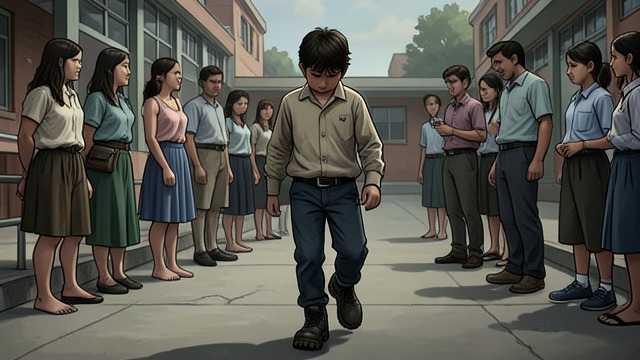
The Tire-Soled Shoes
A father's improvised repair
The father patches the boys' worn shoes with bicycle tire. The bulky soles keep their feet covered but invite ridicule at school.
Poverty displayed on the body
Frank McCourt feels conspicuous, caught between barefoot classmates and better-dressed boys. Clothing becomes a public sign of class rather than mere protection.
The Altar Door
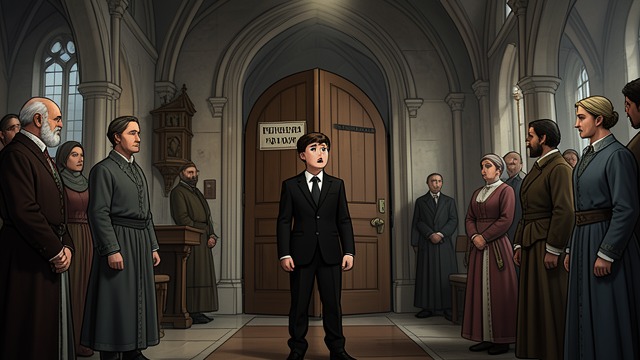
The Altar Door
A rejection without explanation
Frank McCourt learns the Latin Mass and applies to serve at the altar. The sacristan says there is no room and closes the door.
Class enters the church
Angela McCourt identifies the rejection as class distinction: poor boys are not wanted on the altar. Religious belonging appears less universal than the Church's language claims.
A Suit for One Day

A Suit for One Day
Respectability assembled
The family prepares Frank in a black suit for First Communion, a rare moment when he can appear formally dressed. The ritual promises religious belonging and the prospect of The Collection.
The promise collapses
A misunderstanding over the host and breakfast leads to embarrassment and conflict. The day reveals how poverty makes a ceremonial suit carry outsized hopes.
Rejected by the Brothers
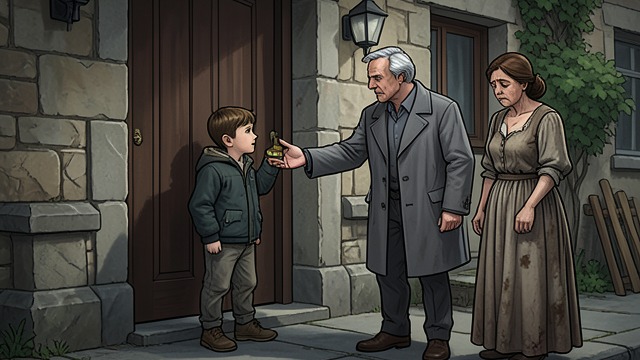
Rejected by the Brothers
A door closes
Thomas L. O’Halloran encourages Frank to pursue secondary education, but the Christian Brothers refuse to admit him. His mother's effort cannot overcome the institutional barrier.
The class route narrows
Frank is relieved to leave school, while his mother mourns what he might have become. The rejection turns a teacher's confidence into a clear account of unequal opportunity.
The Lane and the Job Interview

The Lane and the Job Interview
Origin read as a defect
The manager notices Frank McCourt's address and calls it a lane, not a street. He treats the boy's background as something Frank must rise above before he can advance.
A limited opening
Frank receives a job despite the insult, but class stigma follows him into work. His ambition is shaped by the desire to leave the lane as well as by the need to earn.
During Frank's early school years in Limerick
During Frank's attempt to become an altar boy
On Frank's First Communion morning
Near the end of Frank's schooling
At sixteen, when Frank applies to Easons
