A Modest Proposal
Angela's AshesA Modest Proposal enters Frank McCourt’s childhood not as an assigned school text but as the strange book Mr. Timoney chooses to hear read aloud. Its shocking proposal—that Irish children could be prepared and eaten—makes the old man laugh and leaves the boy puzzled. Through this recurring reading, the work becomes both a source of small but valuable earnings and an early encounter with satire whose meaning Frank is told he will understand only when he grows up.
An Unexpected Reading
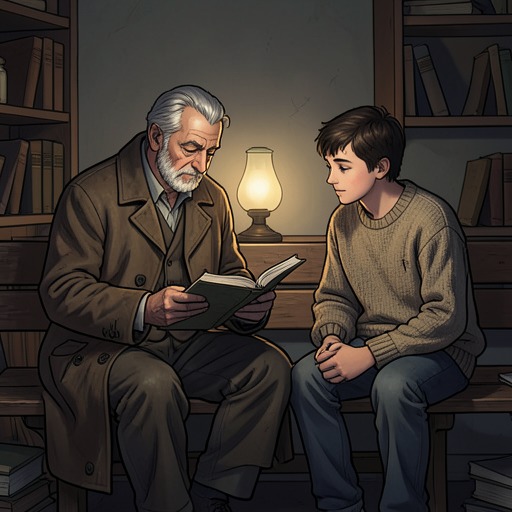
Frank is sent to read to Mr. Timoney in return for payment. When asked whether he will read the Limerick Leader, Mr. Timoney rejects the newspaper and directs him instead to a book on the table, Gulliver’s Travels. The requested piece is not the book’s main narrative but A Modest Proposal, found at the back. Mr. Timoney says he knows the whole work by heart, yet still wants Frank to read it aloud.
The choice makes the reading unusual from the start. Mr. Timoney interrupts Frank after two or three pages and asks what he thinks of the argument that a healthy, well-nursed child of one year could be nourishing food, whether stewed, roasted, baked, or boiled. The passage’s ostensible practicality and its grotesque subject are held together in the question: Mr. Timoney treats the proposal as something to discuss, while the child reader is still trying to understand the response it calls for.
Satire and the Reader’s Understanding
A Modest Proposal works in the episode through the gap between its literal claim and its satirical force. Mr. Timoney laughs throughout the reading, although, as the young Frank observes, the subject is the cooking of Irish babies. The laughter is not evidence that the proposal is meant straightforwardly; it marks the distance between the piece’s shocking surface and the adult recognition of what that surface exposes. The narrative presents that distance through Frank’s limited understanding rather than explaining the satire in an abstract lesson.
The contrast also shapes Mr. Timoney’s response to the boy. He tells Frank that Jonathan Swift is the greatest Irish writer, indeed the greatest man to put pen to parchment, and predicts that Frank will laugh when he grows up. When Frank points out that adults repeatedly promise children that understanding will come with age, Mr. Timoney erupts in laughter and calls him a treasure. The work thus becomes part of a small exchange between adult literary knowledge and a child’s clear-eyed impatience with deferred explanations.
Reading as Work and Household Support
The reading has immediate material consequences. Mr. Timoney pays Frank sixpence and tells him to return the following Saturday. Frank’s mother is pleased that he has earned the money, though she initially asks whether Mr. Timoney wanted the Limerick Leader. When Frank explains that he read A Modest Proposal from the back of Gulliver’s Travels, she dismisses it as a children’s book and attributes Mr. Timoney’s unusual interests to his years in the English army in India and to stories about his past.
The next reading becomes part of a regular arrangement. Frank receives sixpence from Mr. Timoney on Saturdays, alongside sixpence earned on Fridays from his uncle Pat. His mother values the resulting shilling a week because it makes a difference to the household, and she gives him tuppence to see the Dead End Kids at the Lyric after the reading. A Modest Proposal is therefore more than an eccentric literary selection: it is attached to a child’s paid labor and to the small, concrete ways his earnings can support family life.
A Book That Outlasts the Occasion
On the following morning, Mr. Timoney returns to the subject of Swift, again praising him as a towering Irish writer and recalling how he laughs through A Modest Proposal. The repeated reading and discussion make the work a continuing point of contact between the two characters, not a single startling encounter. Frank’s difficulty in understanding the laughter remains part of the episode’s meaning: the book is presented as a satire whose full effect depends on a perspective the child has not yet acquired.
The scene also gives literature a practical and social place in Frank’s life. A text encountered at home through a paid reading offers a different kind of instruction from a formal lesson: it supplies income, invites Frank to speak back to an adult, and leaves him with a question about why people laugh at words that sound so terrible. The promised future understanding is not resolved here. Instead, the episode preserves the distance between the child’s present reading and the adult interpretation that Mr. Timoney expects him eventually to reach.