American wake
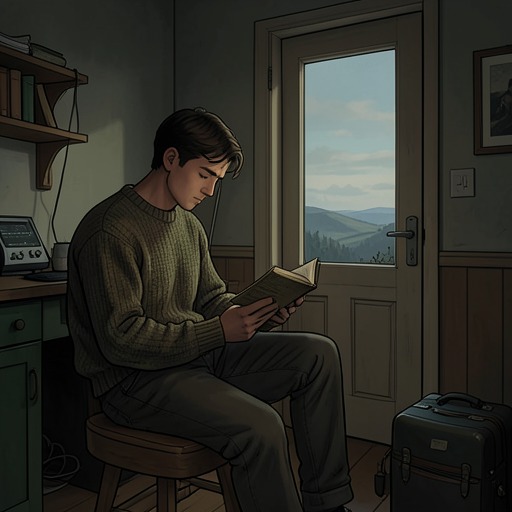
Angela's AshesAn American wake is a farewell party held before someone leaves Ireland for America, a gathering shaped by the expectation that the departing person may never be seen again. In Frank’s case, the custom gives a family celebration the weight of mourning: he is leaving for a hoped-for future, but his mother sees another child slipping away, after his older brother Malachy has already gone to England. The party’s songs, food, tears, and talk of reunion hold hope and loss together without resolving either.
Meaning and Family Context
The name reflects the distance built into the departure. Angela explains that people once held parties when someone went to America because it was so far away that the family did not expect to see that person again in this life. The wake is therefore not simply a cheerful send-off. Its form acknowledges a possible permanent separation, borrowing the language and emotional gravity of mourning for a living person who is about to leave.
For Frank, emigration is part of a longer family history rather than a sudden, isolated decision. His parents met and married in New York, where he was born, but brought the family back to Ireland when he was four. Later, his father Malachy leaves for England to work in Coventry, saying that America is in the war and that the cause must be just. He asks Frank to become the man of the house. At first, his departure appears to offer practical relief: a shopkeeper extends credit in anticipation of money coming back. After Malachy leaves, a letter arrives and then a three-pound money order, briefly allowing the children to imagine treats and outings. The payments stop, however, and the family’s hopes of regular support give way to waiting and renewed hardship. Frank’s own planned journey to America thus follows a pattern in which migration promises work and family security but also divides the household.
Frank’s Decision and the Gathering
Frank has a concrete route and price for his departure. At O’Riordan’s Travel Agency, he learns that flying to America would require traveling first to London and would cost too much. The agent offers him passage on the Irish Oak, sailing from Cork in a few weeks: nine days at sea, a cabin, thirteen passengers, and a fare of fifty-five pounds. Frank has the money. When he tells Angela that he is leaving, she cries; his younger brother Michael asks whether they will all go someday, and Frank says they will. Alphie turns at once to what he hopes Frank might send from America, asking for a cowboy hat and a returning toy. The brothers’ argument about whether a boomerang can be found there briefly shifts the conversation from separation to the imagined contents of the destination.
Angela insists on holding a party the night before Frank goes and identifies it as an American wake. The gathering is small and assembled from what the family and relatives can manage. Angela saves a few shillings from caring for Mr. Sliney to buy bread, ham, brawn, cheese, lemonade, and stout. Uncle Pa Keating brings stout, whiskey, and sherry for Aunt Aggie, who brings a cake filled with currants and raisins. The Abbot contributes six bottles of stout, reserving a couple for himself so he can sing. These particular provisions make the occasion a family effort, not a grand public ceremony: the farewell is built from saved wages, shared food, drink, and the contributions of relatives and friends.
The songs do not simply make the party festive. The Abbot sings “The Road to Rasheen,” and his tears confuse Alphie, who asks why he is crying over a song that makes no sense. Uncle Pa objects that the songs are becoming worse and worse and asks whether the night is turning into a wake altogether; he wonders if someone might sing something livelier or whether the sadness will drive him to drink. His complaint names the tension already present in the gathering: the custom calls for a party, but the family’s awareness of separation repeatedly turns celebration toward grief.
Separation, Hope, and the Departure
Frank’s feelings about leaving are unsettled. Some days he does not want to go and would like to recover the fifty-five pounds from the travel agency. He considers waiting until he is twenty-one so that Malachy could travel with him and he would know at least one person in New York. At home, Michael tries to console Angela with the prospect that the family will one day be together in America, with both brothers and their father there. Instead, the imagined reunion brings Angela and the children to tears. They sit together as a family, grieving a separation that has not yet happened while relying on a future reunion no one can guarantee.
Angela’s account of the custom sharpens the irony of that hope. She laments that the family’s first party is taking place as her children leave one by one: Malachy to England and Frank to America. Her wish that Malachy could come back from England, followed by her belief that they will all be together in America someday, links the wake to the earlier, unfinished departure. The family imagines America as a place where separations might be reversed, even though the experience of Malachy’s migration has already shown that distance and absent remittances can persist.
The family also marks the night through a sign in the sky. When Aunt Aggie remembers that the moon is eclipsed, everyone goes into the lane to watch it disappear behind a round black shadow. Uncle Pa calls it a good sign for Frank’s journey. He rejects the suggestion that the eclipse means the end of the world, describing it instead as the beginning for Frank and imagining him returning in a few years, prosperous and changed. His confidence offers a counterweight to Angela’s grief, but it remains a prediction, not a settled outcome. The scene places a hopeful interpretation of departure beside the family’s fear of losing Frank.
Late in the day, the Irish Oak sails from Cork, passing Kinsale and Cape Clear; by dark, the lights at Mizen Head are the last Frank sees of Ireland for an unknown length of time. On board, he questions whether he should have stayed, taken the post-office examination, and earned money for Michael and Alphie’s schooling, shoes, and food. He thinks of the possibility of moving the family from the lane to a better street and relieving Angela of her work for Mr. Sliney. Then he recognizes that he is already at sea. The wake has prepared the family to experience the departure as both an opening and a loss, but it cannot remove Frank’s sense of obligation to the people left behind.
The Wake as a Recurring Pattern
The custom acquires force from the book’s repeated movement across the Atlantic. Frank’s parents once left New York and returned to Ireland; later, relatives arrange the family’s passage back from Manhattan, purchasing tickets and finding a steamer trunk through the St. Vincent de Paul Society. Angela identifies the Statue of Liberty and Ellis Island as the ship pulls away, then becomes ill during the crossing. These earlier journeys make migration a lived family history, marked by practical arrangements and bodily hardship as well as by the promise of a new beginning. Frank’s wake recalls that history even as his direction is the reverse: he is leaving Ireland for the country in which he was born.
The wake also distinguishes Frank’s American journey from Malachy’s labor migration to England. Malachy leaves for Coventry with the idea that work and overtime could make him prosperous, and the family initially expects money to follow. For Frank, passage requires a specific fare paid in advance, and America is a destination whose imagined abundance is shared with his brothers at the party. Yet the earlier failure of remittances and the family’s repeated separations prevent the destination from being a simple guarantee of rescue. The wake gives those competing expectations a public form within the household: the relatives can bless the journey and imagine Frank’s return, while the food, songs, and tears show what his leaving costs.
As a ritual, the American wake does not promise that its farewell will be followed by reunion. It allows the family to make a departure visible and to share its uncertainty through food, songs, predictions, and grief. Frank leaves after a night that is at once his first family party and a farewell patterned on the possibility of death-like absence. The custom thus frames emigration not as a clean break or uncomplicated escape, but as a passage whose hope remains bound to the people, obligations, and places the emigrant leaves behind.