Angela McCourt
Angela's AshesAngela McCourt, born Angela Sheehan, is Frank’s mother, a migrant whose life is shaped by poverty on both sides of the Atlantic and by the daily labor of caring for children when wages, housing, and dependable family support fail. Sent from Limerick to New York as a girl, she later returns to Ireland with her children after the death of her baby daughter. Her history is told chiefly through Frank’s view: the mother who keeps the household going is also the woman he watches cry, grow ill, seek help, and eventually leave the place where her family has been living.
Identity and Background
Angela grows up in a Limerick slum with her mother, two brothers, Thomas and Patrick, and a sister, Agnes. She never meets her father, who leaves for Australia weeks before she is born. At the St. Vincent de Paul School, she learns to read, write, and calculate, but her education ends by the time she is nine. Her attempts to work as a charwoman, servant, and maid do not secure her a place: she cannot manage the curtsy expected of a maid, and her mother judges that she lacks the knack for such work.
Her mother offers her the fare to America, presenting emigration as a way out for a girl who has not found a suitable position at home. Angela arrives in New York at the beginning of the Great Depression, on Thanksgiving Day. At a party hosted by Dan MacAdorey and Minnie MacAdorey on Classon Avenue in Brooklyn, she meets Malachy McCourt. He has just spent three months in jail after he and a friend hijack a truck they believe contains canned pork and beans; it is actually loaded with buttons. Angela is drawn to his hangdog appearance, and the two begin a relationship.
Marriage, Children, and Migration
In Brooklyn, Angela’s care for her children is measured against Malachy’s drinking and the insecurity of his wages. She brings the children to the gate of his workplace and asks whether she can go in to collect some of his pay before he spends it in bars. The gatekeeper refuses, explaining that the employer cannot make such arrangements for wives. Angela waits outside with the children until the workers emerge, but Malachy does not appear. The search leaves her distressed and does not protect the family’s income; when he brings home his wages the following week, he blames her for complaining at the gate and says that the complaint gave the employer grounds to sack him.
After the family has eaten, Angela is still at the kitchen table smoking and crying while Frank imagines becoming a man who can earn money for eggs, toast, and jam. The episode exposes the narrow choices available to her: she tries to secure the wages on which the children depend, but cannot control either her husband’s drinking or the employer’s decision to dismiss him. The children’s hunger and her distress are not separate problems; they are consequences of the same unstable household income.
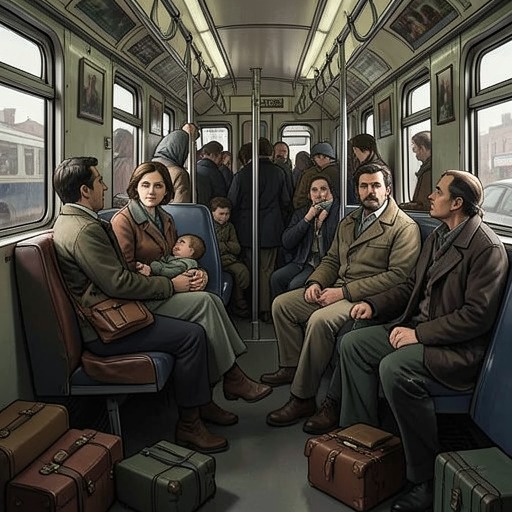
Angela’s baby daughter Margaret dies, and the loss transforms Malachy’s drinking and the family’s prospects. Minnie recalls that the death sent him into the bars along Flatbush Avenue and Atlantic Avenue, where he was thrown out; she also says he had not been drinking even after the baby’s birth. Angela and her children leave New York for Ireland. Her mother sends money to nieces Philomena Flynn and Delia Fortune, who buy the tickets, find a steamer trunk through the St. Vincent de Paul Society, and arrange a van to the Manhattan pier. As the ship departs, Angela points out the Statue of Liberty and Ellis Island to the children, then vomits over the rail, the wind scattering it among the passengers. The homeward journey is both a family flight from an unbearable loss and another passage into uncertainty.
Survival in Limerick
In Limerick, relief and kinship help meet needs that wages do not. When Angela takes her sons to the St. Vincent de Paul Society, women in the queue question why an American woman is seeking charity in a city where poor residents also lack bread. She explains that her husband is out of work, that she has other children at home, and that she left America after her baby daughter died. Her account turns suspicion into shared grief: women who have also lost children cry with her, then pass around snuff, and the boys’ violent sneezing breaks the sorrow with laughter. Angela’s appeal is not simply a claim for provisions; the women recognize the bereavement that brought her back.
She repeatedly has to ask institutions for necessities while managing the demands of childcare. When visitors inspect the family’s damp, overcrowded home, she asks whether boots might be provided for Frank and Malachy. She is told to apply at Ozanam House and that the process requires her to join a queue, though she says she has been unwell since the baby’s birth and cannot stand for long. The visitors leave without resolving the need. This episode makes visible how formal assistance depends on a poor mother’s ability to wait and travel even when illness and the care of children make those demands difficult.
When Malachy leaves for England after Christmas, he tells Frank that he will work in a Coventry factory and that Frank must be the man of the house. The departure initially brings a letter and a three-pound money order, prompting hopes of fish and chips, sweets, and Saturday films. No further money orders arrive. Angela turns again to charitable assistance, while keeping the household going with weak tea and whatever food is available. She also requires Frank and Malachy to take turns taking their youngest brother Alphie out in the pram for fresh air. The promised wages from England thus become a brief expectation rather than reliable support, and the care of the younger child falls partly to the older children.
Later, while Frank works, Angela earns money caring for an elderly man, Mr. Sliney, on the South Circular Road. She tells Frank to come by for tea and a sandwich if his paper route takes him there. In the clean kitchen, with tea, bread, butter, cold meats, flowers in the garden, and music on the wireless, he sees her in a setting far removed from the family’s crowded home. The visit is an instance of her paid care work, but it also lets her provide her son with food. Her account of the household’s unfamiliar food draws a distinction between what the poor eat in the lanes and what the wealthy choose, while her recollections of America keep another standard of comfort in view.
Illness, Kinship, and Displacement
Angela falls ill with pneumonia in a cold, wet house where there is no money even for bread. She has been shivering, asks for lemonade, and then spends the night moaning for water. The children stay home from school and try to manage the household; when a doctor arrives with Aunt Aggie, he takes Angela to hospital. The children go to Aunt Aggie’s house until their mother returns. Angela’s illness makes the family’s dependence on women’s work and kinship explicit: her children try to replace her care, but relatives and a doctor must intervene before they can be looked after safely.
After her recovery, Angela returns weak and pale. The doctor has advised warmth, rest, and nourishing food, including meat and eggs three times a week, a prescription that collides with the household’s means. Malachy prepares tea and bread for her, but soon leaves again for work in Coventry. Angela does not rise from bed to see him off. Frank follows his father down the road until Malachy tells him to go home to his mother and brothers. The family briefly receives another money order, but the payments soon stop; once more, Angela must seek charity and make daily provisions last.
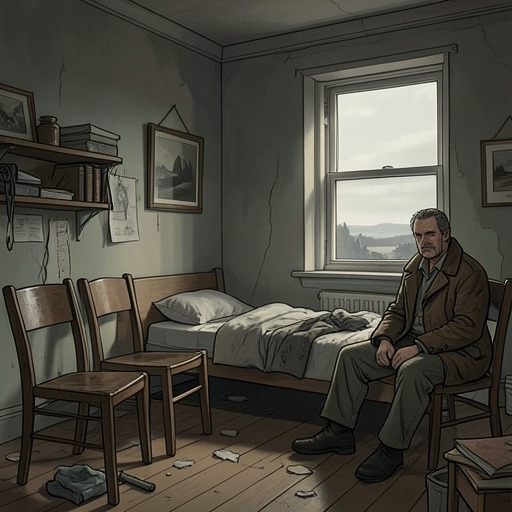
Angela’s relations with her own family are strained by the McCourts’ conflicts and by the prejudice directed at Malachy, who is from the North. Frank recalls that Grandma no longer speaks to Angela because of something he did, while Angela is also estranged from Aunt Aggie and Uncle Tom. When the family’s home is threatened with eviction, Grandma says she cannot accommodate them but suggests that cousin Gerard Griffin might take them in. In the middle of the night, she and Frank walk nearly two miles through the rain to Rosbrien Road to ask for shelter. Angela’s lack of a coat or umbrella, and the distance she must travel to secure somewhere for her family, turn housing insecurity into a physical ordeal.
The arrangement at Laman Griffin’s house does not hold. Frank is told that he must remain in school and not fall into the messenger-boy job trap; his headmaster, Mr. O’Halloran, urges Angela to take him to the Christian Brothers and pursue secondary education. Later, when Michael begins staying at the Abbot’s instead of returning to Laman’s, Angela comes to see him. She and Frank speak as if nothing has happened, but she gradually stays in the upstairs room with Alphie, returns to Laman’s less and less, and eventually stops going there altogether. The family’s move is piecemeal, shaped by where the children can stay and where Angela can make a home.
Care, Independence, and Narrative Significance
Angela’s story is made of repeated negotiations over money, shelter, food, and care. She tries to reach Malachy’s wages at the Brooklyn workplace gate, seeks boots and relief in Limerick, nurses a sick household until pneumonia takes her to hospital, and takes paid work caring for Mr. Sliney. Her labor includes both earning and the less visible tasks of feeding and arranging care for the children. When her own health fails, the older children take on some of that work, but the family’s dependence on relatives, charitable organizations, and chance remains.
Her relationship with Frank is close but not sentimentalized. He watches her cry at the kitchen table, sees her return from the hospital weakened, and travels with her through the rain to find shelter. In turn, she insists that he continue school and later manages a gradual move away from Laman’s house, while he contributes wages and imagines saving to leave Ireland. Her choices help preserve the family, but they unfold within limits imposed by poverty, bereavement, unreliable employment, and the small authority available to a woman seeking relief or access to a husband’s pay.
When Frank tells Angela that he plans to leave for America, she cries. Michael asks whether they will all go there someday, and Frank says they will; Alphie asks for a cowboy hat and a returning boomerang. The exchange places Angela’s earlier migration and return beside her son’s coming departure. America has been a destination she reached as a child, a place where the family lived and lost Margaret, and a measure of comfort she continues to invoke. Frank’s promise of a future reunion does not undo the separation. It leaves Angela once again at the threshold of an Atlantic crossing, this time watching a child leave rather than leading her own children home.