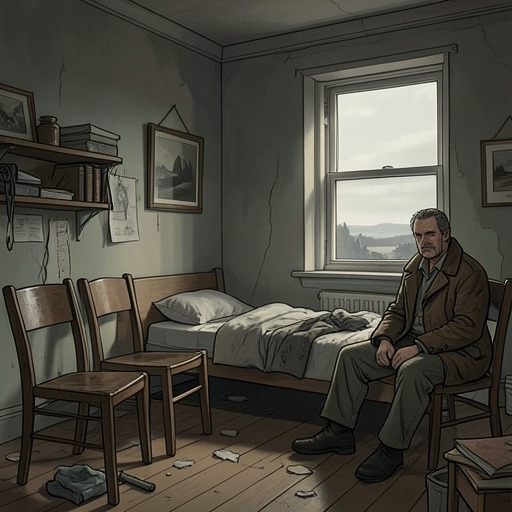
Collapse of the McCourt home
Angela's AshesThe collapse of the McCourt home is both a literal household disaster and the turning point that makes eviction imminent. Behind it lie unpaid rent and a shortage of fuel: the McCourts dismantle their home to keep warm, and Frank’s removal of a supporting beam brings down part of the ceiling. The landlord’s agent treats the resulting damage as grounds to remove the family, leaving them with a week to find somewhere else to live. The episode’s bitter irony is that the house fails under the pressure of poverty, while the family is held responsible for the failure.
Rent arrears and the search for fuel
The immediate crisis begins with the rent man’s warning that the family is four weeks behind. He names the arrears as one pound and two shillings, then calculates that the total due the following week will be one pound, eight shillings, and sixpence. His own livelihood, he says, depends on collecting rent and reporting to Sir Vincent Nash; if he cannot do so, he fears losing his job. He threatens that the McCourts will be put out onto the pavement if they cannot pay. The exchange makes eviction a material possibility before anything in the house collapses.
Back upstairs, Angela sits by the fire, unable to see how she can pay even another week’s rent. The household has no easy way to boil water for tea, so Malachy pulls a loose board from the wall between the two upstairs rooms. Angela accepts that the board can be burned, but insists that there must be no more. For two weeks, she repeats the warning as the family uses the wall for fuel until only its framing remains. She specifically forbids the children to touch the beams, which hold up the ceiling and the house itself. The distinction between wall boards that can be burned and beams that must remain intact is the household’s fragile boundary between getting through the cold and losing its shelter.
The beam gives way
While Angela is away visiting Grandma, the cold in the house drives Frank to take an axe to one of the beams. Malachy urges him on and Michael claps; when Frank pulls at the timber, the ceiling groans and part of it falls onto Angela’s bed. Frank and his brothers run to tell Angela that there is a hole in the house and that it is coming down. She rushes back with Grandma, sees the bed covered by fallen building material, and rebukes Frank for interfering with the beams.
The children’s excitement and joking response contrast with the consequences of Frank’s act. Michael sings that Frank has broken the house, while Malachy fears they will all be killed. Their reactions do not undo the damage: the beam had been holding up the structure, just as Angela had warned. The episode turns a small, practical decision made in the cold into an immediate threat to the family’s home.
The rent man’s inspection
Grandma goes to the landlord’s office and returns with the rent man, who notices that an upstairs room has disappeared. He insists that he rented the family two rooms upstairs and demands to know where the other one has gone. Angela and Grandma feign not to remember a wall or a room. Their denials turn the damage into a comic dispute over whether the missing space ever existed, but the humor is edged with danger: the rent man remembers, and he has come to investigate a home already deep in arrears.
The rent man calls the situation desperate, complaining that tenants are not paying and are making walls and rooms disappear. He then orders Angela out, declaring that he will return in one week and expects everyone to be gone for good. When she protests that it is a pity he was not alive when the English were evicting Irish people and leaving them by the roadside, he threatens to send men to remove the family the next day if she says anything more. He leaves the door open behind him, a final gesture that makes his contempt plain without changing the ultimatum.
Consequences and narrative significance
The collapse compounds an existing housing crisis rather than creating one from nothing. The McCourts were already behind on rent, and the agent’s threat makes clear that the family’s immediate need is not merely to repair the ceiling but to secure another place to live. Angela says she does not know what to do; Grandma cannot house them herself, but proposes asking their cousin Gerard Griffin to take them in temporarily and sets out to find him, with Frank accompanying her. The threat of eviction therefore leads directly to a search for refuge among relatives.
The scene also brings together the material pressures that recur in the family’s life: inadequate housing, cold, lack of fuel, and rent they cannot pay. The wall’s transformation into firewood briefly helps them manage one need, but consumes the structure that shelters them and exposes them to another. The rent man frames the vanished room as the tenants’ wrongdoing; the episode instead shows how the family’s attempt to endure deprivation has made the home itself unsafe. A precarious domestic space becomes a forced departure, and the joking denial of the missing room cannot hide the urgency of what follows.