Frank's 'Jesus and the Weather' Composition
Angela's AshesFrank’s “Jesus and the Weather” composition is the unlikely work that gets him out of fifth class and into sixth. Set by Mr. O’Dea as an exercise about Jesus growing up in Limerick, it transforms the religious subject into a comparison between the warm, abundant world Frank imagines in ancient Israel and the damp, impoverished city he knows. The composition is both a response to Frank’s circumstances and the means by which his teachers recognize his writing.
The assignment and the repeated year
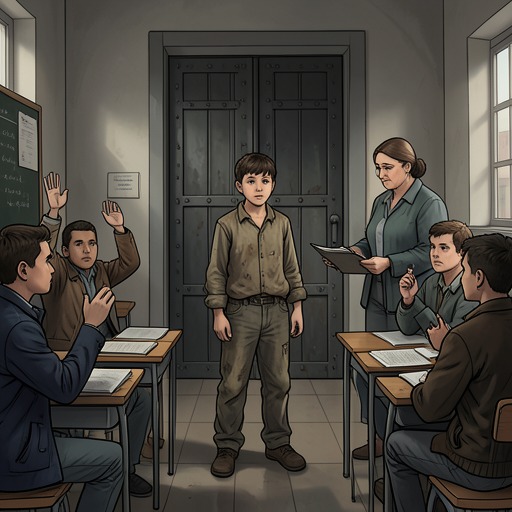
After being kept in fifth class, Frank has to sit through Mr. O’Dea’s lessons in catechism and other material he already learned the previous year. He is not permitted to answer questions; Mr. O’Dea tells him to be quiet and let his brother respond. Instead, Frank corrects the other pupils’ arithmetic tests and Irish dictation. Mr. O’Dea also gives him special compositions to write and read aloud, explicitly presenting him as someone who learned to write well in the class the year before.
The new assignment turns that repetition into a challenge. Mr. O’Dea asks Frank to imagine Our Lord growing up in Limerick, which he calls Ireland’s holiest city, and frames the task through the city’s piety and its lack of crucifixion. Frank must take the composition home and bring it back the next day. His father, Malachy, jokes about the hardship of adding Limerick’s dampness to Christ’s suffering, then goes for a long walk, leaving Frank to work out the composition alone.
A comparison of two worlds
Frank titles the piece “Jesus and the Weather.” Its argument begins with Limerick’s persistent rain and the dampness associated with the River Shannon. Frank connects that climate to illness and to family bereavement: his father calls the river a killer because it took Frank’s two brothers. The imagined biblical setting offers a stark contrast. In the pictures Frank has seen, Jesus walks through ancient Israel in a sheet, where it does not rain and people do not cough or suffer from consumption.
The contrast extends from weather to food and work. Frank imagines Jesus finding figs or oranges whenever he is hungry, while the people around him stand, eat manna, and gesture at crucifixions. If Jesus wanted a pint, Frank writes, he could produce one with a wave of his hand. Mary Magdalene and Martha would provide dinner, but Frank notices the unfairness of Martha washing dishes while her sister talks with Jesus. The composition draws its humor from applying the ordinary needs and domestic frustrations of Frank’s world to a sacred subject.
Its ending makes the contrast consequential. Frank concludes that Jesus was fortunate to be born in a warm place: in Limerick, he would have caught consumption and died within a month. Without Jesus, Frank reasons, there would be no Catholic Church, Communion, or Confirmation, and pupils would not have to learn catechism or write compositions about him. The school exercise thus becomes a chain of cause and effect in which weather and illness threaten not only an individual life but the religious institutions that shape Frank’s education.
From classroom reading to promotion
When Frank reads the composition, Mr. O’Dea is quiet and gives him a look that makes him fear someone is about to suffer. He asks who wrote it; Frank takes responsibility. Mr. O’Dea then brings him to the headmaster, Mr. O’Halloran, and shows him the work. Asked again whether he wrote it, Frank confirms that he did.
The consequence is immediate: Frank is removed from fifth class and placed in Mr. O’Halloran’s sixth class, among boys he knows, including Paddy Clohessy, Fintan Slattery, and The Question Quigley. The promotion answers the problem that had sent him to the statue of St. Francis to pray for release from the repeated year. Afterward, despite his legs still being weak from typhoid, Frank walks back to the statue to give thanks. He remains unsure whether the composition succeeded because he said something good or something bad, preserving the uncertainty around how his irreverent humor was received even as its practical result is clear.
Significance
The composition changes Frank’s position at school through the very assignment that exposes how much he has already learned. Mr. O’Dea had made him a public example of the previous year’s writing instruction; Frank uses that opportunity to replace an abstract religious prompt with the material differences between biblical plenty and life in Limerick. Rain, the Shannon, consumption, hunger, and household labor give his argument its particular force.
The piece also joins personal loss to comic invention without erasing either. Its claim that Limerick’s dampness could kill Jesus is irreverent, but it draws on the deaths of Frank’s brothers and on the illness associated with the city. The same composition that challenges the reverent terms of the assignment demonstrates Frank’s ability to shape an idea in writing, and it carries him out of fifth class into a new classroom.