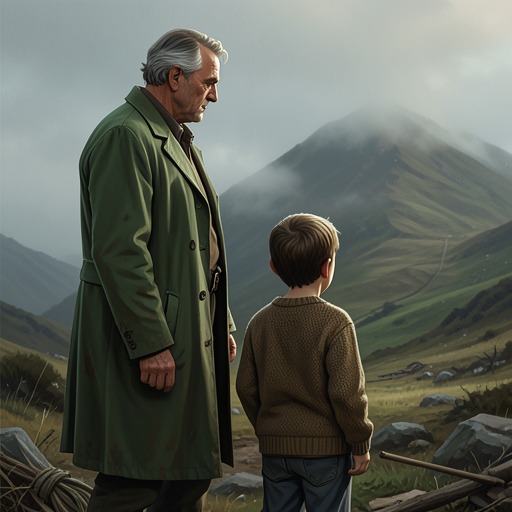
Frank’s departure from Ireland for America
Angela's AshesFrank’s departure from Ireland for America is both a practical decision and a family rupture: he has saved the fare for a transatlantic passage, but leaving means stepping away from his mother and younger brothers, the places where he grew up, and the possibility of supporting them at home. The American wake makes that contradiction public. Its songs, food, tears, and jokes send him off with affection while exposing how little certainty anyone has about when—or whether—the family will be together again.
The decision to leave
The prospect of America has been bound up with the family’s hopes for years, but the earlier movements across borders have not brought dependable security. Frank’s father goes to England to work in Coventry after America enters the war, reasoning that the cause is just and telling Frank he must become the man of the house. At first, a money order for three pounds raises hopes of better food and small pleasures; after that first payment, the money stops. The family’s experience of migration is therefore not an uncomplicated promise of prosperity: work abroad may send help home, but it can also leave those at home waiting and struggling.
Frank’s own departure becomes possible through wages he has earned and saved. At O’Riordan’s Travel Agency he learns that flying via London would cost too much; the alternative is a place on the Irish Oak, sailing from Cork in a few weeks. The agent describes a nine-day voyage, a private cabin, thirteen passengers, and good food for fifty-five pounds. Frank can afford the fare. The decision is thus made through a concrete calculation about transport and money, even as its emotional costs remain unsettled.
When Frank tells his mother he is leaving, she cries. His brother Michael asks whether they will all go someday, and Frank promises that they will. Alphie focuses on what he hopes his brother will bring back: a cowboy hat and a boomerang. Michael corrects him that a boomerang belongs to Australia, not America, and the brothers argue over the distinction until their mother reminds them that Frank is leaving. Their disagreement briefly turns the distant destination into a child’s question of souvenirs, before the family’s immediate separation comes back into view.
The American wake
The family calls the farewell an American wake, a name that carries the fear behind the custom: America is so far away that those left behind once expected not to see the departing person again in this life. Frank’s mother hopes that he, his father, and the rest of the family will eventually be together in America, with God and the Blessed Mother’s help. The gathering is consequently neither simply a celebration nor a funeral. It makes departure into a shared rite while leaving reunion as a hope rather than a certainty.
Frank’s mother says this is the first party the family has ever had and laments that it comes as her children are slipping away one by one: Malachy to England and Frank to America. She sets aside a few shillings from her work caring for Mr. Sliney to provide bread, ham, brawn, cheese, lemonade, and stout. Uncle Pa Keating brings stout, whiskey, and sherry for Aunt Aggie; Aunt Aggie contributes a currant-and-raisin cake she baked herself. The food and drink give the gathering the shape of a party, but the occasion keeps its sadness close to the table.
The Abbot brings six bottles of stout and says the family may drink them so long as he keeps a bottle or two to help him sing. He sings “The Road to Rasheen” with his eyes closed, and tears come as the song continues, although its words make little sense to the children. Uncle Pa complains that one song is worse than the one before and wonders whether the night is becoming a wake after all. The singing does not resolve the grief; it gives the room a way to hold it, even when the children cannot understand why the song brings tears.
An eclipse becomes another subject through which the family reads Frank’s future. They stand in the lane watching the moon disappear behind a round black shadow. Uncle Pa calls it a good sign for Frank’s journey, while Aunt Aggie takes it as a bad omen and associates it with the end of the world. Uncle Pa rejects her interpretation and instead imagines Frank returning in a few years, better dressed and prosperous, with a girl beside him. His confidence offers the family an optimistic counterimage to the finality implied by the eclipse, but Frank’s mother can only answer that she hopes it will not be so.
The last look at Limerick
Before leaving, Frank walks through Limerick and revisits places associated with his life there: Windmill Street, Hartstonge Street, Roden Lane, Rosbrien Road, and Little Barrington Street. He stands outside Theresa Carmody’s house until her mother asks what he wants. He also visits the graves of Oliver and Eugene at the old St. Patrick’s Burying Ground and Theresa’s grave at St. Lawrence’s Cemetery. These stops make his departure a reckoning with the dead as well as with the living; he wonders whether those who have died can follow someone across the Atlantic.
He tries to preserve the city in memory by looking carefully at its churches and familiar landmarks. At St. Joseph’s Church and the Redemptorist church, he tells himself to take a good look in case he never sees them again. He walks along Henry Street to say goodbye to St. Francis, while still believing he will be able to speak to the saint in America. The ritual of looking turns departure into a deliberate inventory: the journey carries him away, but the places and religious ties of home remain part of what he takes with him.
His confidence falters. There are days when he would rather recover the fifty-five pounds and wait until he is twenty-one, when Malachy could travel with him and he would know at least one person in New York. Sitting by the fire with his mother and brothers, he feels tears coming and is ashamed of appearing weak. His mother jokes that his bladder must be near his eye; Michael reassures him that the family will all go to America and be together. Then his mother cries too, and the four of them sit together in tears. The promised future briefly comforts them, but it cannot make the present parting painless.
Departure aboard the Irish Oak
The Irish Oak sails from Cork late in the day, passing Kinsale and Cape Clear; after dark, the lights at Mizen Head mark the last of Ireland Frank expects to see for a long time. Once aboard, he thinks through the life he might have chosen instead. He could have stayed, taken the post-office examination, and tried to rise in the world. With that income, he imagines, his brothers might have had proper shoes and full stomachs, the family might have moved from a lane to a street or an avenue with gardens, and his mother might no longer have had to empty Mr. Sliney’s chamber pots. These possibilities do not undo his decision; they give his leaving a moral weight, because he measures his own chance at a future against the needs of those he leaves behind.
As Ireland disappears into the night, songs and people from home crowd his thoughts: his mother, his brothers, Aunt Aggie, Uncle Pa, his father in England, and the hard experiences that have made Limerick both a place of deprivation and a place of belonging. He regrets that he is leaving and recognizes the foolishness of looking back, yet cannot stop doing so. A priest beside him on the deck understands the ache because he too left Ireland and never got over it. Though he lives in Los Angeles, he tells Frank that he asks God for one soft, rainy day in Limerick. The exchange gives Frank’s homesickness a future echo: distance may change a person’s surroundings without dissolving attachment to the place left behind.
The departure therefore closes not with a settled promise of success but with competing possibilities still in view. Frank has paid his passage and is at sea, but he imagines the family he might have helped by staying, grieves those already lost, and holds onto the hope that his mother and brothers will eventually join him. The American wake gives the separation a communal form; the final sight of Ireland makes its cost unmistakably his own.