Ireland
Angela's AshesIreland is the McCourt family’s home after Frank’s parents leave New York and return with their children, but in Frank’s account it is also a place from which the family repeatedly hopes to escape. The country holds family history, cultural memory, and stories of possibility; the family’s everyday experience, however, is shaped by poverty, insecure work, and housing that offers little protection from weather or illness. The contrast between Ireland as home and Ireland as an obstacle to a safer future gives the setting its central significance.
Family Return and the Northern Journey
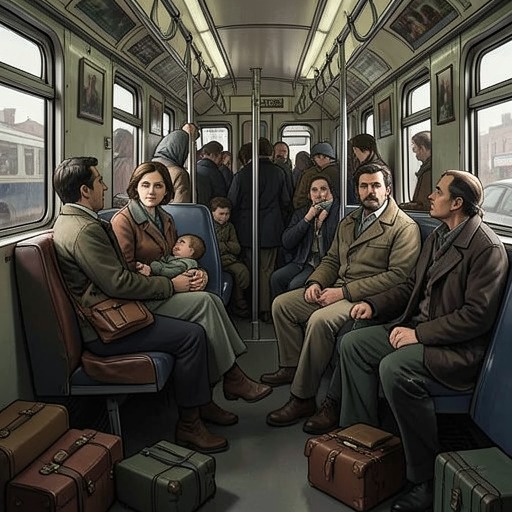
Frank’s parents return to Ireland when he is four. His older brother Malachy is three, the twins Oliver and Eugene are barely one, and his sister Margaret has died. The journey back is organized with help from family: Grandma Sheehan sends money to Philomena Flynn and Delia Fortune, who buy the tickets, find a steamer trunk through the St. Vincent de Paul Society, and arrange transport to the pier. The departure from New York and arrival in Ireland are thus not a clean break from family support, but a passage made possible by relatives and charitable help.
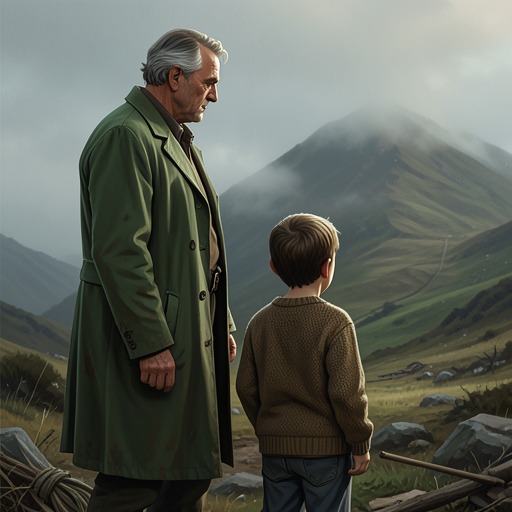
After a week at sea, the family lands at Moville in County Donegal, travels by bus to Belfast, and then continues to Toome in County Antrim. From there they walk two miles toward Grandpa McCourt’s house. The journey’s practical hardship is immediate: Frank’s father carries the twins, who cry from hunger, while his mother repeatedly stops to rest. At dawn, the children encounter unfamiliar cattle in the fields. The episode places the returning family in a landscape that is at once their inherited country and a place they must learn anew.
The family’s onward journey toward Dublin is marked by another contrast between material need and imaginative inheritance. Grandpa offers the father bus fare and suggests that he seek money from the IRA, but the family soon leaves for Dublin without that assistance. On the bus, the father identifies local landscapes through the stories of Cú Chulainn: he points out places associated with the legendary hero and describes Lough Neagh as a lake where Cú Chulainn swam after battle. These stories give the children a vivid cultural map, even as their journey is driven by the practical need to find a way forward.
Limerick: Housing, Weather, and Public Infrastructure
In Limerick, the family moves into a small house at the end of Roden Lane, on Barrack Hill. It has two rooms upstairs and two below, with a shed, a lavatory, and a stable beside the entrance. The family first experiences the house as a welcome improvement: with a table, two chairs, two beds, and a sideboard hauled across the city on a pram, they can move between rooms and up and down stairs. But the apparent security of a private home is undermined when they discover that the lavatory serves the whole lane, including eleven families. Their household space is not separate from the neighborhood’s shared sanitation arrangements.
Rain exposes the limits of the house. Two weeks before Christmas, Frank and Malachy come home from school to find the kitchen furniture moved upstairs and the fire burning there. Rain has poured in under the front door despite the family’s efforts to block it with rags; water remains on the kitchen floor, and the walls are damp. The family decides to stay upstairs through the wet winter, naming that part of the house Italy as a way of imagining it as a warmer, foreign refuge. The Pope’s picture remains downstairs, however, while Frank’s mother seeks a little relief from its presence in the bedroom. The move upstairs is both an adaptation to the flood and an imaginative reordering of a home that the weather has made difficult to inhabit.
The shared lavatory continues to shape family life after the flood. In warm weather, the smell and the flies make it harder to stay indoors, while the nearby stable and its poorly maintained conditions add another source of trouble. The family chases rats that reach the house and closes the door when neighbors carry buckets past. These details make the setting’s privations cumulative: the problem is not a single unpleasant incident but an everyday environment in which inadequate sanitation, damp housing, and pests repeatedly intrude on domestic life.
The father takes the complaint to the Town Hall, where an official says the family can move but offers no other remedy. The father argues that the lane needs more lavatories; the official points to the houses’ poor condition and says they are expected to be demolished after the war. The exchange leaves the family caught between a hazard they cannot ignore and a proposed solution—moving—that they cannot afford. Public authority recognizes the conditions without changing them, making the home’s insecurity part of a wider urban failure rather than a private misfortune alone.
Work, Remittances, and the Promise of Elsewhere
The father’s move to England begins as a family strategy for escaping want in Ireland. After the United States enters the war, he decides that the cause is just and accepts an agent’s offer of factory work in Coventry. He tells Frank to become the man of the house. The family’s expectations turn quickly toward remittances: the prospect of money allows Frank’s mother to obtain credit at Kathleen O’Connell’s shop, and the children imagine better clothes, food, and a home with a proper lavatory. The expected money is also linked to a longer route of migration—first England, then perhaps America.
At first, that expectation seems confirmed. A letter reports that the father has arrived safely, and a three-pound money order prompts dreams of food, films, and a visit to the Savoy Café. Then the money stops. No further telegram or payment arrives on the following Saturdays, and Frank’s mother returns to seeking help from the St. Vincent de Paul Society. The discrepancy between the first remittance and its silence afterward shows how completely the family’s plans depend on wages earned abroad—and how vulnerable those plans are when support does not continue.
The father’s absence does not erase Ireland’s cultural and political presence in the home. Frank recalls his father speaking about hedge schools, where Catholics learned English, Irish, Latin, and Greek when the English would not allow them ordinary schooling. He describes the people’s love of learning and of stories, even when learning did not lead to employment. At the same time, his father imagines America as a place where Frank might work at a desk, stay out of the rain, and have warm clothes and a secure home. These accounts hold two different inheritances together: a history of Irish education and resistance, and a hope that a child may find practical opportunity outside Ireland.
That hope is not only the father’s. Listening to American broadcasts, Frank imagines America as a place where households have lavatories, food is plentiful, and life ends happily. The contrast is especially pointed because the family’s problems in Limerick are not abstract: they have lived with a flooded kitchen, a shared privy, and repeated dependence on charity. America functions as an imagined refuge precisely because its promise is framed against conditions experienced in Ireland, even though the distance between the ideal and the actual destination remains unknown at this point.
Cultural Memory and the Meaning of Ireland
Ireland is also conveyed through stories that make the landscape legible to the children. During the bus journey, the father connects places to Cú Chulainn, presenting the country as the setting of heroic memory. In later family life, Irish history appears in his accounts of the hedge-school masters and in his insistence that Frank should remember those who died for Ireland. The country is therefore more than a place of residence: it is a history taught within the family, through legends, political memory, and stories told at home.
This inheritance is complicated by poverty and the father’s departures. Frank’s account contrasts the father who shares books, history, and stories with the family’s dependence on income that must be earned elsewhere. Ireland supplies the stories through which Frank understands his place, while America represents the imagined possibility of escaping rain, hunger, and insecure housing. The tension is not resolved by choosing one meaning over the other: affection for family history coexists with a desire to leave the material conditions that define the family’s life.
Frank’s later plan to travel to America makes that tension concrete. When an air journey would require an expensive route through London, a travel agent offers passage on the Irish Oak from Cork for fifty-five pounds. Frank says he has the money and tells his mother he will leave in a few weeks. The decision turns the family’s long-standing image of America into an actual departure, while his mother’s tears and his brother Michael’s question about whether they will all go preserve the emotional cost of leaving. Ireland remains the place of family, memory, and the life he has known; it is also the point from which he sets out toward the future he has imagined elsewhere.