Leamy’s National School
Angela's AshesLeamy’s National School is the Limerick school where Frank and his younger brother Malachy begin their education after returning from America. Its location on Hartstonge Street helps shape the family’s move there: Angela wants a warmer room with a lavatory down the hall and no fleas or damp, close enough for the boys to come home at noon for tea and fried bread. At school, the brothers encounter Irish discipline and local suspicion of their American speech; later, the headmaster’s intervention offers Frank a path beyond the work expected of a poor boy. The school is thus both a daily institution of punishment and a place where Frank’s promise is recognized.
Setting and arrival
Angela brings the boys to the school after she takes the family’s relief money from Malachy at the Labour Exchange and moves them to Hartstonge Street. The new room has two beds, and its proximity to school is part of its practical value: Frank and Malachy can return home at noon for a cup of tea and a cut of fried bread. The move makes school an immediate part of the family’s effort to secure a more manageable life after the deaths of Oliver and Margaret and the hardship of their return to Limerick.
On their first visit, the headmaster, Mr. Scallan, tells the boys to return Monday at nine with a composition book, a pencil, and a pen with a good nib. He warns that pupils must not come with ringworm or lice, and insists that noses be blown into a handkerchief or clean rag rather than on the floor or sleeves, which he says spreads consumption. When he asks whether the boys are good, their answer prompts his joking question about whether they are Yanks. Angela tells him about Margaret and Oliver; he responds with sympathy, then places Malachy in the infants’ class and Frank in first class, in the same room under one master.
American speech and local belonging
The boys’ accent makes their arrival conspicuous. Their classmates ask whether they are Yanks and whether they came from America; the questions quickly turn to whether they are gangsters or cowboys. When an older boy presses Frank for an answer, Malachy says that he is a gangster and Frank is a cowboy. The older boy praises Malachy’s quickness while calling Frank a stupid Yank. This exchange gives the schoolyard a sharper edge than the headmaster’s initial teasing: the brothers’ American identity is a ready-made target, and Frank is made to feel the difference between his own uncertainty and his younger brother’s verbal ease.
Discipline and curriculum
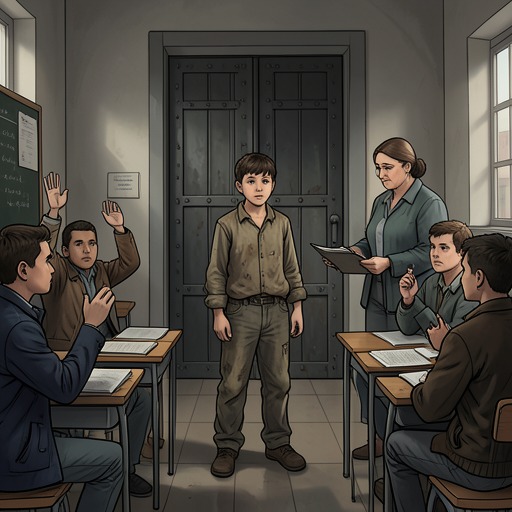
The school’s discipline is organized around frequent physical punishment. Seven masters carry leather straps, canes, or blackthorn sticks; pupils may be hit for lateness, a leaky pen nib, talking, laughing, wrong answers, or not knowing required material. The expectations range from religious knowledge and arithmetic to the patron saint of Limerick, the chief towns and products of Ireland’s thirty-two counties, and the location of Bulgaria on a classroom map. Irish-language requirements extend to saying one’s name and the Hail Mary in Irish and asking for a lavatory pass. The breadth of what is tested makes the classroom a place where mistakes of knowledge and conduct alike invite punishment.
Hoppy O’Halloran, the headmaster, is the only master who sits. He has a short leg and a twisting walk, and summons pupils to the front when he means to punish them. Yet his lessons also open onto subjects that animate him. He speaks about America, its climates and history, and the possibility of recovering Ireland from England; questions about America can distract him from algebra or Irish grammar. He recites the names of Native American tribes and chiefs, then calls the subject poetry. His classroom therefore holds two different kinds of authority: the threat of the stick and the imaginative energy of a teacher whose interests can carry a lesson beyond its formal routine.
In seventh class, O’Halloran gives the boys Oliver Goldsmith’s The Deserted Village, presenting a poem that appears to concern England as a lament for Ireland. The pupils must memorize twenty lines each night and recite them in the morning. Six boys are called to the front, where a missed line brings two slaps on each hand; then the class chants a passage about the village schoolmaster. The episode joins literary instruction to the school’s punitive method, while the teacher’s interpretation makes the poem part of a nationalist account of loss and belonging.
Frank’s prospects and the school’s significance
Frank’s time at Leamy’s is not limited to the classroom. Boys from his class invite him on a weekend cycling trip to Killaloe, and he imagines borrowing Laman Griffin’s bicycle, learning to ride it after Griffin goes to bed, and taking a blanket, tea, sugar, and bread. The invitation shows the school as a source of peer connections and plans extending beyond lessons, even as Frank’s access to those ordinary opportunities depends on borrowing equipment and negotiating with an adult in the household.
When Frank is considering leaving school for work as a messenger boy, O’Halloran tells Angela that her son must continue his education. He warns her against the messenger-boy trap and recommends that she take Frank to the Christian Brothers, describing him as bright and deserving of secondary school and university. He explains that he did not become headmaster to preside over an academy of messenger boys. The intervention gives Leamy’s a consequential role in Frank’s future: although its everyday culture is marked by strict punishment and social division, one of its teachers contests the assumption that a poor boy’s education should end as soon as paid work becomes available.