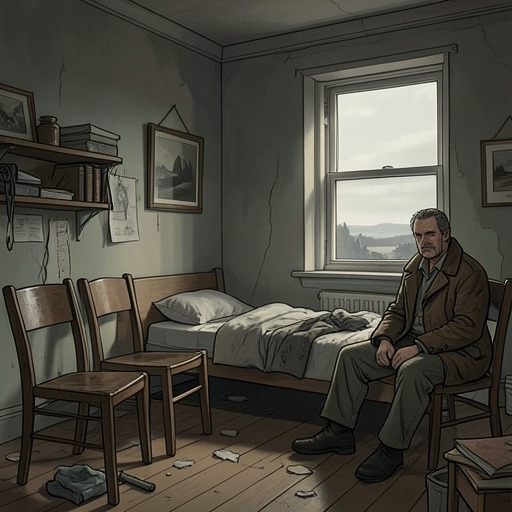
Limerick Labor Exchange
Angela's AshesThe Labour Exchange in Limerick is the place where unemployed men sign for the dole, a routine that structures the days of the men who gather around it and the uncertain household budgets of their families. For the McCourts, it is both a source of essential relief and a point of departure into a cycle of waiting, lost wages, and shortages. Its importance lies not in any promise of security, but in how precariously the family must live around the payments and work that may or may not follow.
The weekly routine
After the family returns to Limerick, unemployed men walk to the Labour Exchange each morning to sign for relief. The routine extends into the rest of the day: men sit outside smoking when the weather is fine, discuss public affairs, and sometimes go to the Carnegie Library to read newspapers or to a bookmaker to study the form. The Exchange thus anchors a wider social world of enforced idleness, where men are expected to remain informed and ready to debate the news even as they have no work.
The father follows this routine while Frank is still a child. He drinks tea in the morning, signs at the Exchange, reads at the library, and takes long walks into the countryside. He sometimes obtains work at the Limerick Cement Company or Rank’s Flour Mills, but those jobs end in the third week when he spends his wages drinking and misses work the following Saturday. Relief is therefore not a bridge to steady employment: his short spells of work and repeated return to the Exchange become part of the household’s recurring instability.
Relief and household insecurity
The family’s dependence on money is visible in the contrast between a payment’s arrival and what happens to it. The father sometimes drinks the monthly dole money, leaving Angela angry and unwilling to speak to him. The children learn that the silence in the house follows what the family calls the bad thing; even the youngest knows to avoid their father when their mother is not speaking to him. The Exchange’s payment is vital, but receiving it does not ensure that food or fuel will be available at home.
An earlier episode in Brooklyn shows the same vulnerability from a different angle: when the father’s wages stop after his employer dismisses him, the family is left without his income. In Limerick, the Exchange becomes part of the repeated setting of unemployment, but it does not erase the consequences of a lost job or a payment spent elsewhere. The family’s security depends on the uncertain combination of wages, relief, credit, and help from others.
Care and the costs of poverty
While the father signs for relief or is absent, care work falls to Angela, Frank, and their neighbors. During one period of hardship, Frank boils sour milk, mixes it with stale bread and sugar, and tries to feed the twins; he and his brother also share the meager food in the house. When the twins are in need of clean clothes and food, Minnie MacAdorey washes them and provides mashed potatoes. These acts make plain that surviving unemployment requires unpaid work and mutual aid, not merely access to a payment.
The imbalance continues when Angela becomes ill with pneumonia. A doctor takes her to hospital, and Aunt Aggie and Grandma insist that the children go to Aunt Aggie’s home rather than leave Frank, then eleven, to manage the household. Elsewhere, Angela cares for an elderly man in the South Circular Road while her daughters work, and offers Frank tea and a sandwich when he is delivering papers nearby. Such arrangements show the family piecing together care and food through relatives, neighbors, and work beyond the Exchange’s relief system.
The Exchange as a measure of precarity
The Labour Exchange gives the unemployed a required daily destination and the family a recurring hope of income, but the narrative presents neither as a reliable way out of poverty. Men’s public conversations and routines coexist with hunger at home; a dole payment can be consumed, and a job can disappear within weeks. Against this instability, the family depends on Angela’s labor, children’s contributions, and neighbors’ practical assistance. The Exchange consequently stands less as a solution than as one institution in a larger struggle to keep the household fed and cared for.