Malachy McCourt and Francis McCourt’s father-son relationship
Angela's AshesThe relationship between Malachy McCourt and Francis McCourt is one of the memoir’s central bonds: a source of imaginative intimacy and bodily comfort that exists within a family life repeatedly disrupted by hunger, absence, and death. Malachy draws Francis close through stories and shared rituals, yet the warmth of those moments does not erase the insecurity of the home. The bond is tender, but it is never insulated from the consequences of the father’s failures to provide.
Identity and early intimacy
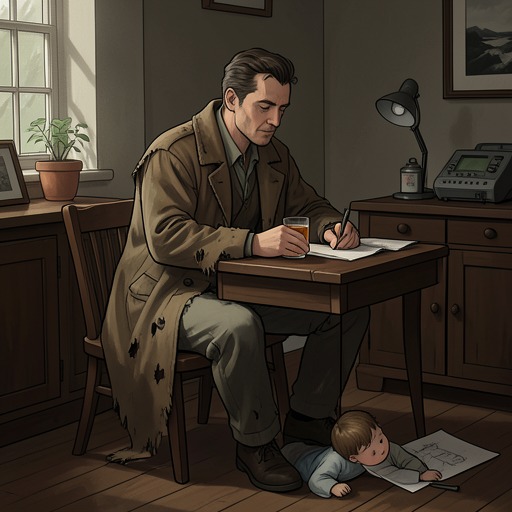
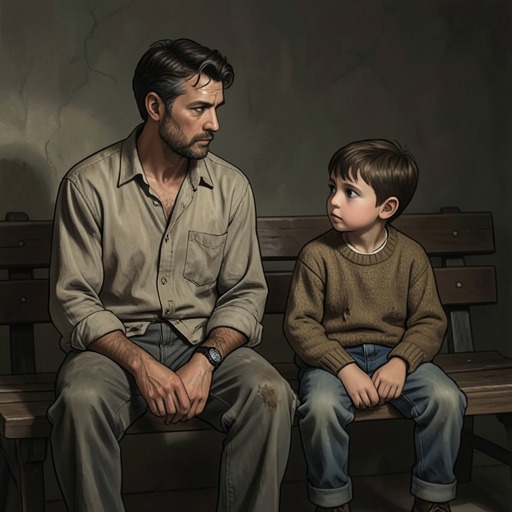
One of the relationship’s clearest scenes begins in an empty apartment. Malachy is out looking for work, Angela is at the hospital with another child, and Francis is hungry: the icebox holds only cabbage leaves floating in melted ice. After Angela returns, Malachy sits in the kitchen with a large white enamel mug of black tea and lifts his son onto his lap. The movement is simple, but it changes the child’s position from solitary deprivation to physical closeness with his father.
Francis asks for the story of Cú Chulainn, whose name he first mispronounces. Malachy makes him repeat it correctly before beginning, turning the telling into an exchange in which the child must listen, speak, and learn. The story moves from the hero’s boyhood as Setanta to his promise to guard the household of Culain after accidentally killing its dog. Setanta changes his name to Cú Chulainn and becomes the Hound of Ulster. Malachy presents him as a hero greater than Hercules or Achilles and capable of facing King Arthur and his knights—though, in his account, a fair fight with an Englishman is impossible.
The tale gives their closeness a distinctly familial shape. Malachy connects the legendary hero’s childhood in Ireland with his own boyhood in County Antrim, making the story at once a lesson in pronunciation, a family exchange, and a connection to the father’s past. When the story ends, he lets Francis sip his tea. It is bitter, but Francis is happy on his father’s lap. The scene joins imaginative nourishment to the household’s material want: the child receives a story and a taste of tea where there is little else to eat.
Stories, language, and shared attention
Malachy’s storytelling is part of a broader pattern of attention to words. At home he reads or shows the children letters and words in the Daily News, tells stories, or smokes and stares at the wall. For Francis, his father is thus not only a provider whose work determines whether wages come home, but also a figure who opens language and make-believe to him. The remembered story of Cú Chulainn gives the child a heroic world shaped by his father’s voice, with Irish history and Malachy’s own origins folded into it.
That intimacy is specific rather than constant. The story is presented as something Malachy cannot tell to the other children down the hall; Francis becomes its particular listener. The lap, the correction of the hero’s name, and the shared tea mark a private exchange inside a crowded and precarious family life. Its importance lies not in changing the family’s circumstances, but in giving father and son a moment of mutual attention amid those circumstances.
Provision, absence, and disappointment
The affectionate scenes stand beside a more painful pattern: Malachy’s employment does not reliably translate into food or wages at home. During one stretch, the children wait for him on a Friday night while Angela gives them bread and tea. Other working men have already returned to their families, and the sound of households talking and a radio singing about spare change sharpens the contrast with the McCourts’ waiting. Malachy eventually comes home singing and calls the children his troops and warriors, but the grand address does not supply what the family has gone without.
The contrast does not cancel the tenderness of the storytelling. Rather, it shows the distance between Malachy’s ability to make a story vivid and his inability to make daily life secure. The same father who offers Francis the legend of a boy who assumes responsibility for guarding a household is part of a household whose children depend on uncertain work and scant meals. The heroic tale can make duty imaginable, even as the family’s immediate need remains unresolved.
Bereavement and the limits of comfort
The relationship is tested most starkly after the death of Francis’s younger siblings. Angela sits crying on the bed while Malachy faces the wall by the fire, beating his thighs with his fists and repeating his grief. Francis is frightened by both parents’ sounds, but his thoughts also turn to the practical need to light the fire and get tea and bread. When he tries to move around his father’s legs to reach the fireplace, Malachy notices and tells him that his younger brother Oliver, his sister, and another younger brother have died.
Malachy then picks Francis up and hugs him so tightly that the child cries out. The embrace does not soften the announcement or remove the hunger that had occupied Francis’s mind; instead, grief and bodily comfort arrive together. The family weeps, while Eugene remains quiet. Malachy then proposes that he and Francis go out to find food. Carrying his son through Limerick, he asks shopkeepers for anything they can give a family with two children dead in a year and three more in danger for want of food and drink. Most refuse and direct him toward charitable assistance or public aid.
The episode gives the father-son bond its most painful double meaning. Malachy holds and carries Francis, but he also brings the child into the streets as he pleads for help, making him a witness to bereavement and dependency. The earlier lap-and-story scene offered closeness without asking Francis to face the family’s crisis; here physical closeness accompanies an explicit encounter with death and poverty. Across these moments, Malachy remains both the source of a child’s imaginative inheritance and a fallible father whose tenderness cannot protect his son from the conditions of their life.