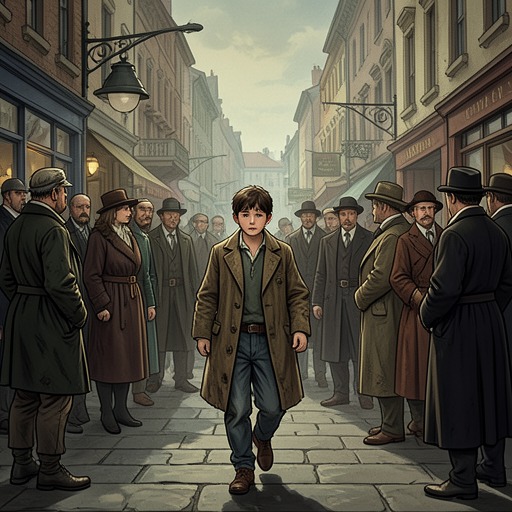
Mr. McCaffrey
Angela's AshesMr. McCaffrey is the Easons manager who gives Frank McCourt his first job after the post office, tests his basic qualifications, and supervises his work distributing newspapers and magazines around Limerick. As a practical employer and an executor of official censorship, he introduces Frank to the routines of a new workplace while exposing the comic disorder of the effort to remove a supposedly unsuitable page from an English magazine.
Hiring Frank
When Frank arrives seeking work, Mr. McCaffrey asks him to demonstrate his handwriting by writing his name and address and explaining why he wants the job and how he hopes to advance through perseverance and diligence. The request frames employment as both a test of competence and a chance for a boy to rise within the company. Mr. McCaffrey also asks whether Frank can add and subtract. Frank says that he can.
Frank's sore eyes give the manager pause. Rather than reject him outright, Mr. McCaffrey says he will contact Dublin to learn the company's policy, but judges Frank's writing clear and takes him on pending that decision. He tells Frank to report at half past six on Monday morning at the railway station. The conditional offer establishes a pattern in their working relationship: Mr. McCaffrey is blunt and businesslike, but he gives Frank an opportunity despite uncertainty about his health.
Work at the station and in the office
At dawn on Frank's first Monday, newspapers and magazines are bundled along the railway-station platform. Mr. McCaffrey and Willie Harold cut the twine, count the publications, and enter the numbers in a ledger. English newspapers and The Irish Times must go out early; magazines are delivered later. The workers label the papers for shops around the city, making accurate counting and record-keeping central to the job.
Mr. McCaffrey drives the van while Willie and Frank carry bundles into shops and record additions or reductions to the next day's orders. After the newspaper deliveries, they unload the magazines at the office and go home for a fifty-minute breakfast. When Frank returns, Eamon and Peter are already sorting magazines, counting them, and filling the newsagents' boxes. Small orders go out by messenger bicycle and larger ones by van. Mr. McCaffrey keeps Frank in the office to learn the counting and ledger work, placing him within the daily system of sorting, dispatch, and accounts rather than limiting him to deliveries.
Authority and workplace discipline
Mr. McCaffrey's authority is conveyed through direct instructions and urgency. When a delivery emergency arises, he sends Frank to shops around Limerick, including the route toward Ballinacurra and the Ennis Road, to retrieve a specified page from John O’London’s Weekly. He tells Frank to claim that the removals are government business and to bring the pages back so they can be burned. The scale of the task turns a routine delivery network into an instrument for enforcing a censorship order.
The episode also shows how Mr. McCaffrey's command depends on the knowledge Frank has acquired elsewhere. He points out that Frank knows the city from his previous work as a telegram boy, and assigns him the outlying shops while taking the larger ones himself. The manager's order is therefore both a demand for speed and a practical use of Frank's local familiarity.
The magazine-page operation
Mr. McCaffrey's response to the order is not quiet or discreet. He drives from shop to shop with the boys, takes the magazines, hands out piles, and tells them to tear out the page. Shopkeepers protest that the magazines belong to them, threaten to call the guards, and object that they will not pay Easons for damaged stock. The scene makes the conflict concrete: a distant government instruction is carried out against the objections of the local businesses that sell the publications.
To justify the operation, Mr. McCaffrey tells the shopkeepers that the issue contains material unfit for Irish readers and that the workers are doing God's work. His explanation presents censorship as a moral duty, while the shopkeepers' insistence on seeing the alleged offending material and their refusal to accept mutilated magazines expose the practical absurdity of the claim. Mr. McCaffrey is at once the person tasked with carrying out the order and the manager responsible for confronting the commercial fallout it creates.
Narrative role
Mr. McCaffrey's importance lies in the way his scenes connect Frank's entry into paid work with the institutions and rules shaping everyday life in Limerick. The ledgers, bundles, delivery rounds, and shop orders establish the ordinary mechanics of Frank's new employment; the sudden instruction to remove a magazine page converts those same mechanics into a vehicle for state censorship. The contrast gives the episode its comedy without erasing its stakes: the workers must obey an order from Dublin, while shopkeepers bear the immediate cost and challenge its authority.
Through Mr. McCaffrey, the workplace is neither simply a refuge nor merely another source of hardship. It offers Frank structured tasks, a place to learn, and responsibilities that draw on his city knowledge, yet it also requires him to participate in an operation whose rationale he does not control. The manager's brisk orders make visible how institutional power travels from an office in Dublin to a van, a ledger, and the magazine counter of a local shop.