Mr. Timoney
Angela's AshesMr. Timoney is an elderly Limerick resident who becomes one of Frank’s readers and teachers, offering him paid work that is also an education in literature and dissent. Their connection turns on books rather than conventional instruction: Mr. Timoney rejects the newspaper Frank is sent to deliver and asks for Jonathan Swift, while Frank gradually discovers that reading can earn money, provoke laughter, and make a companionship endure even after its ordinary routines have been broken.
Identity and Introduction
Frank first encounters Mr. Timoney while delivering a newspaper. A large dog named Macushla announces the visit, and the white-haired man, wearing thick glasses and a white sweater and leaning on a stick, calls from inside before opening the door. The encounter establishes the household’s unusual balance of threat and comedy: the dog is formidable, but Mr. Timoney’s response is to joke and to invite the boy in.
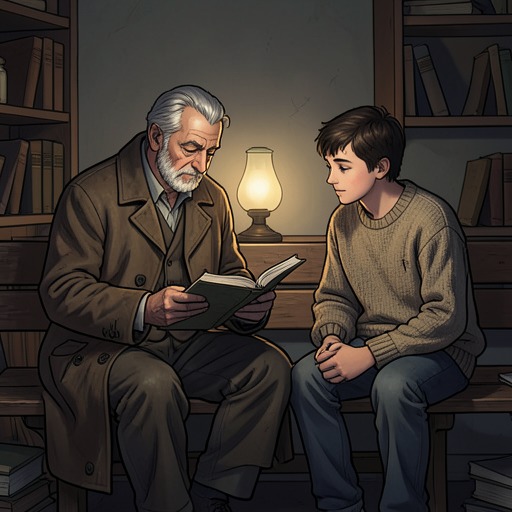
The older man initially appears as a customer of Frank’s newspaper route, but the newspaper is not what he wants. He tells Frank that he would not use the Limerick Leader and directs him instead to a copy of Gulliver’s Travels, asking the boy to find and read A Modest Proposal at the back. Mr. Timoney already knows the essay by heart; he nevertheless wants to hear it read aloud. His request makes the reading itself, not the acquisition of information, the point of their meeting.
Reading and Apprenticeship
Mr. Timoney stops Frank after a few pages, praises his reading, and asks what he thinks of Swift’s proposal that Irish children be treated as food. The outrageous premise is presented as satire, but the child is not yet equipped to share the older man’s response. Mr. Timoney laughs as he reads and returns to the passage about cooking infants, turning the shock of the text into a lesson in how a reader may recognize meanings that are not apparent at first.
The arrangement becomes regular paid work. Mr. Timoney gives Frank sixpence and tells him to return the following Saturday. His mother is pleased that the boy has found another source of income, though she assumes he was asked to read the newspaper. When Frank explains that he read A Modest Proposal, she dismisses the work as suitable because Mr. Timoney is, in her view, eccentric after years in the English army in India. She also recounts local stories about his late wife and his clashes with a neighbor who had cleaned his house. These accounts reach Frank as neighborhood gossip, rather than as facts he independently witnesses, and they show how the community interprets the old man’s irreverence through its own religious expectations.
Mr. Timoney’s teaching extends beyond the reading session. He promises that Frank will understand the joke when he grows up, and Frank replies that adults always tell children that understanding will come later. Mr. Timoney erupts in laughter at this challenge. The moment reverses the usual arrangement between adult and child: Frank’s observation is not corrected or silenced, but welcomed as a genuine wit. Their shared humor gives the lessons an intimacy that the payment alone cannot explain.
Work, Money, and Loyalty
Frank’s work for his uncle and his Saturday reading for Mr. Timoney give the household meaningful extra income. Uncle Pat eventually tells Frank’s grandmother that he no longer needs the boy to help with the papers and argues that Frank ought to give him part of his Saturday earnings, since the reading job came through his connection. The loss of the paper work does not end Frank’s attachment to Mr. Timoney. He decides he will continue reading even if the payment stops.
That decision is tested when Macushla is taken away after biting several people, including a passing nun. A neighbor tells Frank that Mr. Timoney laughed during the incident but cried when the dog was removed; she also says his distress became so severe that he was taken to the City Home, where elderly people needing care were kept. The story makes clear that the end of the Saturday payments is not simply a change in Frank’s work. Macushla’s removal and Mr. Timoney’s departure break the familiar scene at the house, while the neighbor’s account suggests that the dog was a source of attachment as well as comic disorder.
Frank refuses to treat that disruption as the end of their relationship. He waits until the neighbor goes inside, climbs through Mr. Timoney’s window to retrieve Gulliver’s Travels, and walks to the City Home so the older man will not miss their reading. At the gate, a man doubts that a boy has come to read to an old resident and tells him to leave the book for someone else to deliver. Frank nevertheless brings the book there for Mr. Timoney. His persistence turns a paid Saturday task into an act of loyalty, carried out without the expectation of a fee.
The City Home and Their Last Meeting
Frank later sees Mr. Timoney again while his mother is taking him for a walk around the hospital grounds during his treatment for an eye infection. The visit is difficult for his mother: the hospital is far away, she cannot always afford the bus, and walking is hard on her feet. Against that setting, Mr. Timoney appears standing by a wall, his eyes raised to the sky. Frank asks his mother’s permission before approaching him, uncertain about what is proper in a hospital.
When Mr. Timoney recognizes Frank, he addresses him warmly and calls mother and son blessed because he has neither family nor Macushla. His remark places his isolation beside Frank’s presence with his mother, without making the younger visitor responsible for repairing it. Frank offers to read, but Mr. Timoney refuses because of the boy’s eyes. He says he is beyond reading and has everything he needs in his head: he was clever enough to store things there in his youth and now has a library within him. The statement gathers the history of their meetings into a final image of reading as something that can outlast the book, the household, and the regular appointment.
Mr. Timoney also names the losses that have shaped his isolation: the English shot his wife, and the Irish put down Macushla. He calls the world a joke, while Frank’s mother answers that it is terrible but God is good. Mr. Timoney echoes her formulation, says goodbye, and urges Frank to rest his eyes and then keep reading. He recalls that they had good times with Jonathan Swift. Their parting preserves both sides of his character: the irreverent reader who laughs at Swift and the lonely man who has lost the people and animal closest to him.
Narrative Role and Significance
Mr. Timoney’s appearances form a compact education in reading and in the difference between an adult’s explanation and a child’s experience. Swift’s satire supplies a deliberately startling text; Mr. Timoney’s laughter signals its comic force, while Frank’s question about grown-ups who promise later understanding turns the lesson back on adult authority. The episode does not require Frank to grasp everything at once. Instead, the older man recognizes the intelligence already present in the boy’s protest and invites him to keep reading until understanding comes.
The movement from the house to the City Home gives that education an emotional consequence. At first, a newspaper delivery leads to paid reading and a weekly routine. Later, Macushla’s removal and Mr. Timoney’s institutionalization end that routine, but Frank’s choice to bring the book shows that the relationship has exceeded its original transaction. At their last meeting, Mr. Timoney cannot accept a reading because Frank must protect his eyes; nevertheless, he can recall the shared pleasure of Swift and describe his mind as a library. His role in the narrative is therefore not only to introduce a young boy to a difficult book, but to make reading a bond that survives separation and loss.