Poverty and deprivation
Angela's AshesPoverty and deprivation in the memoir are a persistent structure of life, not a passing hardship: they determine what the McCourts can eat, whether they can heat a room, how they seek assistance, and what compromises Frank eventually makes to leave Ireland. From an empty icebox in New York to a relief docket and a fireless home in Limerick, scarcity recurs in altered forms. It is measured in missing wages, stale bread, sour milk, coal, credit, and the distance between a promised payment and the next meal.
A household organized around want
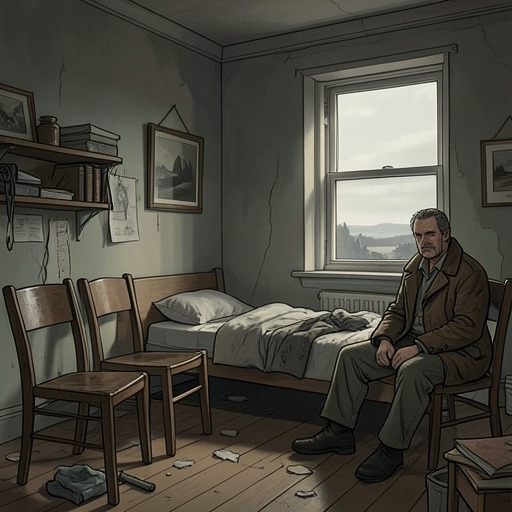
The account places poverty among the defining hardships of Frank’s childhood, alongside his father’s drinking, his mother’s exhaustion, and the pressures of Irish Catholic life. Its effects are immediate and bodily. In the New York apartment, Frank finds no food in the icebox except cabbage leaves floating in melted ice. His father is away looking for work, his mother is at the hospital with Malachy, and Frank falls asleep hungry on his parents’ bed. When his mother returns, she reports that the baby nearly bit through his tongue and needed stitches; illness and hunger occupy the same small domestic space.
Even when Malachy’s father has a job, earnings do not reliably become food at home. During the third week of one job, he brings home no wages. The family waits on Friday night while Angela gives the children bread and tea; around them, other households eat eggs, and neighboring families’ voices and a radio carry through the building. The contrast makes deprivation social as well as domestic: the children hear the ordinary signs of other people’s dinners while their own father arrives late, singing, after the money has failed to appear.
The recurring phrase that food is a shock to the system sharpens the irony. The father uses it to explain why he drinks tea without eating, even as his family faces hunger. His explanations, stories, and songs coexist with the practical consequences of wages withheld from the household. Scarcity is therefore not simply a lack of employment; the memoir also shows how the family’s access to money depends on whether earnings are brought home at all.
Hunger, credit, and improvised care
Angela tries to reach the wages at their source. She takes the children to a workplace gate and asks the man in the payment booth whether she can go inside and obtain some of her husband’s pay before he spends it in bars. He refuses, saying that allowing it would bring half the wives of Brooklyn to the gate; as long as men arrive sober and do their work, the employer will not intervene. The family waits across the street. The twins receive bottles of water and sugar, while Frank and Malachy must wait until Angela can get money and take them for tea, bread, and eggs.
When the father does not come home, Angela tries the bars near the station, then sends Frank back to ask whether the barman will fill the babies’ bottles. The men laugh at the sight of bottles being filled, but the barman tells them to stop. Learning that the family cannot afford milk, he empties the bottles and fills them with it, explaining that water and sugar will not provide what the babies need. Angela accepts the help without pretending it solves the shortage. Her response that beggars cannot be choosers registers both gratitude and the humiliation of having to ask.
Credit at the Italian grocery offers another small bridge over the gap between need and cash. When they reach Classon Avenue, Angela tells the grocer that her husband is late and asks whether she can take a few things and pay the next day. He says she can have anything in the store because she always pays sooner or later. The exchange makes trust, reputation, and delayed payment part of the household economy: when wages are absent, the grocer’s willingness to extend credit keeps food within reach.
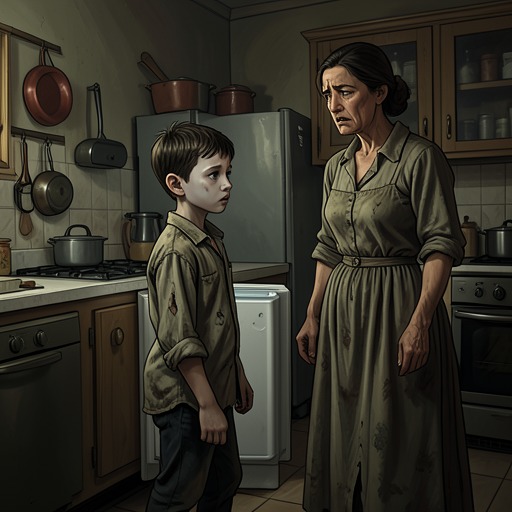
After Margaret’s death, that improvisation becomes more desperate. Angela remains in bed, while Frank and Malachy fill the twins’ bottles with water and sugar. The milk has gone sour in the icebox, where the ice has melted again, and there is only stale bread and two cold sausages. Frank boils the sour milk, mashes in bread, and tries to feed the twins from a cup. They refuse it until he adds enough sugar to cover the taste. The children eat on the floor, sharing the makeshift meal with the cold sausages and water. Care here is not an abstract virtue: it is the child’s work of turning spoiled and inadequate ingredients into something his brothers can swallow.
Relief, dignity, and the price of pride
Poverty also determines where the family can go and what forms of help are available. After being stranded in Dublin without money or shelter, Frank’s father tells Angela that he has failed to find assistance. The children are hungry, and the family has nowhere to stay. A policeman takes them to the barracks so that the authorities can see what can be done. Later, in Limerick, the father goes to the Labour Exchange to claim the dole; the narration notes that a laborer with a Northern accent has little hope of finding work there. The family is told it will receive nineteen shillings a week, but Angela immediately calculates the pressure on that sum: rent takes five shillings, leaving fourteen for food, clothes, and coal for boiling water.
Public assistance arrives as specified goods rather than a dependable income. When Angela pleads her need, officials issue a docket for a week’s groceries at McGrath’s shop on Parnell Street—tea, sugar, flour, milk, and butter—and a separate docket for coal from Sutton’s yard on Dock Road. They make clear that the help is not weekly and that they will visit her home to decide whether the need is genuine. The dockets bring immediate relief, but the conditions make assistance provisional and subject to inspection.
The father’s idea of dignity can work against the family’s survival. Walking with Frank, he sees women and children gathering coal from the road. When Frank points it out, his father refuses: they will not pick coal because they are not beggars. The refusal gives pride a concrete cost: a possible source of fuel is passed by while the family lacks what it needs to make a fire. Elsewhere, the father asks shopkeepers for food after two children have died within a year and three more are at risk for want of food and drink. Some give bread, potatoes, or tins of beans; others tell him to seek public assistance or the charity society. His appeal to Christian charity brings further rebuke from shopkeepers who resent a man with a Northern accent lecturing them. Need is thus filtered through local prejudice and judgments about who may ask, how, and with what claim to respectability.
Work, remittances, and repeated disappointment
Employment and migration repeatedly promise an escape from want, but the promise is uncertain. After Frank’s long hospital stay for typhoid, he returns home expecting that his father has found work and that food and shoes will no longer be scarce. Instead, his father is sitting in the kitchen with baby Alphie and is unemployed again. The doctor has recommended nourishing food and beef to restore Frank, but Angela can make only beef tea from a cube. His brothers watch him drink it and ask for some; she sends them away because they have not had typhoid. Even recovery is rationed, with a prescribed food available to the sick child but not shared equally among the hungry household.
The father agrees to go to England to work in Coventry, where an agent promises plentiful factory work and the possibility of saving money. Before he leaves, the family’s expectation of future earnings changes the grocer’s terms: Kathleen O’Connell is willing to extend credit because she knows he is going away and money will be coming back. On a later departure, he has no money for the journey and carries four cuts of fried bread wrapped in newspaper in his coat pockets. He goes on foot toward the Dublin road, leaving Frank to follow him only as far as the route allows.
A letter confirms that he arrived safely, and a money order for three pounds briefly transforms the children’s expectations. They imagine fish and chips, jelly and custard, and visits to the cinemas. But another Saturday brings no money order, and neither does the next. The hoped-for treats are displaced by Angela’s renewed appeals to the charity society and the daily evidence of scarcity: crumbs remain on the table, the mugs and jam jars go unwashed, and flies gather wherever sweetness is left. The sequence turns remittance into a recurring pattern—announcement, hope, a short-lived payment, and then absence—rather than a stable solution.
Deprivation and the possibility of leaving
The family’s scarcity begins before the Limerick years. Frank’s parents met and married in New York, where he was born, but returned to Ireland when he was four. His sister Margaret had died, and his brothers were very young. Later, relatives arrange the family’s passage back across the Atlantic: Grandma Sheehan sends money to Philomena and Delia, who buy the tickets, find a steamer trunk through the St. Vincent de Paul Society, hire a van, and put the family aboard ship. The move is not narrated as a simple journey toward security; the means of travel themselves depend on relatives’ money and charitable provision.
As an adult, Frank’s wish to reach America is again shaped by a precise shortfall. He says he needs a few pounds to complete the fare and have money when he lands. On the Friday before his nineteenth birthday, he finds Mrs. Finucane dead in her chair. He takes seventeen pounds from her open purse, then forty of the hundred pounds kept in her trunk, along with the ledger in which he has recorded debts. The act gives him enough to pursue the escape that poverty has made urgent, while involving him in a moral breach rather than a clean triumph over want.
He destroys the ledger by throwing it into the River Shannon. In doing so, he also cancels the recorded balances owed by people in Limerick’s lanes, including the nine pounds listed against Aunt Aggie. Frank connects the theft to his own plan to leave and to his regret for having written threatening letters to poor people who owed money. The ledger’s destruction does not erase the deprivation that produced those debts; it removes the instrument by which they were collected, and turns his departure money into an uneasy act of personal escape and release for others.
At O’Riordan’s Travel Agency, air travel through London is described as too expensive. The agent can instead arrange a passage on the Irish Oak from Cork for fifty-five pounds: nine days at sea, with a cabin and thirteen passengers. Frank says he has the money. This final fare puts the recurring arithmetic of poverty in sharp relief. Across the memoir, a few shillings decide what can be eaten or heated; at the end of this thread, the cost of a ship passage marks the sum Frank has struggled to secure in order to leave.
Narrative significance
The memoir makes deprivation legible through repeated calculations and substitutions rather than through a single episode. Wages become absent money; a public docket becomes specific food and coal; a neighbor’s credit postpones payment; sour milk becomes a meal only after bread and sugar are added. The household is continually forced to convert one inadequate resource into another, while children participate in the labor of keeping one another fed.
These scenes also reveal that poverty is governed by relationships and judgments as much as by cash. A grocer’s trust can make a meal possible, a barman can choose to fill baby bottles with milk, and officials can authorize groceries while reserving the right to inspect the home. At the same time, pride may reject coal, employers decline to release wages to a wife, and local prejudice shapes the unemployed father’s prospects. Assistance and exclusion coexist; neither turns want into security.
Migration offers a repeated imagined answer—first the family’s return to Ireland, then the father’s work in England, and finally Frank’s passage to America—but each movement is entangled with dependency, failed remittances, or money that must be found by morally compromised means. Poverty therefore does more than establish a bleak background. It organizes the memoir’s recurring tests of care, dignity, and obligation, and makes escape appear not as an effortless promise but as a fare that must be assembled from the wreckage of other debts.