Shannon River dampness and disease
Angela's AshesShannon River dampness and disease is the environmental condition through which the McCourts experience illness, housing insecurity, and bereavement in Limerick. Rain carried inland from the Atlantic settles over the city, saturating homes and clothes and making sickness seem inseparable from place. The river becomes an explanation for the family’s repeated losses, but the narrative gradually places that explanation beside more immediate causes: a flooded, poorly maintained home and a shared lavatory serving the lane.
Rain as a citywide condition
The account establishes dampness as Limerick’s defining weather and a force with consequences for health. From October through April, the city’s walls glisten; clothes fail to dry, and the damp coats become places where living things and unfamiliar growth take hold. The description links persistent wetness to a chorus of coughs and breathing complaints. It also records the household remedies used against congestion, including onion boiled in milk and a paste of flour and nettles applied to the chest. These details present illness not as an isolated misfortune but as part of ordinary life in a city where the weather remains inside the home and on the body.
Rain shapes public as well as domestic space. People gather at Mass, Benediction, and novenas in the church, which serves as refuge and the only reliably dry place. There, moisture steaming from clothes mingles with incense, flowers, and candle scent. The narrator’s account thus complicates Limerick’s reputation for piety: the crowds in church are presented not simply as evidence of devotion but also as people driven indoors by the rain. Religious practice and environmental necessity occupy the same space.
Illness, loss, and the river as explanation
The river acquires its deepest emotional force after the deaths of Oliver and Eugene. Six months after Oliver’s death, Eugene dies of pneumonia on a November morning. Dr. Troy says Eugene should have been brought to hospital earlier and warns the family to seek medical attention if the surviving boys show even slight signs of a cough or a rattle in the throat. He also instructs Angela McCourt to keep them dry, noting a weakness in the family’s chests. His account names both a specific illness and the practical urgency of care; it does not identify the river as the medical cause.
In the family’s grief, however, Malachy McCourt attributes both boys’ deaths to the River Shannon and its dampness. He beats his fists against his thighs at Eugene’s bedside and speaks to the dead child, making the river an agent that has taken Oliver and Eugene. The accusation gives the family a comprehensible focus for losses that Dr. Troy describes as arising partly from what people did not know. The tension between medical explanation and the father’s lament is central to the motif: the river is not confirmed as the cause of the deaths, but it becomes the language through which the bereaved father expresses blame and anguish.
The household’s response to Eugene’s death continues to frame grief through care and religious ritual. Grandma washes him; Aunt Aggie brings a white gown and rosary beads; the family lays him by the window where he used to look out for Oliver. Angela draws a blanket over his legs, while Malachy’s address to him returns to the river. These acts do not resolve the loss. They place it within the same family life in which dampness and chest illness have already become sources of fear.
Housing, sanitation, and exposure
The move to Roden Lane makes the environmental problem concrete. The McCourts’ house is one of six homes on one side of the lane, with a single house opposite, and stands beside a shed, a stable, and a lavatory shared by the lane’s families. When the family arrives, an old man empties a bucket into the lavatory, explaining that it serves eleven families and has apparently never been cleaned. The family’s new furniture has taken all day to haul across Limerick on a pram with one faulty wheel. The house initially feels like an improvement because it has stairs and rooms to move between, but its shared facilities immediately undermine that sense of security.
Angela fears that the lavatory will expose the family to disease; Malachy argues that they cannot afford another move, given the rent of six shillings a week, and proposes boiling water to clean it. Angela points out that fuel is itself scarce. The exchange shows how poverty restricts even basic responses to unhealthy surroundings: recognizing the hazard does not provide the money, fuel, or alternative housing needed to escape it.
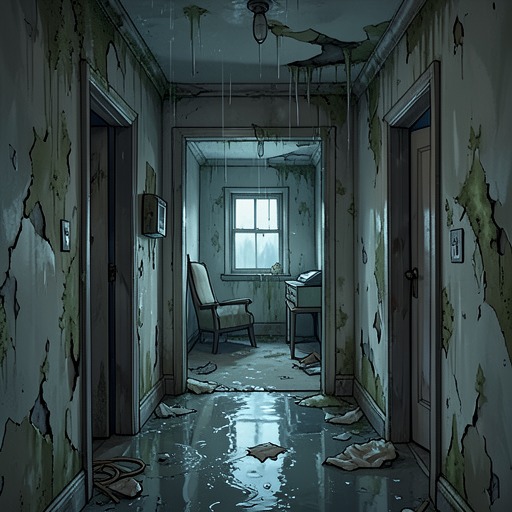
During heavy rain, water enters beneath the door and spreads across the kitchen floor. Attempts to block it with rags fail, and the household moves its furniture upstairs, where a fire makes the rooms warmer. The flood is compounded by the bucket-emptying outside and the foul condition of the shared lavatory. Malachy calls the upstairs rooms Italy, turning an improvised retreat into a family name for temporary shelter; the Pope’s image remains downstairs. The domestic joke does not remove the underlying problem: the family must leave part of its home unusable because rain and inadequate sanitation have made it intolerable.
Reconsidering the source of danger
At first, Malachy describes the damp river air as poison and resists sleep because he fears what it carries. As the family’s experience of Roden Lane accumulates, Angela insists that the lavatory, rather than the River Shannon, is what will kill them. In warmer weather, the household faces flies and rats as well as the smell from the shared facility and nearby stable. The children play away from the lavatory when they can, while the family’s daily movements and use of its home are shaped by the conditions outside the door.
Malachy eventually takes Frank McCourt to the Town Hall to complain. The official tells him that moving is the only option, although the family cannot afford to do so, and dismisses the prospect of new facilities by pointing to the lane’s deteriorating houses and their expected demolition after the war. Malachy argues that the lavatory could kill them; the official answers that they live in dangerous times. This exchange shifts the emphasis from an elemental threat to a civic one. Rain and damp remain real, but the family’s exposure is intensified by a shared facility, inadequate housing, lack of affordable alternatives, and official refusal to improve conditions.
The motif therefore holds two explanations in view without treating them as interchangeable. The river supplies the family with a vivid account of illness and loss, especially in Malachy’s grief for Oliver and Eugene. The episodes in Roden Lane reveal how the consequences attributed to dampness are also structured by the material conditions of poverty: a home that floods, a lavatory shared by eleven families, insufficient fuel, and nowhere affordable to move. The rain gives those conditions their recurring form; the city’s infrastructure determines who must live with them.