Thomas L. O’Halloran
Angela's AshesThomas L. O’Halloran, called Hoppy by his pupils, is the headmaster of Leamy’s School and a teacher whose strictness is matched by an uncommon commitment to explanation, intellectual independence, and practical care. He advances Frank McCourt to sixth class after reading his composition, challenges the school’s patriotic version of Irish history, and raises money so barefoot pupils can have boots. In a school where authority is often expressed through blows, Hoppy’s demand that boys understand and question what they learn marks a consequential difference.
Identity and Introduction
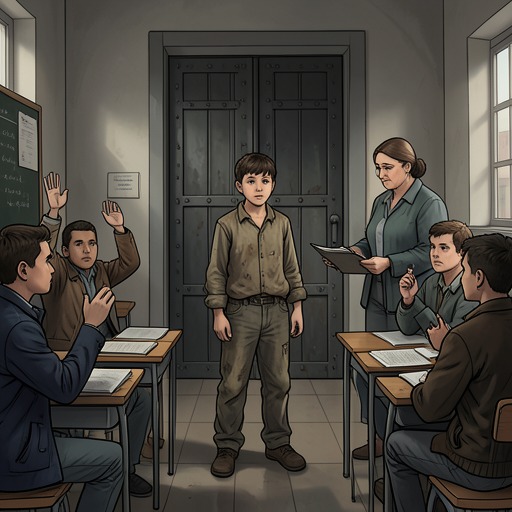
Hoppy teaches three classes—sixth, seventh, and eighth—in one room. The boys call him Hoppy because one leg is short and he hops as he walks. He knows the nickname and answers it with a warning that he will hop on them. His appearance is distinctive: a head compared to President Roosevelt’s, gold glasses, navy or gray suits, and a gold watch chain stretched across his waistcoat. He carries a long pointer, an instrument of discipline as well as instruction.
His classroom is not lenient. A boy who is inattentive or gives a foolish answer may receive three slaps on each hand or a blow across the backs of his legs. Hoppy expects pupils to memorize extensively, making him the hardest master in the school. Yet severity does not exhaust his character: unlike the other masters as Frank remembers them, he does not call the boys idiots or fly into a rage when questioned.
Teaching and Intellectual Independence
Hoppy prepares charts at home on Irish grammar, Irish history, and algebra, then sets them on an easel for the boys to recite. Their lessons range from grammatical cases and conjugations to Irish historical figures and battles, proportions, ratios, and equations. He also makes them learn the American states in alphabetical order, reflecting his love of America. The breadth of this curriculum is joined to a different kind of rigor: he explains why particular dates and facts matter, rather than requiring rote answers without context.
His lessons make room for questions. Hoppy pauses to ask whether the boys understand and whether they want to ask anything. When he teaches the Battle of Kinsale in 1601, he calls it the saddest moment in Irish history and says there was cruelty and atrocity on both sides. Asked directly whether the Irish committed atrocities, he says they did: they killed prisoners, and were neither better nor worse than the English. The answer unsettles pupils accustomed to hearing that the Irish were always noble and made brave speeches before being hanged. Hoppy does not replace one simplification with its opposite; he tells them to study, fill their minds with knowledge, and then make up their own minds about history and everything else. An empty mind, he insists, cannot make a sound judgment.
He makes that principle vivid through an image of the mind as a house of treasure. A person might be poor and have broken shoes, but the mind can still be a palace; filling it with rubbish, he warns, lets that rubbish rot there. The metaphor does not deny material hardship. Instead, it distinguishes poverty of possessions from the capacity to think, and treats education as something the boys can possess and defend for themselves.
Care for His Pupils
Hoppy’s attention to the boys extends from their minds to their feet. He calls them to the front of the room one by one and inspects their shoes, asking why they are broken or why a boy has none. He calls their condition a disgrace and arranges a raffle for Leamy’s School’s boot fund, giving the pupils books of tickets to sell around Limerick. The prizes are five pounds for first place and five prizes of a pound each.
The fund provides new boots to eleven boys who had none. Frank and his brother Malachy receive no boots because they do have shoes, even though their soles are worn away. They have helped sell tickets for other boys and wonder why they ran all over Limerick to do so. Fintan Slattery suggests that charitable work earns plenary indulgences; Paddy Clohessy answers with a crude rebuke. The episode leaves the charity’s uneven result visible: Hoppy identifies a need and secures help for the barefoot boys, but the distinction between having no shoes and having nearly worn-out ones still matters to the children who remain without new boots.
Recognition and Narrative Significance
After Frank’s composition draws the attention of Mr. O’Dea and the headmaster, Hoppy asks whether Frank wrote it. Frank confirms that he did, and is removed from fifth class and placed in Hoppy’s sixth class alongside boys he knows, including Paddy Clohessy, Fintan Slattery, and Brendan Quigley. The advancement is especially striking because Frank has only recently suffered typhoid and is still weak enough to sit on steps and hold on to walls. At the end of the school day, he returns to the statue of Saint Francis of Assisi to give thanks, unsure whether something good or bad in his composition brought about the change.
Hoppy’s importance lies not in gentleness but in the way he makes authority answerable to learning and need. He disciplines, demands memorization, and insists on intellectual work, yet he also invites questions, acknowledges uncomfortable facts about Irish history, and acts on the visible poverty of his pupils. For Frank, his recognition opens a path into a higher class; more broadly, his classroom offers a model in which knowledge is not merely imposed but used to form independent judgment.