United States
Angela's AshesAmerica functions in the memoir as both a remembered standard of security and a destination imagined from the hardship of life in Limerick. For the McCourts, it is associated with a lavatory inside the home, dependable food, and the possibility of a future beyond the lane; for Frank, it becomes the goal for which he saves until he can leave Ireland at nineteen. The contrast between remembered America and the golden city he imagines approaching New York gives the place its double meaning: a practical escape from poverty and an ideal that no actual arrival can yet test.
The remembered home
The family’s first American home is recalled through the ordinary comforts it offered. When Angela is unable to find her husband after a night out, she tells her children that one day they will return to America and live somewhere warm, with a lavatory down the hall as in their former home on Classon Avenue. The remembered indoor facility is more than a domestic convenience: set against the shared lane lavatory in Limerick, it stands for privacy and a standard of living the family has lost. America enters the children’s lives not simply as a country but as a measure of how far their present circumstances have fallen.
That contrast is reinforced by the family’s housing and sanitation. In Roden Lane, the McCourts discover that the lavatory beside their house serves eleven families, while flooding and the adjoining stable bring persistent difficulty into the home. Frank’s father complains to the Town Hall that the lane needs more lavatories, but is told that the family can move if it dislikes the conditions; they cannot afford to do so. Against that refusal of local remedy, the memory of Classon Avenue becomes a concrete image of a different kind of life. America signifies a home in which basic facilities are private rather than shared, and where poverty does not dictate every household arrangement.
Separation and the pull of return
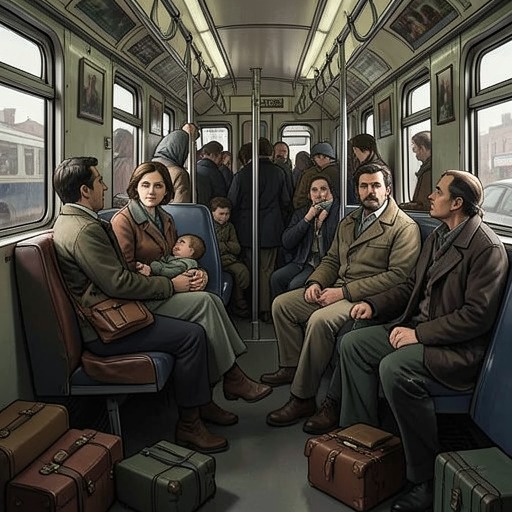
America is also bound to the family’s separation from the relatives who remain there. When the McCourts leave, Grandma Sheehan sends money to Philomena Flynn and Delia Fortune. The two women buy the tickets, find a steamer trunk at the St. Vincent de Paul Society, hire a van to take the family to the pier in Manhattan, and see them onto the ship. Their help makes departure possible, but the farewells also leave the children without the familiar network they are leaving behind. The voyage begins with Angela identifying the Statue of Liberty and Ellis Island, landmarks associated with immigrants’ arrival; her seasickness turns the outward-looking scene into an uncomfortable departure rather than a triumphant return.
Later, America remains part of the family’s talk even when a return is not immediately possible. Frank’s father agrees to go to England for work after Christmas, reasoning that America is now at war and the cause must be just. He signs with an agent for a factory job in Coventry, presenting the move as a way to earn money for the family. Frank is told he will have to be the man of the house. The episode distinguishes the father’s migration to England for wages from the family’s earlier American life and Frank’s eventual transatlantic plan: movement between countries is repeatedly made in response to work, family need, and the absence of a reliable income.
The promised remittances from England briefly make America’s imagined abundance feel close. After the father leaves, a letter arrives, followed the next week by a three-pound money order. The children immediately picture fish and chips, sweets, films, and even tea and cakes at the Savoy Café. No further money order comes. The expectation of continuing support gives way to renewed reliance on charitable aid and credit, and America remains a remembered alternative rather than a place the family can simply return to together. The gap between the first payment and the silence that follows also shapes Frank’s later insistence on saving his own fare.
From childhood refuge to personal objective
As a boy, Frank imagines America as a place where people can live warmly and comfortably. A night out with his brother Michael makes that image vivid: Frank buys him a meal, lemonade, chocolate, a film, and tea and buns, and Michael says it must be wonderful to live in America, where people have nothing else to do but sing and dance. Frank shares the attraction but recognizes that spending his money on immediate pleasures works against the longer journey. He decides that, at fourteen, he must save a few shillings each week if he is to leave Limerick by the time he is twenty.
His work as a telegram boy exposes the social divisions within the Ireland he hopes to leave. Many deliveries bring no tip: clerks accept telegrams without thanks, and maids at respectable houses likewise ignore him. On routes beyond the city, he sees large estates, long drives, lawns, and expensive cars, while being directed to servants’ entrances. These encounters do not prove what America will be like, but they sharpen the difference between the future he wants and the limits imposed on him in Limerick. America becomes a personal objective sustained by weekly saving, not merely a family story about a former home.
The goal acquires a precise financial shape when Frank is nearly nineteen. He calculates that he needs a few pounds to complete the fare and additional money for his first days after landing. The sums he gathers include money taken from Mrs. Finucane after her death; he also removes part of the cash in her trunk and destroys the ledger in which she recorded debts owed by people in the lanes. His decision connects the prospect of departure to both a material calculation and a moral consequence: the ledger’s destruction cancels the recorded balances, while the money enables him to pursue the destination he has long imagined. The episode makes clear that reaching America is not accomplished by hope alone but depends on finding a way to meet the cost.
The Atlantic crossing and the imagined arrival
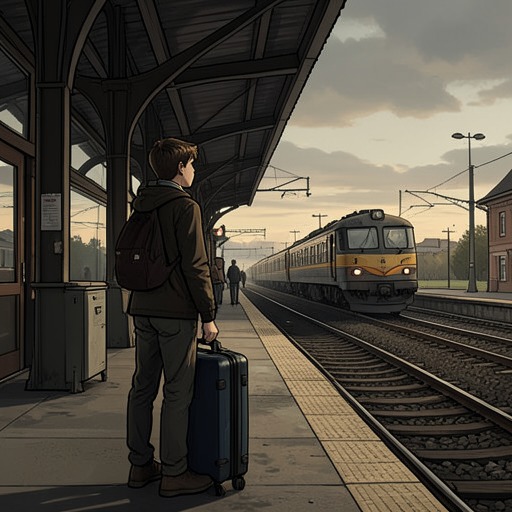
Frank secures passage through O’Riordan’s Travel Agency. Air travel would require going first to London and cost too much, so the agent offers him a place on the Irish Oak, sailing from Cork in a few weeks. The fare is fifty-five pounds; Frank says he has it. The ship makes the goal tangible at last, converting years of savings and expectations into a booked passage. When he tells Angela he is leaving, she cries, while Michael asks whether the family will all go someday. The question preserves the distinction between Frank’s individual departure and the family reunion he cannot promise.
As the Irish Oak sails past Kinsale and Cape Clear, Frank watches the lights at Mizen Head, the last part of Ireland he expects to see for a long time. On deck, he wonders whether he should have stayed, taken the post-office examination, and earned enough to help his younger brothers and his mother. He imagines better shoes and full meals for the children, a move out of the lane, and an end to Angela’s work emptying chamber pots. The decision to go therefore carries a counterfactual cost: the same earnings and prospects that might improve life at home could also keep him from leaving. His departure is not presented as uncomplicated triumph; even after boarding, he measures the choice against the family responsibilities it interrupts.
At dawn, as the ship approaches New York, Frank experiences the view through the expectations he has carried. He thinks he is in a film and recognizes the Statue of Liberty, Ellis Island, the Empire State Building, the Chrysler Building, and the Brooklyn Bridge. The sun turns the city golden in his vision; he imagines the wealthy returning home in formal clothes and other people going to comfortable offices without worries. This picture extends the childhood idea of America as warmth and security into a whole city imagined as free of care. It is Frank’s expectation, not a confirmed account of the lives he will find there, and the narrative ends this evidence with arrival in sight rather than with a settled judgment about America.