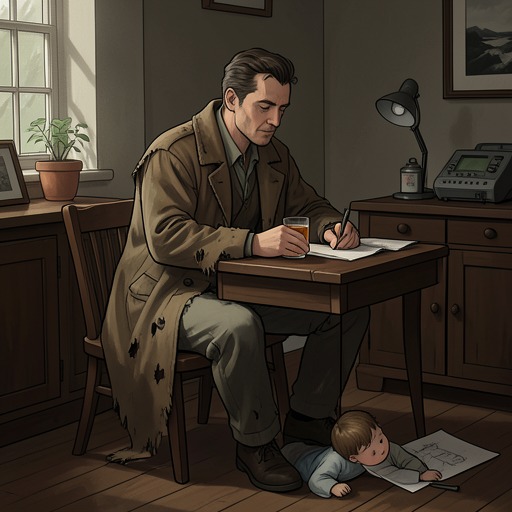
Destructive drinking
Angela's AshesDestructive drinking is the recurring force that turns the McCourt family’s narrow chances of stability into renewed want. When Malachy McCourt finds work, his wages might buy food and keep the children fed; instead, drinking can consume the pay, cost him the job, and leave Angela McCourt and the children to manage the consequences. The pattern reaches beyond one household: Peter Molloy’s winnings from competitive drinking likewise fail to reach his family, while his wife struggles to feed their children. In these episodes, alcohol is not an isolated indulgence but a mechanism by which scarcity reproduces itself.
Work, Wages, and Repeated Loss
Malachy’s employment at the cement factory briefly appears to offer a way out of hunger. Angela waits for him to return before serving tea, because his pay matters to the household and his northern accent makes finding work difficult. As darkness falls, however, she gives the children bread and cheese rather than keep waiting; she smokes a Wild Woodbine bought on credit and worries that losing this job would leave them with nowhere to turn. She remembers the family’s earlier searches for him around Brooklyn and imagines a return to America, where they might again have a warm home and a lavatory indoors. The delayed wages are already reshaping the evening before Malachy comes through the door.
When he arrives late, he calls for tea and summons the boys to collect the Friday penny. Angela does not answer. The children hear him offer the coin, but Malachy, their eldest son, refuses it, and Frank refuses too. Their father then turns the moment into a drunken patriotic performance, marching around the room with a candle and urging the family to die for Ireland. The penny remains in his pocket. Angela bars him from their bed; he sleeps downstairs, misses work in the morning, and loses the cement-factory job. The sequence makes the cost concrete: the delayed return becomes a quarrel, the quarrel becomes a missed shift, and the household is back on the dole.
This is not a single failure. Frank recalls that his father repeatedly moves through the same cycle: signing for relief, looking for work, and losing a job in its third week. If Malachy gets work at the Limerick Cement Company or Rank’s Flour Mills, he reaches the third Friday, drinks his wages in the pubs, and misses Saturday morning’s half-day. Angela contrasts him with other men from the lanes, who bring their wages home before going out for a pint or two. Her complaint is not simply that he drinks, but that he gives other men pints while his own children go without a decent dinner. The comparison shows that drinking is not presented as an inevitable feature of working-class life: the decisive difference is whether wages are first turned into household provision.
Relief and Household Consequences
The dole is another fragile resource exposed to the same pattern. After Oliver’s burial, Malachy says he will collect the week’s relief—nineteen shillings and sixpence—and return by noon with coal, a fire, rashers, eggs, tea, and perhaps sweets in honor of his son. Instead, the children boil the few potatoes shopkeepers have given them. Their father does not return during the day; long after the pubs have closed, they hear him singing as he rolls along Windmill Street. The contrast between the promised meal and the children’s potatoes measures the distance between income received and care actually delivered.
The Friday penny makes this failure visible to the children. They are hungry enough to want the small coin, yet refuse it when it comes after their father has stayed out drinking. Later, when he offers the same penny in the room, they again decline. His gesture cannot restore the wages, the lost job, or the trust worn down by repetition. The episode also shows how the children learn to judge provision by what reaches the household, not by what their father says he intends to bring home.
At the birth and baptism of the new baby Alphie, the family faces another test of whether money will be used for its stated purpose. Their grandfather in the North sends a five-pound money order for the child. Angela cannot leave her bed to cash it, so Malachy says he will go to the post office and asks the boys to accompany him. Malachy’s eldest son warns him not to go to the pub and insists that the money is for the baby. The scene places the children in the position of policing an adult’s access to funds intended for family care: experience has taught them that a promise to bring money home is no guarantee that it will arrive.
After the money is cashed, Frank imagines searching the pubs for his father and finds himself torn between anger and the memories of their mornings by the fire, when Malachy tells him stories about Cú Chulainn, Éamon de Valera, and Franklin D. Roosevelt. He suspects that the money for the baby has gone to drink, but does not confront his father. Instead, he anticipates Malachy’s eventual return, singing and offering the children a penny to die for Ireland. The recurrence matters: the children recognize both the familiar ritual of the return and the new severity of spending money meant for a newborn. Their knowledge is made of accumulated episodes, not of a single accusation.
Care Work and Neighborly Aid
The household’s survival depends on labor that drinking leaves to others. On the family’s long walk home in Brooklyn, Angela seeks help at a bar for the twins’ bottles. The barman fills them with milk after learning that she cannot pay, while the men’s laughter gives way to his rebuke that babies need milk rather than sugared water. Once home, Angela obtains food on credit from the Italian grocery shop, whose owner trusts her to pay later. Eggs, toast, and jam provide supper, but the children are too weary to chew easily; the twins fall asleep, and Frank rinses their dirty diapers so they can be hung up and used again the next day. Malachy helps wash the babies, though he is exhausted. Angela sits smoking and crying at the kitchen table. This scene shows both sides of the family economy: a father’s employment has not guaranteed security, while a mother, children, shopkeeper, and stranger assemble the necessities through unpaid work, credit, and kindness.
The same dependence on care appears when Minnie MacAdorey responds to the children’s neglect. She replaces the twins’ rag diapers, helps wash their sore skin, and gives the family mashed potatoes with salt and butter. Frank’s wish that Minnie and Mrs. Leibowitz could both be his mothers registers the force of an ordinary meal in a house where food and attention are uncertain. Their intervention follows the neighbors’ discussion of Malachy’s drinking after Margaret’s death. Minnie recalls that he had been thrown out of bars around the Long Island Railroad Station while grieving, and says the loss of the little girl had brought out something in him that had not appeared even after her birth. The account connects grief and drinking without making grief an excuse for the hardship imposed on the surviving children.
The contrast is especially sharp in the account of Peter Molloy. He wins money by drinking more pints than anyone, then makes himself able to continue by bringing the drink back up; yet his winnings do not go home. Sometimes he drinks the family’s dole. Nora is left with five children and such desperate anxiety that she is taken to the asylum; before she goes, she bakes frantically, begging for flour from priests, nuns, Protestants, Quakers, and Rank’s Flour Mills so the children will have bread. A supposed champion’s drinking skill produces no security for his family. Instead, his wife’s unpaid labor and public appeals must compensate for the money he has won and withheld.
When Angela is stricken with pneumonia, the children try to carry on as if they can manage the household themselves. Frank insists that, at eleven, he can look after his brothers, keep them fed and washed, and stay home from school. Grandma and Aunt Aggie reject the plan; after a doctor arrives, Angela is rushed to hospital and the children are sent to their aunt’s house. The episode is not attributed solely to drinking, but it belongs to the wider pattern in which family survival rests on women, children, relatives, and neighbors taking up care when the household cannot reliably function. Later, Angela herself works caring for an old man on South Circular Road, where she gives Frank tea and a sandwich while he delivers papers. Her spotless apron, polished kitchen, and food differ sharply from the lane’s deprivation; this paid work offers a small measure of order, though it does not erase the history of instability.
Patriotic Performance and the Pattern’s Meaning
Malachy’s drunken speeches and songs repeatedly set national sacrifice beside the immediate duties he neglects. He boasts that he will die for Ireland, and after drinking he invokes the same cause while failing to bring wages home or keep a job. Angela’s criticism exposes the contradiction: he speaks as though patriotic sacrifice were a proof of virtue, yet his children are hungry while he spends money standing pints for other men. The book does not present the speeches as a remedy for the family’s poverty; their force lies in the gap between a grand public ideal and the private obligations left unmet.
The pattern makes economic hardship cumulative. Wages are lost, jobs end, relief fails to become food, and children learn to expect promises to break. Against that sequence, the book gives unusual weight to small acts that convert resources into care: milk in baby bottles, groceries on credit, a week’s food and coal supplied by a relief docket, potatoes shared by a neighbor, or a sandwich offered to a boy at work. These details distinguish money’s arrival from its use. Destructive drinking matters because it repeatedly interrupts that conversion, transferring the burden to Angela, the children, and the wider network of people who feed, wash, house, and help them.