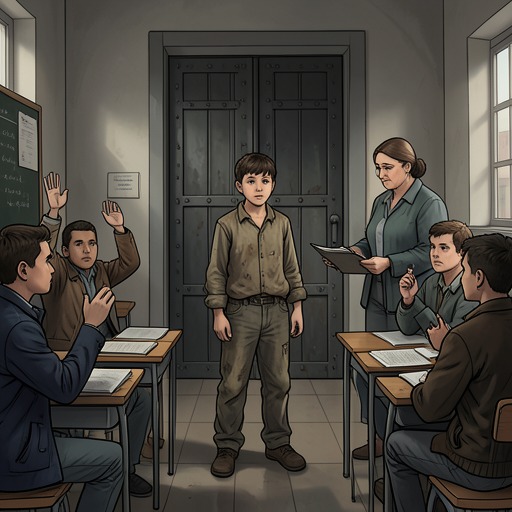
Frank is rejected by the Christian Brothers and leaves school
Angela's AshesFrank is rejected by the Christian Brothers and leaves school after his headmaster urges Angela to pursue a secondary education for him. The episode turns a question of schooling into a collision between Frank’s desire to earn wages, his mother’s hope that education might lift the family beyond precarious work, and the limited opportunities available to a boy from a poor household. The door closes; Frank feels free, and the next step is the post office.
Background and competing futures
Mr. O’Halloran, headmaster of Leamy’s National School, argues that Frank should continue his education rather than become a messenger boy. He asks Angela to take her son to the Christian Brothers, present him as a bright pupil, and seek a path through secondary school and, potentially, university. O’Halloran says he did not become headmaster to preside over an academy of messenger boys. His appeal makes education a matter not only of Frank’s ability but of the social destination assigned to children from families like his.
Frank does not share the headmaster’s ambition. He wants to leave school, find work, receive wages every Friday, and go to the pictures on Saturday nights. When Angela tells him they are going to the Christian Brothers, he says he wants to work and to be a man. She insists that he will attend secondary school and says she will manage even if she has to scrub floors. The disagreement is sharpened by their different measures of independence: Frank associates it with earning his own money, while Angela sees continued education as a way to avoid a narrow future.
The application and refusal
Angela takes Frank to the Christian Brothers and asks to see the superior, Brother Murray. She explains that Mr. O’Halloran considers her son bright and asks whether he might be admitted for secondary school. Brother Murray replies that there is no room for him and closes the door in their faces. The short exchange gives no indication that Frank’s academic ability is the problem; the stated obstacle is a lack of space.
After the refusal, Angela and Frank walk home in silence. She makes tea, sits by the fire, and tells him this is the second time the Church has shut a door in his face. She recalls an earlier rejection involving Stephen Carey and Frank’s unsuccessful attempt to become an altar boy. The repetition turns the school’s refusal into more than a single administrative decision: in Angela’s account, it belongs to a pattern of exclusion by religious institutions.
Angela’s response and Frank’s relief
Angela tells Frank never to let anyone slam a door in his face again. Her words frame the rejection as something to resist rather than accept as a verdict on his worth. Yet she cries that she did not bring her children into the world to make them a family of messenger boys. Her reaction reveals how urgently she hoped schooling might distinguish Frank’s future from the work available to the family.
Frank, by contrast, is relieved that he will not have to remain in school for another five or six years. He says he is free. The opposing responses do not resolve their disagreement: Angela grieves the loss of an educational possibility, while Frank welcomes the end of compulsory schooling and the prospect of work. The episode therefore makes the rejection both a setback in his mother’s plans and, from Frank’s immediate point of view, a release.
From school to the post office
Frank is thirteen, nearly fourteen, and June is his last month of school. Angela takes him to see Dr. Cowpar about finding work as a telegram boy. At the post office, the supervisor, Mrs. O’Connell, asks whether he can ride a bicycle. Frank says that he can, although he cannot; she tells him he cannot start until he is fourteen and should return in August. His entry into paid work is thus delayed by an age requirement and begins with a lie about a skill he does not possess.
The rejection leads not to immediate independence but to a specific, limited job. As a temporary telegram boy, Frank will walk his first deliveries because the post office has too few bicycles. The contrast between his hoped-for wages and the actual conditions of the work becomes clearer when he joins the other boys: temporary workers have lower pay, no uniform or holidays, and can be fired after a day’s sickness. They cannot remain in the job beyond sixteen. Permanent boys, by comparison, can take further examinations, progress to postman or clerk, and obtain waterproof capes, paid holidays, and work regarded as steady and respectable. The school door closes on one route, while the post office sorts young workers into sharply different prospects.
Work, class, and the meaning of the refusal
The episode sits within a wider pattern in which children take on labor before they have secure choices. Frank has already helped care for his younger brothers, preparing food when Angela is confined to bed; he has also carried newspapers for his uncle, including eight papers tucked under each arm on a rainy evening. Later, delivering coal with John Hannon, he helps move sixteen bags and sees the physical demands of work that can leave an older laborer’s legs failing. These experiences make the proposed messenger-boy future tangible: it is a continuation of children’s responsibility for work and household survival, not an abstract career choice.
The headmaster names that social limit directly. He condemns an Ireland that, in his view, maintains a class system and sends talented children toward menial labor. His protest cannot secure Frank a place at the Christian Brothers, and Angela’s insistence cannot overcome the refusal. The result is a formative contradiction: Frank leaves school partly because he wants to, but the institution’s rejection helps determine the terms on which he enters adulthood. Angela’s warning about closed doors remains beside his declaration of freedom, as both the hurt of exclusion and the appeal of earning his own wages shape what follows.