Irish nationalism and anti-English sentiment
Angela's AshesIrish nationalism and anti-English sentiment are not simply political opinions in the memoir: they organize family loyalties, school lessons, arguments about work, and hopes of escape. The McCourts inherit a language of Irish suffering and resistance, but Frank’s education complicates its certainties, making independent historical judgment part of the same intellectual inheritance as patriotism.
Family inheritance and national memory
Frank’s father, Malachy McCourt, links Irish identity to stories of historical exclusion and cultural survival. He tells Frank that English rule kept Catholics from having schools, so children learned in hedge schools where teachers risked transportation or worse. The teachers passed on English, Irish, Latin, and Greek, as well as history and poetry. In Malachy’s account, the love of learning endured despite political repression, even when it offered little prospect of employment. He contrasts those earlier risks with Frank’s chance to attend school and imagines education eventually taking his son back to America for secure work.
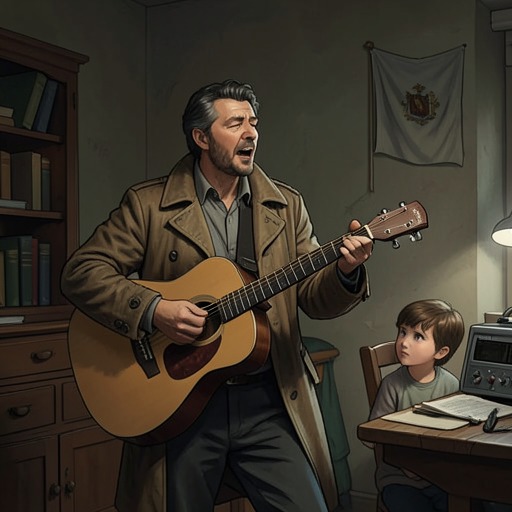
This family history sits beside a more direct patriotic demand. Malachy sometimes wakes the children in the middle of the night and makes them promise to die for Ireland. Yet the memoir also shows a quieter form of attachment: in the early morning, while the rest of the world sleeps, father and son share the fire and the newspaper. Malachy discusses world affairs and Irish history, but does not demand the same pledge in those private hours. The contrast presents national loyalty as both inherited public duty and intimate family conversation.
Schooling and the limits of patriotic certainty
At Leamy’s National School, national identity is reinforced through discipline and language. Pupils can be punished for failing to state their names in Irish, recite the Hail Mary in Irish, or ask for a lavatory pass in Irish. Irish-language competence is thus not merely an academic subject: it is imposed as a test of proper conduct within an institution already marked by physical punishment.
The teaching of national history can also depend on the master. Frank hears that one teacher insists Eamon De Valera was the greatest man who ever lived, while another gives that distinction to Michael Collins. Such competing declarations make patriotic knowledge appear shaped by authority as much as by evidence. The contrast becomes decisive when Frank enters the classes of Thomas L. O’Halloran, known as Hoppy, who teaches sixth, seventh, and eighth class together. Hoppy still uses corporal punishment and requires memorization, but he explains why particular facts matter and invites pupils to ask whether they understand.
Hoppy O’Halloran and a revision of history
Hoppy unsettles the heroic version of the past by calling the Battle of Kinsale in 1601 the saddest moment in Irish history and describing cruelty and atrocities on both sides. Frank has been taught that the Irish always fought nobly and fairly, and that defeat resulted from traitors and informers. He therefore asks directly whether Irish forces committed atrocities at Kinsale. Hoppy answers that they killed prisoners, and that they were no better or worse than the English.
The answer matters because it refuses to protect national pride through a simplified moral story. Hoppy does not replace one patriotic certainty with its opposite; he tells the boys to study before forming judgments. His image of the mind as a house that should be furnished with knowledge makes education a defense against received opinion. Irish history remains central to Frank’s schooling, but it is no longer presented as proof that one side is always virtuous. The possibility that English people might have done good things follows as a challenge to the inherited account, not as a new conclusion supplied in its place.
Anti-English sentiment in daily life and departure
Political grievance also colors ordinary judgments about work and poverty. When neighbors boast about food, Malachy attributes their prosperity to English money and condemns those who work or fight for England. Angela answers from the family’s material circumstances: there is no work at home, little coal, and the children’s shoes and clothes are worn; she says she would go to England for factory work if she could afford the fare. Malachy’s refusal to help England and Angela’s insistence on the needs of the household expose the friction between political principle and economic survival.
That conflict shifts when America enters the war. Malachy then agrees to go to England, reasoning that the cause must be just because the Americans have joined. He signs through an agent for factory work in Coventry, described as heavily bombed, and leaves his family with the expectation that earnings will be sent home. One money order arrives, but further payments do not. The episode shows how a national argument over England becomes a family separation shaped by work, remittances, and unmet expectations; ideology does not shield the household from poverty.
Migration, belonging, and the limits of national hope
Migration gives the family’s competing attachments a practical form. When the McCourts leave America for Ireland, Philomena Flynn and Delia Fortune use money from Grandma Sheehan to buy tickets, find a steamer trunk through the St. Vincent de Paul Society, and arrange a van to the Manhattan pier. Their departure turns return into a journey organized through relatives and charitable assistance, rather than a simple homecoming. Later, Malachy’s story of English oppression and Irish resistance coexists with his hope that Frank can return to America, where he imagines better work and shelter than in Limerick.
The memoir does not resolve that tension by treating either England or America as a straightforward answer. Malachy’s trip to Coventry is undertaken for wages, while America remains the promised destination in his conversations with Frank. At the end of Frank’s time in Ireland, passage to America still depends on practical means: an agent offers a place aboard the Irish Oak, sailing from Cork, for fifty-five pounds and a nine-day journey. The long movement among Ireland, England, and America makes national identity inseparable from poverty, family obligation, and the search for a place to live. Against inherited hostility, Frank’s schooling offers no easy reconciliation; it does, however, provide a method for testing the stories through which national loyalty is taught.