Laman Griffin
Angela's AshesLaman Griffin, whose birth name is Gerard Griffin, is a former Royal Navy officer whose decline shapes the McCourt family’s last refuge in Limerick. He gives Angela McCourt and her children shelter when they are displaced, but the help comes with an unequal household arrangement: Angela and the children live in his deteriorating home, do work for him, and remain vulnerable to his drunkenness and temper. His story joins lost status to present dependence, making the house both a shelter from eviction and the setting of Frank McCourt’s final break with him.
Identity and Background
Laman’s name itself carries a small uncertainty. When Grandma Sheehan leads Frank to the cottage on Rosbrien Road, Frank asks why she calls the man Laman when his name is Gerard. She replies that everyone calls him Laman, just as people call her brother Ab. The distinction between the name on record and the name used in the neighborhood introduces him through local familiarity rather than formal identity.
Angela later recounts the history behind his diminished circumstances. His mother once ran a grocery shop from the cottage’s little window and saved enough to send him to Rockwell College. He became an officer in the Royal Navy; a photograph shows him dining with fellow officers and the American film star Jean Harlow. Angela connects his later drinking and expulsion from the Navy to his unreturned love for Harlow, though this is her account of his past, not an independently confirmed explanation. By the time the McCourts arrive, he is a laborer for the Electricity Supply Board, and the house is in disrepair.
Shelter on Rosbrien Road
Laman enters the family’s immediate story during a crisis of housing. After the McCourts are left without a home, Grandma says she has no room but suggests that her cousin Gerard Griffin might take them in. She and Frank walk nearly two miles through the rain to a row of cottages on Rosbrien Road. Grandma calls Laman through the closed door and assumes he may be working overtime; the visit turns a distant family connection into a practical, if uncertain, arrangement for shelter.
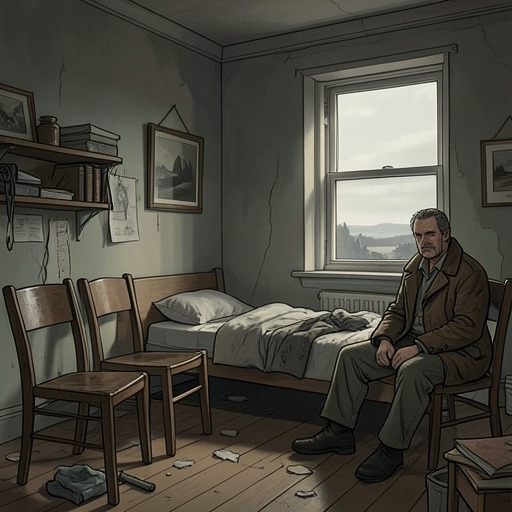
The cottage preserves the signs of a life stalled. Angela says Laman has not moved anything since his mother died, and the family must clear the accumulated belongings to make the place livable. A collapsing wooden shed supplies fuel, although the wood is rotten and full of white maggots. Boxes of purple hair oil, old magazines, bars of Pear’s soap, and a thick Pear’s Encyclopedia fill the house. The children’s curiosity about the encyclopedia offers Frank a rare resource amid the disorder, while the work of clearing the rooms falls to the newcomers who need a place to stay.
Household Dependence and Conflict
Laman’s daily habits organize the household around his needs. He comes home at six except on Fridays, eats, and sleeps; on Saturdays he goes to bed at one and stays there until Monday morning. His sleeping place is in the loft, reached by a makeshift climb involving the kitchen table and a chair. When he is too drunk to climb, he asks Frank to bring his pillow and blankets, and may sleep on the kitchen floor or in bed with the boys. The family’s shared rooms thus become subject to his drinking, his movements, and the demands of caring for him.
The arrangement also assigns Angela physical work in exchange for rent-free shelter. Laman complains about having given up his downstairs room for the loft and about the climb to the backyard lavatory. When he decides to use his mother’s chamber pot instead, Angela must move the table and chair, climb to the loft, empty and rinse the pot, and climb back down. He dismisses the labor as women’s work and part of the bargain of free rent. The phrase makes the imbalance explicit: shelter is not simply generosity, but a debt paid through Angela’s service.
Violence and Narrative Significance
The household’s dependence reaches a breaking point when Laman attacks Frank. After Frank insists that Laman had promised him something, Laman punches him in the shoulders and then the head. Angela tries to pull him away, but he punches and kicks Frank into the bedroom and continues beating him on her bed. Frank keeps repeating that Laman promised. Angela pleads with Laman to stop and tries to redirect the moment toward the fish and chips, but the assault leaves the contradiction of the refuge exposed: the home that took the family in is also a place where its children can be violently abused.
Laman’s narrative function is therefore inseparable from the material conditions around him. His former naval standing survives in Angela’s story and the officers’ photograph, while his present authority rests on ownership of a cottage the family cannot afford to refuse. The contrast does not excuse his treatment of them; it shows how poverty turns shelter into leverage. For Frank, the beating marks the end of the arrangement and is associated with his departure from Laman’s house. Laman remains a figure of both rescue and harm: the man who opens a door when the family has nowhere to go, and the man whose household Frank must ultimately leave.