Limerick Municipal Relief Society
Angela's AshesThe City Home is a Limerick institution whose different functions expose the narrow and often painful boundary between care and exclusion. It houses a fever hospital and an eye ward, while also serving as a destination for elderly people judged helpless or demented; for the McCourts, it is where a seriously ill child can receive treatment and where an old friend is removed from ordinary life.
An institution of care and confinement
The City Home is not presented as a single-purpose refuge. The narrative connects it to medical wards for infectious disease and eye treatment, as well as to the institutional care of old people. These uses place treatment and confinement side by side: people arrive because they need care, but entry can also mean being taken away from familiar surroundings and relationships.
That tension is especially clear in the contrasting experiences of Mr. Timoney and Frank. Mr. Timoney is taken there after authorities decide he is beyond recall, while Frank is admitted to its Fever Hospital during a life-threatening illness. The same institution thus marks both social removal and an exceptional effort to save a child.
Mr. Timoney and removal from the neighborhood
Frank learns from a woman next door that Mr. Timoney’s dog, Macushla, bit a postman, a milkman, and a passing nun on the same day. The incident acquires unusual weight because the nun’s involvement brings the matter to the bishop, and the dog’s owner is described as a known Buddhist and a danger to good Catholics. Mr. Timoney laughs and cries so violently that a doctor is called; the authorities then take him to the City Home, where old people described as helpless or demented are kept.
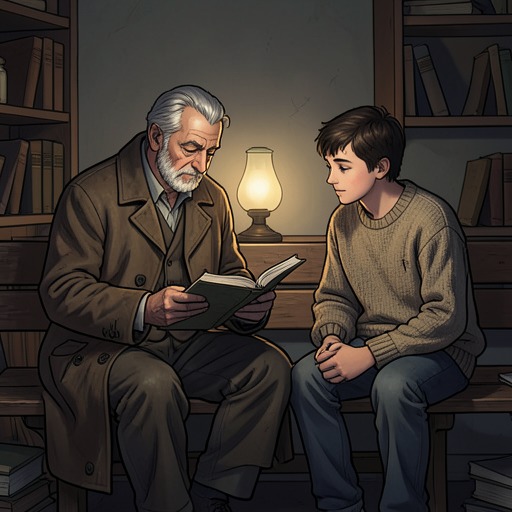
The institution’s authority is felt not only in Mr. Timoney’s removal but also in the abruptness with which his ordinary companionship is interrupted. Frank still wants to read to him, even after losing the Saturday job that had paid him sixpence. He climbs through Mr. Timoney’s window to retrieve Gulliver’s Travels and walks to the City Home, refusing to let the lost wages end the reading visits. At the gate, a man doubts that a boy would come simply to read to an old man and orders Frank away; Frank asks whether he can leave the book for someone else to read. The gatekeeper agrees to send it up. The encounter gives the City Home a literal threshold: Frank’s loyalty reaches the entrance, but he cannot simply resume the visits inside.
The Fever Hospital and a child’s crisis
The City Home’s Fever Hospital becomes a place of urgent treatment when Frank develops typhoid fever. After another doctor dismisses his symptoms as a bad cold, Dr. Troy recognizes the danger, identifies the illness, and rushes him by motor car to the hospital. Frank’s mother rides with him, holding him in her lap and fearing that she may lose her whole family. The emergency admission makes the hospital a source of specialized care at the point when home treatment has proved inadequate.
Inside, the white sheets, nurses’ uniforms, and Sister Rita’s white habit contrast with the illness and bleeding that have left Frank weak. The doctors administer blood through tubes placed in his ankles and the back of his right hand; Sister Rita explains that it is soldier’s blood from Sarsfield Barracks. His mother is allowed to remain at his bedside despite the usual prohibition on visitors entering the Fever Hospital for fear of infection. A nurse explains that an exception has been made because Frank is at a crisis point and may recover if he survives it. The hospital’s rules are therefore strict, but in this case they bend to the family’s need to stay together during a medical emergency.
The eye ward and the limits of home remedies
The City Home also contains an eye ward. When Dr. Troy examines Frank’s eyes, he orders him into the hospital at once, calling his conjunctivitis the worst case he has seen and noting that there is something else he cannot identify. The instruction redirects the family from home care to specialist treatment: the severity of Frank’s condition exceeds what can be managed through household remedies or observation.
That medical turn sits within a wider pattern of illness in the family. After Oliver and Eugene die, Dr. Troy stresses the danger of coughs and chest rattles and insists that the boys be kept dry; later, he responds decisively to Frank’s typhoid and eye disease. The City Home’s wards are part of this larger landscape of recurring sickness, where professional diagnosis can change what the family does and where a child is sent.
A shared setting for vulnerability
The City Home gathers together people vulnerable for different reasons: an old man separated from his neighborhood, a boy fighting typhoid, and a child whose eye condition requires hospital treatment. The episodes do not make its services interchangeable. Mr. Timoney’s placement signifies loss of ordinary access and companionship, whereas Frank’s admissions bring medical attention that his family cannot provide at home.
By giving the same institution these different roles, the narrative makes public care tangible without presenting it as a simple solution to poverty or illness. The City Home can supply wards, doctors, and treatment, yet its gate also stands between Frank and the friend he has come to see. Its significance lies in that double function: it is both a necessary resource in a world of recurrent disease and a place where vulnerable people may be removed from the lives that surround them.