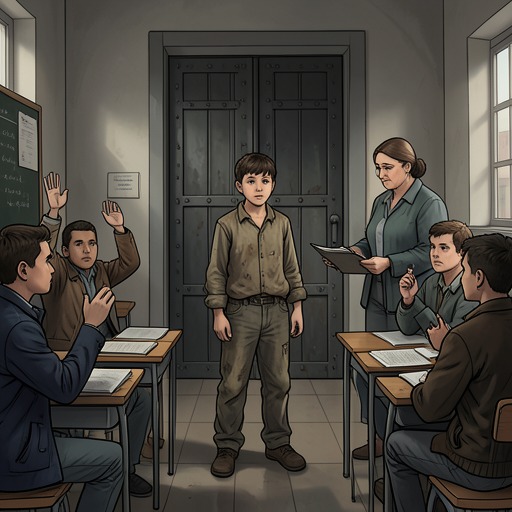
Mr. O'Dea
Angela's AshesMr. O’Dea is a schoolmaster at Leamy’s National School whose political demands and calculated humiliations make him an especially feared figure. He insists that pupils learn to hate England, and he uses public punishment to turn their involuntary tears into a spectacle of shame.
Identity and Classroom Authority
The boys learn about each master from older pupils, who pass along what he likes and hates. Mr. O’Dea’s stated political test is hatred of England: a pupil who fails to remember it risks being hit. That lesson belongs to a wider school culture in which masters demand allegiance to competing political heroes, making recitation and conformity matters of bodily safety.
Punishment and Humiliation
Mr. O’Dea’s particular method is pulling a pupil’s sideburns, which the boys call “cossicks.” He brings a boy before the class, stands behind him, and pulls upward until the pupil is on tiptoe. The pain makes tears rise despite the pupil’s effort to hold them back; the class watches, and Mr. O’Dea is described as the master who can always produce tears and shame.
The episode exposes the contradiction in the school’s discipline. Pupils are expected not to cry under punishment, since tears mark them as weak, yet Mr. O’Dea’s technique is designed to make crying unavoidable. The shame is therefore not evidence that a boy has failed to be tough: it is an intended outcome of the master’s authority.
The Boys’ Code and the System of Violence
The pupils’ response is shaped by solidarity with one another and resistance to giving the masters satisfaction. They consider it better not to cry because they have to live among the boys at school and do not want to reward the masters with a visible reaction. Yet the rule offers no real protection: Mr. O’Dea can make tears come regardless of a boy’s resolve.
This pressure extends beyond the classroom. The narrative says that a child who complains to his parents about being hit is likely to be told he deserved it and should not act like a baby. Mr. O’Dea’s cruelty thus operates within a broader acceptance of corporal punishment, while its public staging makes the pupil’s humiliation part of the lesson. Through him, the school’s authority appears not only as instruction but as enforced political conformity and control over how boys may show pain.