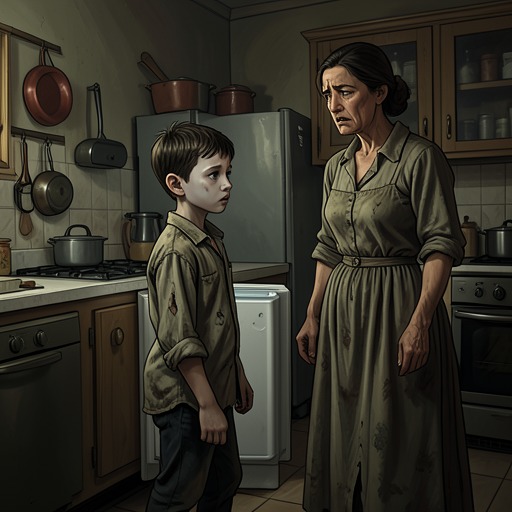
The McCourt Children Cope with Angela's Pneumonia
Angela's AshesThe episode in which Angela develops pneumonia turns the children from dependants into improvised providers. With their mother confined to bed, no money for bread, and their father absent in England, Frank and his brothers must find food and fuel while trying to keep her comfortable. Their thefts and raids are acts of care shaped by extreme scarcity; the arrival of Guard Dennehy and Angela’s removal to hospital finally brings adult intervention, but only after the children have been left to manage a crisis far beyond their years.
Illness and the household crisis
The scene opens with a home already short of necessities. The children are living upstairs in what they call Italy, and Angela shivers beside the fire, asking for lemonade. There is no money even for bread the next morning. She drinks tea and goes to bed, then spends the night turning and moaning for water. In the morning, she remains in bed, flushed and still asking for lemonade; Frank gives her water in a jam jar. Her silence about cigarettes, usually part of her routine, signals to the children that something is wrong.
The family’s poverty is made plain through what is missing as much as through what remains. The boys drink tea and Alphie eats the last piece of bread with sugar; the children cannot laugh freely because Angela may hear and send Frank and Malachy to school. They cannot obtain more credit at O’Connell’s shop, and they cannot turn to Grandma, who blames Angela for marrying a Northern man and says that her absent husband sends no money from his work in an English munitions factory. The illness therefore develops inside a household with little food, no reliable adult income, and strained family support.
Frank’s route through Limerick sharpens the contrast between his home and the homes of the better-off. On his way out, he sees warm, brightly lit kitchens through windows: tables laid with bread, butter, jam, eggs, and rashers, families gathered beneath images of the Sacred Heart. In his own head, he can find no music, only his mother’s moaning for lemonade. The repeated request becomes the immediate task around which his day is organized.
The children’s acts of care
Frank first takes two bottles of lemonade from crates outside South’s pub. He tries to walk away as if nothing has happened, carrying the bottles under his jersey. At Kathleen O’Connell’s shop, he takes a loaf from the open back of a bread van while the driver is inside having tea. He knows Kathleen has often been kind to the family, but imagines that asking her for bread would disturb her morning and bring a rebuke. Rather than ask, he steals and promises himself he will confess.
The food is used at once. His brothers are back in bed under their overcoats; they tear at the loaf without slicing it and make tea from the morning’s leaves. When Angela stirs, Malachy holds a lemonade bottle to her lips, and she drinks it down. Frank decides he will have to find more. The family’s care work is practical and immediate: the boys share what they have found, try to soothe their mother, and keep the household going without enough coal to make a proper fire.
Frank next takes an entire provision box left outside a large house on Barrington Street. It contains milk, bread, cheese, tomatoes, and marmalade. He considers whether to take only some of it, then carries off the box, pretending to be a messenger making a delivery. His brothers devour thick slices of bread with marmalade; Alphie gets it on his face, hair, legs, and belly. They drink cold tea because there is no fire. The abundance of the box briefly changes the household’s immediate prospects, but it does not resolve the mother’s illness or the absence of dependable provisions.
When Angela asks for more lemonade, Frank gives her half of the second bottle and dilutes the rest with water. He cannot spend his life stealing it from pubs. As her condition worsens, she raves about her dead daughter and the twin boys who died before they were three, asking why God could not take the rich instead. She still asks for lemonade. The scene joins present illness to earlier bereavement: the children hear their mother’s grief while they struggle to meet the practical demands of her sickness.
From begging to raiding
The boys try to secure fuel by going to the rich avenues in a pram, hoping to collect turf, coal, and wood. Their plan is to take Alphie because his smallness and smile might make people feel sorry for them. Instead, maids turn them away, threaten to call the authorities, and shame them for bringing a baby in a dirty, broken pram. Their rebuff turns a request for help into an encounter with class contempt. Malachy says he will never ask the rich for anything again and proposes going around the backs of houses and taking what they need.
The children’s supposed outlaw identity grows out of these choices. Frank tells his brothers stories about being chased while stealing bread and lemonade, and imagines sanctuary at St. Joseph’s Church, where, in his invented account, no one could follow a criminal. Malachy compares him to Robin Hood, while Michael calls him an outlaw and imagines him being hanged in the People’s Park as in a film at the Lyric Cinema. Their play turns necessity into a shared story, but it also exposes the thin boundary between childhood adventure and acts forced by hunger.
Michael’s visit to a rich woman’s house brings the crisis into public view. She gives him cake, milk, bread, and jam and asks about the family. He says their father has a big job in England, but that Angela is in bed with a desperate disease and keeps asking for lemonade. He also boasts that the children are managing by themselves and have plenty of bread and marmalade. Malachy scolds him for revealing their situation, fearing that the woman will tell others and bring priests to the house. Instead, the knock at the door comes from Guard Dennehy.
Intervention and hospital care
Frank and Malachy try to keep the guard from entering, claiming that Angela’s illness may be typhoid or consumption, that the children are getting spots, and that Alphie has a lump. Dennehy pushes inside and climbs the stairs to Italy. There he sees Alphie crawling from under the bed, covered in dirt and marmalade, and finds Angela and the children in their desperate circumstances. He takes off his cap, scratches his head, and calls the situation desperate. The children’s improvised cover story cannot conceal what the room reveals.
The guard insists that the boys will continue going to school, asks whether they have relatives, and sends Frank to bring Grandma and Aunt Aggie. When they arrive, Dennehy tells Aunt Aggie to get a doctor. The doctor comes with her in his motor car and rushes Angela to hospital with pneumonia. Aunt Aggie orders the children to come to her house until their mother returns. Frank protests that he is eleven and can stay home to feed and wash his brothers, but Grandma refuses and Aunt Aggie thumps him. Dennehy tells him he is too young to be both an outlaw and a father, though he adds that Frank has a promising future in both.
Angela’s hospital transfer ends the children’s attempt to act as the household’s sole carers. It does not erase what they have done: Frank has stolen food and drink, the brothers have tried to obtain fuel, and they have tended their mother while hungry themselves. The episode’s turning point is not a sudden recovery or a solution to poverty, but the arrival of outsiders who recognize that the household cannot safely manage alone.
Significance
The episode gives caregiving a material, collective form. Frank finds food and drink; Malachy helps give Angela lemonade; the brothers share what has been taken; and the children attempt to find coal and wood. These actions are neither easy evidence of triumph nor simply a record of wrongdoing. The story keeps their moral discomfort—the theft from a shopkeeper who has been kind to them—beside the fact that they have no money, cannot get more credit, and are trying to feed a family in which the mother is ill and the father is away.
Its reversals show how narrow the children’s choices are. The attempt to beg for fuel leads to humiliation; the decision to steal is recast as outlaw adventure in the boys’ stories; a generous encounter with a woman in a large house brings the family’s situation to the attention of a guard. That intervention matters because it changes the immediate course of events: Angela is taken to hospital, and the children are sent to stay with relatives. Yet the account does not suggest that the underlying poverty has vanished. It records, instead, how children absorb adult responsibilities when food, warmth, and medical care are not reliably available, and how their resourcefulness can sustain a household only until someone with authority acts.