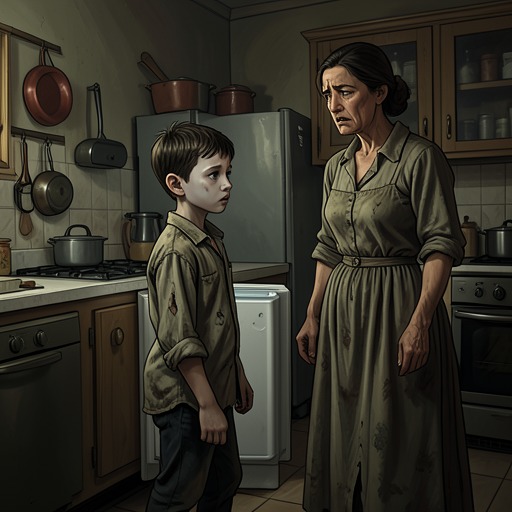
The McCourts’ coal-gathering Christmas
Angela's AshesThe McCourts’ coal-gathering Christmas is an episode of hardship and improvised aid in which a Christmas meal depends on fuel scavenged from the road and coal given by a publican. When Frank and Malachy set out with an old canvas bag, their uncle Pa Keating intervenes, leading them to South’s pub and securing enough coal to get the family’s fire going. The journey home is difficult, but the dinner that follows turns scarcity into a fragile domestic celebration.
The shortage that sends the boys out
The immediate problem is practical: there is not enough coal to cook, the water is no longer boiling, and Angela’s back pain prevents her from making the trip herself. Their father will not go, because he refuses to stoop to collecting fuel and will not carry it through the streets. The boys are therefore sent to the Dock Road, where coal and turf may have fallen from lorries. Their bellies are full from sausages and bread, and the rain has held off, but the errand exposes how little stands between the household and a Christmas without a cooked meal.
The road is nearly empty. Frank and Malachy pick bits of coal and turf from cracks in the roadway and walls of the coal yards, along with paper and cardboard that can help start a fire. They carry the finds in a canvas bag borrowed from Mrs. Hannon. The work is not enough to solve the problem until Pa Keating comes upon them and learns why they are there. His reaction makes plain how stark the need is: on Christmas Day, the boys are gathering fuel so their family can cook its pig’s head.
Pa Keating secures coal
Pa takes the boys to South’s pub, which is not supposed to be open. As a regular customer, he can enter by a back door and order a pint for himself and lemonade for them. He asks the publican for coal. The request is unusual enough to be remarked upon: after twenty-seven years serving drink, the man has never before been asked for coal. Pa nevertheless makes the request on the boys’ behalf, and the publican agrees generously, directing them to the coal hole beneath the stairs and telling them to take what they can carry.
This changes the errand from desperate scavenging into a moment of local assistance. The coal from the pub is real fuel, not the small fragments the boys have gathered along the Dock Road. Pa’s appeal and the publican’s response allow the children to bring home what the household needs, without asking their father to abandon his rule about collecting fuel in public.
The difficult walk home
The bag has a hole, so Frank drags it while Malachy repeatedly picks up the coal that falls out and puts it back. On the way to Barrack Hill, rain begins. They cannot wait in a doorway without leaving a trail of coal on the pavement, and Malachy becomes black from handling the lumps and wiping his face with wet hands. A woman tells them to move away from her doorway; further along, children in a house point and mock them. The boys keep going because the coal is needed for the meal.
Their return brings them into a household still marked by damp and deprivation: rainwater has flooded the downstairs kitchen, but the family is already soaked, and they can wade through it. Their father drags the bag upstairs, praises the boys, and assumes the Dock Road was covered with coal. Angela laughs at how black they are, then cries at how wet they have become. She washes their hands and faces and postpones cooking long enough to give them hot tea. The episode’s reversal is modest but decisive: the children come home dirty and drenched, yet with enough fuel to restore warmth and make dinner possible.
A Christmas dinner made from what is available
The meal is pig’s head with cabbage and potatoes. When Malachy objects to eating the pig, his father takes slices from its cheeks, puts them on the boys’ plates with mustard, and sets the head under the table. By presenting the meat without its source in view, he gets Malachy to eat. The scene makes the meal’s scarcity concrete: the family has what it can obtain, and the father adapts its presentation rather than letting the objection prevent dinner.
The father also treats food as something not to waste. He eats potato skins and argues that nourishment lies in them; Angela answers that he would even chew eggshells if he could. He leaves much of his own small portion for the boys, who eat the rest of the pig’s cheek and the cabbage and potatoes. Tea, bread, and jam provide a sweet after the meal, so the family can say it had one on Christmas Day. The celebration is built not from plenty but from careful division, salvaged fuel, and food made to go around.
Significance within the family’s material world
The episode links a basic resource—coal—to several kinds of dependence. The household needs fuel to cook; the children supply labor; a neighbor lends the bag; Pa uses his standing at the pub to ask for help; and the publican gives the coal. These practical exchanges sit beside the father’s refusal to gather fuel himself, preserving a distinction between his personal rule and the work the family must undertake to eat. The boys’ humiliating journey does not erase that constraint; it shows how the household manages around it.
The Christmas meal offers relief without changing the family’s poverty. Floodwater remains below, the clothes are wet, and the warmth upstairs lasts only because the boys have brought coal home. Yet the episode also gives that limited relief a communal shape: Pa’s intervention and the publican’s generosity make a cooked meal possible, while the father and mother divide and adapt the food for their children. Christmas is not an escape from deprivation, but a day on which improvised help, family labor, and small portions hold the household together.