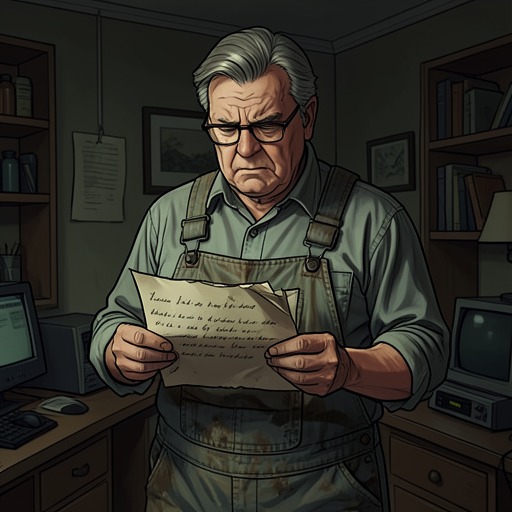
The father’s personal code of dignity and seeking help
Angela's AshesThe father’s personal code of dignity and seeking help is a recurring standard by which the father measures himself and his family’s conduct. It is expressed most plainly in his insistence on wearing a collar and tie, refusing to ask for food or carry ordinary parcels, and preserving his appearance even when unemployed. The code gives him a form of self-respect, but it also draws a sharp, consequential distinction between forms of support he accepts and forms he regards as beneath him.
Identity and Principles
The father treats dress as evidence of personal worth. On weekdays he rises early, prepares tea and hot water for shaving, fastens a collar to his shirt with studs, puts on his tie and cap, and goes to the Labour Exchange to sign for the dole. He will not leave home without the collar and tie: the clerk might know of a job at Rank’s Flour Mills or the Limerick Cement Company, and he believes that appearing properly dressed matters even for laboring work. His appearance is therefore not simply a habit; it is preparation for the possibility of employment and a public defense of his dignity while out of work.
That insistence coexists with repeated unemployment. The father says that bosses and foremen are initially prepared to hire him, but change their minds when they hear his North of Ireland accent and choose a Limerick worker instead. When his wife suggests dressing like a proper workingman or speaking like a Limerickman, he refuses both adjustments. He says he will not give an inch or sink so low, and laments that his sons have acquired the Limerick accent. When the narrator asks what afflicted means, the father explains it as sickness and things that do not fit. His code thus joins self-respect to resistance to assimilation, even as the family bears the material consequences of the prejudice he describes.
Work, Money, and the Limits of Assistance
The father’s conduct on farms reveals how his rule operates outside the Labour Exchange. When not looking for work in town, he walks miles into the country and asks farmers whether they need help, explaining that he grew up on a farm and can do anything. If hired, he starts at once in his cap, collar, and tie, and works so long and hard that the farmers have to tell him to stop. Yet he does not bring home the money he earns there: the farm earnings go to the pub, while the dole is treated as money that should be brought back to the household. His family recognizes the difference in practice, though both sources of income are needed in a home short of food.
He also refuses to ask farmers for provisions or take vegetables home, despite the family’s need. His wife contrasts this refusal with her own requests for food assistance, including seeking a docket from the St. Vincent de Paul Society, and asks why he cannot put a few potatoes in his pocket. He answers that it is different for a man: he must preserve dignity, wear the collar and tie, maintain appearances, and never ask for anything. The code therefore does not prohibit every form of dependence. He signs for public unemployment relief, but regards direct requests for food or gifts from employers as a more humiliating kind of help. That distinction protects his self-image while leaving his wife to pursue the forms of assistance he will not seek.
The family’s need is also met through credit and organized relief, in contrast to the father’s restrictions. At the Italian grocery on Classon Avenue, his wife explains that her husband is late and asks to take a few things, promising to see the shopkeeper the next day. The shopkeeper tells her she may have what she needs because she has always paid eventually. Later, when she applies for assistance, men give her a docket for a week’s groceries at McGrath’s shop on Parnell Street and a separate docket for coal from Sutton’s yard on the Dock Road. They warn that this support will not necessarily be repeated weekly and that they will inspect the household to review the claim. These scenes show the family surviving through credit and conditional aid, forms of help the wife can negotiate even as the father holds to his personal prohibition on asking for ordinary goods.
Food, Family, and Contradictions
The code becomes especially visible when the family must find Christmas food. The father does not help carry the pig’s head through the streets, because he says carrying parcels, bags, and packages would cost him dignity. His wife, already struggling to carry it, points out that he has carried the twins when they were tired and carried the Pope, but he insists that those are not comparable to carrying an ordinary object. He teaches his sons that when they grow up they must wear a collar and tie and never let people see them carrying things. The distinction turns a practical task into a lesson about masculinity and public appearance, while the family’s immediate burden falls on his wife and children.
His stance does not mean that he never acts for the household. On Christmas morning he lights the fire early so they can have sausages, bread, and tea; he takes two of his sons to Mass while the pig’s head boils. These acts sit beside his refusal to find or carry the meal and his earlier explanation that a man must not ask for anything. The tension matters: the code is not a complete absence of care, but an unstable ideal that can coexist with moments of household participation and with choices that make providing for the household harder.
The same division between public respectability and family need appears when the family is grieving. After Oliver’s burial, the father says he will collect the week’s dole of nineteen shillings and sixpence, buy coal, make a fire, and provide rashers, eggs, tea, and perhaps sweets in Oliver’s honor. He does not return by noon or during the afternoon; the children eat the few potatoes shopkeepers had given the family, and he comes home late after the pubs have closed. The promised meal never arrives. Later, after the deaths of Oliver and Eugene, the Labour Exchange reduces the dole to sixteen shillings; rent takes six shillings, leaving ten for four people. The father’s insistence on respectability persists within a household whose finances are plainly unable to meet even basic needs.
Meaning and Consequences
The code gives unemployment a vocabulary of dignity and resistance, but its costs are distributed unevenly. The father continues to dress for work and refuses to alter his accent, while his wife seeks credit, food dockets, and other relief to keep the household going. His insistence on never asking for anything is not a rule shared by the family in practice: its survival depends on the very requests and accommodations he rejects for himself. The contrast makes dignity both a source of personal resolve and a restriction on practical help.
The rule is further complicated by his handling of money. Farm earnings disappear at the pub rather than coming home, even though he distinguishes them from the dole, which he believes belongs to the household. The evidence does not present his code as a consistent system that reliably protects the family; instead, dress and refusal to request provisions preserve an appearance of self-respect while money intended for the household may fail to reach it. When the narrator returns from fourteen weeks in hospital, he sees his father at home with Alphie and feels an empty certainty that his father is out of work again, having previously believed that there would be food and shoes. The return makes the household’s insecurity visible once more, beneath the father’s familiar standards of appearance.
The code’s final contrast is between the father’s principled refusal to ask and his son’s later decision to secure money by taking it. On the Friday before his nineteenth birthday, the narrator finds Mrs. Finucane dead, takes money from her purse and trunk, and carries off her ledger. He plans to add the money to his savings for passage to America; by throwing the ledger into the River Shannon, he also ends the recorded debts of the people he had been sent to pressure for payment. This is not the father’s own action, but it sharpens the article’s central contrast: the father makes dignity depend on refusing certain forms of help, whereas the son’s departure is made possible by taking money and destroying the record of others’ debts. The household’s recurring struggle over food, relief, work, and self-respect gives the father’s personal rule its force—and exposes its limits.