Tyler's Father's Letter
AnimalsTyler's Father's Letter is an unfinished bridge between Tyler and the father from whom she is estranged: it contains his admission of harm, his request for renewed contact, and the ordinary news he hopes might draw her back into conversation. Its discovery does not produce a reconciliation. Instead, Laura reads it while Tyler is lying unwell, then puts it out of sight, leaving Tyler's choice about whether to open it unresolved.
Discovery and framing
The letter arrives with another, shorter note from Tyler's mother. She explains that the papers were found while people were clearing Tyler's father's house and forwarded to her with other paperwork. She has not opened the enclosed letter; whether Tyler reads it is explicitly left to her. The note offers to talk and affirms her mother's love, placing the longer letter inside a small act of care that does not presume to decide for Tyler.
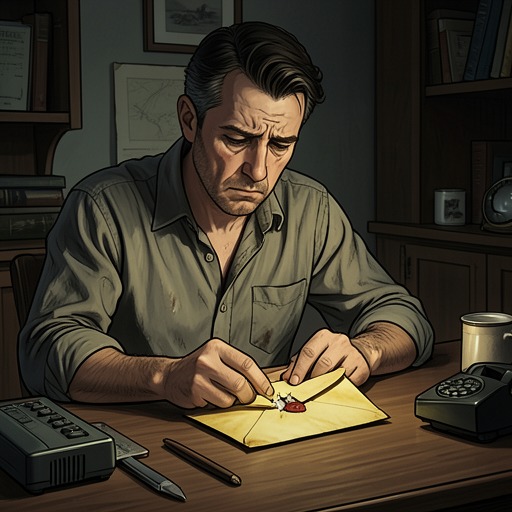
Laura comes upon the papers while collecting wine glasses left on the table from the previous night. She notices writing on the sheets as she picks them up from the floor, reads the short note first, and nearly walks into a door frame before reaching the longer letter. Dated 24 December 2006, it begins by addressing Tyler directly. The scene thus makes the letter's arrival immediate for Laura, while its contents belong to an earlier attempt by her father to reach her. The gap between its date and its discovery gives the appeal a second, belated life: it has been preserved and passed on, but Tyler has not yet decided whether to receive it.
The request for contact
Tyler's father presents the letter as his remaining way to communicate. He says Tyler will not take his calls and that she threw him out of her apartment during his recent special trip to England to see her and Jean. He also reproaches her for refusing to give him Jean's London address, arguing that Jean should have been allowed to decide for herself whether to see him. His account makes clear that the estrangement affects both daughters, while also showing how he frames the dispute: he describes himself as dismissed before Tyler has heard the whole picture.
His proposed reconciliation is modest in its stated terms but not free of pressure. He asks for a few minutes of conversation once a week or every two weeks, news about Tyler's life, and some sense of what it is like to live far from home. He invokes the financial support he says he did not hesitate to provide after she arrived in England, including the apartment he bought and the extra studies she wanted to pursue. From that support he draws an expectation of reciprocity, using a principle about getting out what one puts in to ask whether Tyler will give something back. The request therefore joins an appeal for familial closeness to a claim that past financial help should count in its favor.
Admission, apology, and self-presentation
The father calls himself a terrible father and husband and acknowledges that the relationship has deteriorated through his own actions. He says he has spent years knowing he threw it all away, but also insists he does not want to dwell on the past. That movement between confession and restraint lets him acknowledge damage without making the letter solely an apology: he wants Tyler to hear his perspective and return to ordinary contact.
The most specific admission concerns the bottle he says he never meant to throw at Tyler. He describes that incident as one of the hardest things for him to forgive himself for. The letter does not establish how Tyler understands the event or whether she accepts his account; it records his own belated naming of the harm and his claim about his intention. He also invokes his Christian belief in second chances, while noting that he and Tyler's mother never forced their religion on the girls. Faith supplies him with a language for reflection and self-forgiveness, but the request remains directed at Tyler: he wants her to give him another chance through renewed attention.
Ordinary news and unresolved choice
After the appeal and admission, the letter turns to local news and familiar details. The population of Crawford is nearly down to 1,000, he says, and a few months earlier boys on a school trip from the city drowned in the river near Fort Robinson. He acknowledges the grimness of the report, then reaches for laughter as a way of bearing it. These details offer the kind of small news he has asked Tyler to exchange with him, although they also carry the distance between her life in England and the place he describes.
He writes that Marshall, Tyler's old horse, is doing well. He takes the horse an apple most Saturdays, despite being laughed at in the store for shopping for himself and an animal, and a girl from the Normangill place, now the Fletcher place, rides Marshall during the holidays. He is considering letting June Fletcher have the horse permanently, but says he wanted to check with Tyler first. The question turns an abstract request for contact into a practical decision about something from her earlier life: even at a distance, he treats Tyler as someone whose consent matters.
A phone number at the bottom offers a direct route back to him, but the scene does not say whether Tyler calls or even reads the letter. Laura wonders when he died and thinks it must have been around the time Jean returned to rehab; this is her uncertain inference, not a date supplied by the letter. She folds both letters and hides them at the back of the cocktail cupboard, behind the glasses. Then she retrieves the stained plastic jug the household uses when someone is sick and carries it to Tyler. When Tyler asks Laura not to leave, Laura promises she is not going anywhere. The letter's appeal for a father's return to family life is thus held beside Laura's immediate promise of presence, while Tyler's response to her father's words remains unknown.