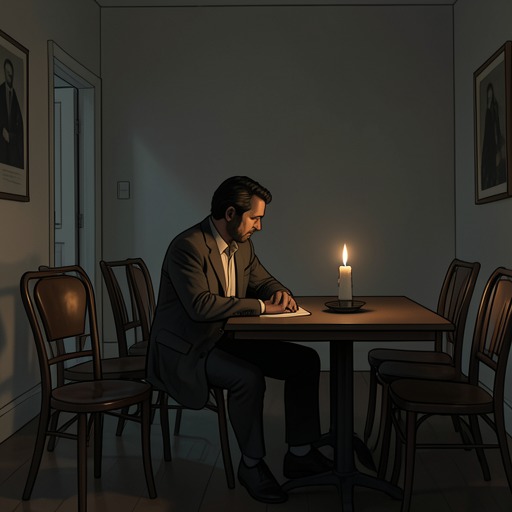
Looking for Pierre in the café
Being and NothingnessThe café search for Pierre is a philosophical example in which an everyday appointment makes absence perceptible. Arriving fifteen minutes late for a four o’clock meeting, the searcher looks for the punctual Pierre among the café’s patrons and declares that he is not there. The scene’s decisive point is that this judgment does not create the absence: expectation and directed attention have already made Pierre’s nonappearance a real relation between him and the café.
The Appointment and the Search
The search begins with a specific expectation. The speaker has arranged to meet Pierre at four, arrives a quarter of an hour late, and assumes that Pierre is usually punctual. Looking across the room, the patrons, and the café’s furnishings, the speaker asks whether Pierre waited and then says, “He is not here.” The statement sounds like a simple report about what the eyes find, but the scene asks whether absence is first intuited or enters only when judgment supplies the negative word.
The setting is initially described as a plenitude: tables, booths, mirrors, light, smoky atmosphere, voices, rattling saucers, footsteps, odors, and colors fill the café. Perception nevertheless does not take in this fullness as an undifferentiated inventory. It organizes a figure against a ground, and that organization depends on the searcher’s attention. On entering to find Pierre, the searcher makes the café as a whole the background against which Pierre is anticipated as the principal figure.
How the Café Becomes a Ground
As attention passes from person to table to chair, each item briefly seems capable of standing out, then recedes into the surrounding field. The café’s objects do not disappear physically; they lose their prominence for the search as they fall back into the ground. The text calls this recession an original nihilation: the marginally attended setting is organized so that a particular figure can appear against it.
The search unfolds through fleeting possibilities. A face holds attention for an instant as a possible Pierre, then dissolves from the foreground because it is not his face. If Pierre were found, his face would arrest the searcher’s attention and the café would reorganize around his positive presence. Since he is not found, the room continues to offer itself as ground, while Pierre’s expected figure slips between the searcher’s look and the café’s solid objects as a continual disappearance.
Absence as a Real Relation
Pierre is not absent from one precise spot in the café. His absence extends across the room: it keeps the café in the background and gives that background its particular, searching significance. The speaker’s expectation is essential. Countless people are not in the café, but their nonpresence is not thereby an absence experienced there; they have no established relation to the place through an expectation of finding them.
The search therefore makes Pierre’s absence an objective fact concerning this café, rather than a merely imagined lack or a phrase added after perception. Pierre haunts the room because the searcher came looking for him; the expectation organizes the surroundings around the figure that fails to arrive. The resulting intuition is described as a double nihilation: the setting recedes as ground, and Pierre appears on that ground as the nothingness of the missing figure.
Negative Judgment and Its Limits
The sentence “He is not here” gives verbal form to an absence that the search has already made perceptible. This reverses the apparent order between judgment and experience: nonbeing does not arrive in things because a negative judgment is pronounced; the judgment is supported and conditioned by the prior apprehension of nonbeing. The scene thus distinguishes a concrete search from the bare application of the word “not.”
The contrast is made explicit through imagined claims that Wellington is not in the café or that Paul Valéry is no longer there. Such statements can be entertained as abstract negations, but, unlike Pierre’s absence, they are not grounded in an expectation that connects either person to this room. The search’s significance lies in that difference: absence becomes more than a logical denial when a directed expectation organizes a world around what is missing.