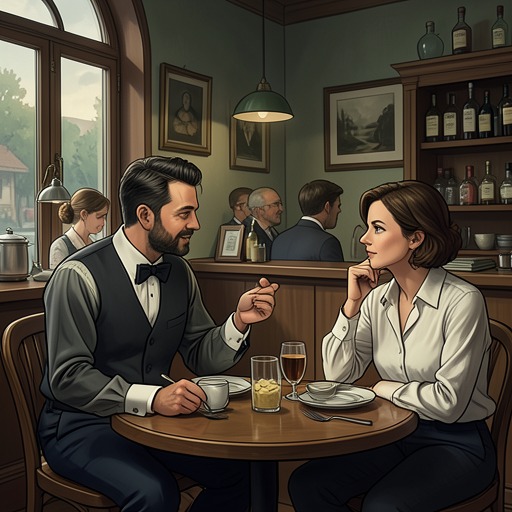
Love
Being and NothingnessLove, in this account, is not simply possession, loyalty, or mutual attachment. It is a project directed toward the Other’s freedom: the lover wants to be chosen freely, yet wants that choice to return upon itself and make the lover an unsurpassable limit. The resulting ideal would make the lover secure as the beloved’s absolute end, but it demands that freedom both remain free and become bound. That contradiction makes love a conflict rather than a settled union.
Love as a Project
The ideal haunting a person’s self-project in the presence of the Other is not identical with love as an enterprise. Love, in the more specific sense, is the organized ensemble of projects by which a person tries to realize that ideal. The ideal supplies love with its motivation and end, while the projects constitute its concrete effort. This distinction matters: love is not a possession already obtained, but an ongoing attempt to make a particular relation to the Other’s freedom real.
The project begins from an insecurity that possession of the beloved’s presence cannot remove. The Other’s freedom helps constitute the lover’s being, confers values, and can withdraw them; it can continually make the lover into someone new. The lover therefore seeks to recover the being received through the Other by getting hold of that freedom—not merely by having the Other nearby, but by making the freedom that constitutes the lover answer to the lover’s own project.
Freedom, Not Ownership
The account distinguishes the lover’s aim from simple ownership or domination. The desire to appropriate the Other is derivative: it arises because the Other makes the lover be. A tyrant can be satisfied with fear and mechanical obedience, whereas the lover does not want a beloved reduced to an automaton. If the beloved’s passion were explained as the inevitable effect of psychological determinism, the lover would feel that both the love and the self it sustains had been cheapened. Likewise, Tristan and Isolde’s passion would be less compelling if it arose from a love potion. Total enslavement would defeat the purpose, because the lover would then be left alone with no freedom to win.
Nor does a freely given promise settle the demand. A love offered solely as loyalty to a sworn commitment would not satisfy the lover, even though it is freely chosen. The lover wants a pledge and is irritated by the pledge: love must be freely renewed at every instant, yet the beloved’s freedom must also seem caught in its own decision, willing its own captivity. What is sought is neither passion determined from outside nor an inaccessible freedom that may choose otherwise at any moment, but freedom playing the role of passion’s determination while remaining caught in that role.
The Beloved’s Limit
The lover does not primarily want to cause the beloved’s transformation, since causing it would treat the beloved as an instrument within the world. Instead, the lover wants to be the privileged occasion of the beloved’s choice and to become, for the beloved, the whole world: an object that gathers the world’s significance rather than one object among others. The lover wants the beloved’s transcendence to surpass all other objects but not to surpass the lover, making the lover the limit at which that freedom consents to find its being and purpose.
This limit must be experienced in two apparently incompatible ways. It must be lived as a facticity—as something binding and suffered—and freely consented to as a choice renewed by the beloved. The beloved’s former decision to love is supposed to act magically within each present engagement, as though an earlier free choice could become a determining motive without ceasing to be free. The lover thus seeks a bond whose force is both given and continually recreated by the freedom it restricts.
Security, Value, and Conflict
At the deepest level, the limit demanded of the beloved is the lover’s own facticity. The lover wants the Other to recreate the lover perpetually as the condition of an engaged freedom, so that fact has pre-eminence over freedom even as freedom consents to it. If this project succeeded, the lover would be secure in the Other’s consciousness: no longer merely an object that the Other could surpass, judge, or use as a means, but an unsurpassable end and the absolute center around which the world’s instrumental things are ordered.
That promised security is also what makes the project conflictual. The lover depends on the Other’s freedom for the being and value the lover seeks, but cannot guarantee what that freedom will make of the lover. The attempt to recover oneself therefore aims to bind the very freedom on which one depends. Love’s ideal is to be chosen as the beloved’s absolute value, beyond the beloved’s whole system of values; its contradiction is that a freedom made incapable of exceeding that choice would no longer be the freedom the lover wanted to possess. The account presents love as a persistent effort to resolve this contradiction, not as evidence that the contradiction can finally be overcome.