The Look
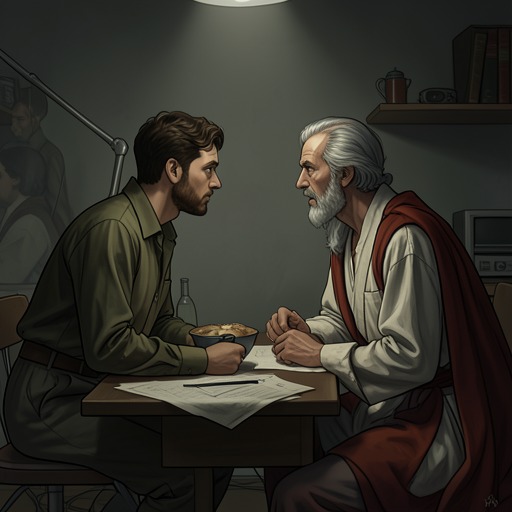
Being and NothingnessThe Look names the encounter in which another person’s presence ceases to be merely a probable object in the world and is experienced as a free subject capable of seeing. Through this encounter, a person apprehends being-seen: an irreducible relation that discloses their objectivity, exposes their body as existing for others, and gives rise to reciprocal conflict over freedom and being.
From visible object to subject
A woman approaching, a man passing in the street, or a beggar calling outside a window first appears as an object among objects. But treating the other person as nothing more than an object leaves their existence conjectural. The probability that a visible human form is truly another person points beyond knowledge of a body toward a more basic connection: the possibility of being seen by a subject. The other is not a hidden consciousness sealed behind a perceptible organism; the person’s presence is bound to a world that the observer cannot regard as exclusively their own.
The relation is therefore reversible without becoming symmetrical in any simple sense. The other is apprehended as a subject through the observer’s own possible objectification, not by extending a line of sight across the landscape until it reaches the observer. An object cannot look at an object. For the other to escape object-status, a radical conversion must occur: the observer discovers that a subject may see them, and that this possibility is not deduced from the observer’s own subjectivity. Being-seen is not a secondary sign attached to the idea of another person; it is the irreducible relation that makes the other’s object-like appearance intelligible.
The look and the disrupted world
The Look does not require eyes to be visibly fixed on someone. A rustle in branches, a footstep followed by silence, a shutter opening slightly, or a curtain moving can occasion the apprehension of a look. For men crawling through brush during an attack, even a white farmhouse outlined against the sky on a small hill can function as an eye. Such signs remain uncertain as evidence of a watcher, but the experience they occasion is not simply a judgment that someone is probably present. It is the immediate awareness of vulnerability: of having a body that can be hurt, occupying a place from which there is no escape from exposure.
When the look is apprehended, visible eyes lose their ordinary role as objects of attention. They may remain perceptible, but they are neutralized: attention no longer examines their color, beauty, or ugliness. The look is present without distance and yet holds the person at a distance, displacing them into an existence they cannot inspect from within. Seeing and being-seen cannot occupy the same experiential foreground. Perception organizes a world as something looked at; apprehending the look instead means becoming conscious of being looked at, as the perceived world recedes.
The keyhole and the arrival of shame
The keyhole example makes the change concrete. Moved by jealousy, curiosity, or vice, a person presses an ear to a door and peers through its keyhole while alone. In non-thetic self-consciousness, there is no separate self standing back to judge the act. The person is absorbed in what is to be seen and heard; the door and keyhole appear at once as instruments and obstacles, to be handled carefully. The act has its immediate justification in the possibilities toward which the scene directs attention.
A noise in the corridor changes the structure of the scene. The watcher is no longer alone in the relevant sense: the possibility of being discovered makes the act appear as something for another person. The self is encountered as an object whose meaning lies beyond its own reach, and shame arises with the recognition of the act under another’s possible view. The look thus does not merely add an observer to an otherwise unchanged world. It alters the person’s relation to their own conduct, revealing an exterior meaning that cannot be made wholly one’s own.
Objectification and the body for others
The Other is not an object in the phenomenon of the look. To turn the other into an object is instead a defence: objectification can relieve the pressure of being-for-the-other by attempting to make the other exist for oneself. Yet the look’s disclosure remains a concrete encounter, not an abstract condition or a universal consciousness inferred behind appearances. The experience that one is an object for some subject is certain in the encounter, while the identity of the particular watcher and the precise way one is singled out within a group remain matters of probability.
This encounter also reveals the body in a new dimension. A person lives their body as a point of view, but the other’s look discloses that same body as existing outside, as an in-itself for the other. The body becomes the intimate inside’s perpetual outside: its senses and facticity are apprehended elsewhere, from viewpoints the person cannot occupy. This is not knowledge that can be derived from the person’s own existence; it is a factual necessity disclosed by the other’s contingent presence. The person is responsible for this being-there-for-others without being its foundation.
Alienation, recovery, and conflict
Under the other’s look, the person’s flight toward possibilities is fixed from outside. What remains open and unfinished for the person is apprehended by the other as a given being, a flight already visible and contemplated. This objectivity is alienating: it cannot be transcended or known as though it were simply another of the person’s own possibilities. The look holds the secret of what the person is for someone else, while leaving that externally conferred being beyond their control.
That division motivates opposing projects. A person may try to deny the being conferred from outside by turning the other into an object in turn. Or they may try to recover their own being by appropriating the other’s freedom without destroying its character as freedom. The second project is no less bound to the other: recovering oneself would require absorbing the freedom that establishes one’s being as an object. Neither attitude begins after an otherwise solitary self has been formed; both arise with the original encounter.
The resulting relation is reciprocal and moving. As one person tries to escape the other’s hold or to enslave them, the other likewise tries to escape or dominate. The Look therefore grounds conflict not as an occasional breakdown between independent individuals but as a basic meaning of being-for-others. The encounter makes another person’s freedom both the source of an otherwise inaccessible self and a threat to any attempt to possess that self completely.