Baby Monotonous dolls
Big BrotherBaby Monotonous dolls are customized pull-string caricatures that transform a person’s repeated sayings and habits into a comic performance. What began as Pandora Halfdanarson’s handmade joke about her husband, Fletcher Feuerbach, became a thriving business built on a deliberately double-edged formula: affectionate intimacy delivered through ridicule. The dolls make repetition audible and visible, then sell that recognition as both entertainment and a substitute for therapy.
Origin and Construction
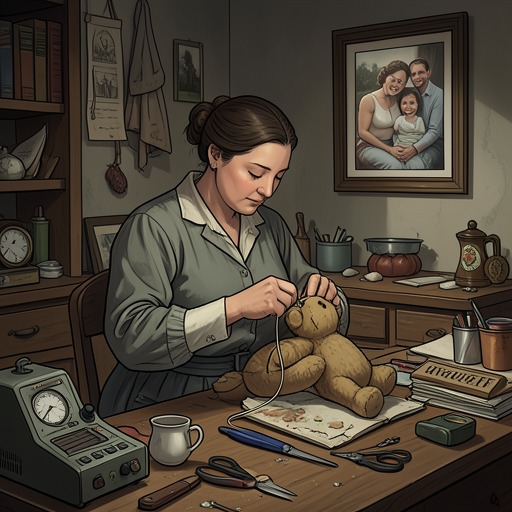
The first doll took shape four years before Pandora’s account of it, when Fletcher had embarked on a sudden health kick and stopped eating her celebrated manicotti. Pandora sewed the figure from scratch as a Christmas present and as a way to keep her humor about the new distance between her cooking and his diet. The project was initially a whimsy, but its specificity gave the joke force: the doll reproduced not an abstract nag, but Fletcher’s recognizable dress, manner, and household decrees.
Its clothes were a miniature version of Fletcher’s standard black fleece, decorated with glued-on sawdust to imitate the dust he carried from his work. The doll wore stovepipe black jeans and calf-high leather boots made from the tongues of an old pair of Fletcher’s boots, with a retread strip from a truck on Highway E36 for soles. Paperclips became wire-rim glasses; a permanent disapproving scowl was stitched into its forehead. One hand held a jeweler’s screwdriver standing in for a chisel, while the other clutched foam rubber that Pandora had to explain was tofu. Even as the fabric began to fray, keeping the mechanism working remained a matter of professional importance.
The doll’s recorded voice was supplied by Pandora’s best friend, Oliver Allbless, who could mince his tones into Fletcher’s huffy, judgmental cadence. A small electronic device in the torso contained twenty edicts and exclamations. The recordings made the object more than a likeness: pulling its string could bring Fletcher’s familiar judgments back into the room in someone else’s voice, converting the annoyance of repeated household rules into a joke the family could share.
From Family Joke to Business
The children took to the Fletcher doll immediately. Its recordings of their father’s oppressive decrees helped endear Pandora to her stepchildren, while Fletcher himself accepted the teasing in good humor and was touched by the scale of her effort. He even engaged Oliver to develop updated digital technology. Dinner guests also enjoyed pulling the string, making the doll’s private family satire a repeatable social performance.
The idea expanded through another domestic irritation. The following year, Pandora’s sister Solstice asked for a caricature of her new boyfriend, whose repeated phrases, including “Good to go!” and “That’s my bad!”, had begun to wear on her. Pandora hesitated because she was still running Breadbasket and understood that a successful doll would need to capture the boyfriend’s build and habits as well as his speech. Solstice offered to pay; Pandora named a price high enough to discourage her, but Solstice sent photographs and a list of phrases that very day. The request showed that the Fletcher doll’s appeal could be reproduced: its subject did not have to be a husband, and its material did not have to be a single family’s private jokes.
Internet word of mouth carried the customized pull-string dolls far beyond the household. By the end of that year, Pandora had folded Breadbasket, and Baby Monotonous had its headquarters outside New Holland and a full-time workforce. Fletcher’s goading misnomer led some locals to believe the company was really called Baby Moronic. The dolls were costly to make and cost customers roughly as much as a KitchenAid mixer and a top-of-the-line Dyson combined. Their high price was part of their appeal: they became status items, and Pandora observed that they would not have been so popular if they were cheap.
Customization, Competition, and Repetition
At the company warehouse, Pandora explained to Edison Appaloosa that the product’s success rested in part on competition among customers rather than between companies. Buyers tried to outdo one another in wit or crudity. Some commissioned male dolls that did nothing but burp, snort, sneeze, hawk, and spit; one wanted a doll that would stink when it farted, a feature the company could not technically provide. The range of requests pushed the caricature past speech into bodily performance, while still making the customer’s chosen target recognizable through exaggeration.
Pornographic orders also became a substantial enough category that Pandora had to decide whether to accept them. Their volume eventually made the decision seem less exceptional: she reasoned that a wife’s choice to give her husband an obscene doll was not for her to judge. The business’s method depended on letting customers decide which repeated traits deserved the spotlight, from a catchphrase to a deliberately grotesque bodily habit. The same structure could accommodate affection, mockery, or both at once.
Pandora described the dolls as a form of branding built from the phrases people use without noticing. Her account linked their commercial premise to an everyday blind spot: people often fail to hear their own repetitions until someone makes them conspicuous. A doll could therefore function as a comic mirror, turning unconscious verbal habits into a signature recognizable to others. The joke was not simply that a person said the same thing too often; it was that repetition could become a personal mark, valuable enough to package and sell.
The Doll as Mirror and Family Performance
The dolls’ humor could also make uncomfortable habits newly visible. During dinner, Pandora imagined an Edison doll after hearing her brother speak about jazz and explain his belief that being white disadvantaged him in the field, especially in Europe, where he felt musicians had to look the part. Her imagined script condensed his self-presentation into two claims: “I’d have been famous, man, if only I was black!” and “I’ve played with some heavy cats.” The imagined doll did not become a documented product, but the scene shows how the form could turn Edison’s recurring account of his musical identity into a pair of instantly repeatable lines.
When Edison visited the warehouse, he saw that customers’ dolls could repeat things their subjects said in ordinary life. He complained that a line attributed to a cat in a photograph was something the cat said all the time. Pandora wondered whether she felt hurt that he had neither read her interviews nor looked at her website, but instead felt more sorry for him. His response exposed the gap between the doll’s public, playful mechanism and the personal recognition it could provoke: a repeated phrase might seem obvious to those around its speaker while remaining unacknowledged by the speaker himself.
Pandora presented the dolls as inexpensive therapy by comparison with the cost of the objects themselves. Their recorded repetitions could show people what they habitually said, while their comic exaggeration made that recognition bearable. The business thus depended on a tension already present in the original Fletcher doll: ridicule was the instrument, affection the condition that allowed it to work. In the family, the doll helped make a stepmother’s teasing legible as intimacy; as a product, it made private recognition into a costly, competitive public novelty.
The Original Doll’s Last Joke
The Fletcher doll remained active in the household long after its fabric began to wear. During a later exchange about toast, the third pull of its string produced its demand for dry toast, repeated with sanctimonious emphasis. Cody and Tanner collapsed laughing. The line returned the doll to its original function: it gathered Fletcher’s dietary seriousness into a precise, familiar refrain, then let the children enjoy the contradiction between the solemn recorded voice and the ridiculous persistence of the demand.
That final pull also clarifies why the company’s formula could endure beyond its first family joke. The doll’s mechanism did not need to invent a new personality; it needed to preserve a recognizable one, complete with its rules, phrases, and irritations. Its success joined material craft, recorded voice, and social recognition. A fraying handmade toy whose mechanism still worked became the prototype for a full-time business, and a joke about one husband’s health kick became a method for making people hear themselves as others did.