Boomerang chair
Big BrotherThe Boomerang chair is a sculptural piece of furniture made by Fletcher Feuerbach, whose elegant, carefully bent wooden frame embodies both his skill and his confidence in his work. It is also a touchstone: a physical reminder that he has made something worth believing in. When Edison Appaloosa breaks it after sitting on it, the chair’s damaged curves bring into view conflicts the household had tried to keep implicit—Edison’s weight, Fletcher’s unspoken ban, and the difference between holding someone responsible and humiliating him.
Design and Personal Meaning
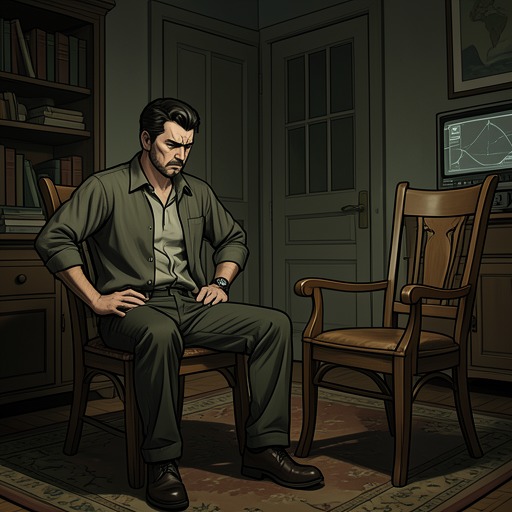
The chair was among Fletcher’s earliest creations, and it remained Pandora Halfdanarson’s favorite even as her husband’s newer furniture displaced most of the department-store furnishings from their combined household. Its red leather cushion is oval. The rail that joins the arms and back rises high on the right, then descends on the left until that arm nearly reaches the floor, giving the whole piece the appearance of something hurled through the room. Its supporting slats repeat the design’s motion in curved lines of laminated Macassar ebony, rosewood, and maple. Fletcher soaked the wood for a week to make it bend.
For Fletcher, the chair carried more than decorative value. Pandora understands it as a talisman: the early proof of a practiced ability, an object he can turn to when a later effort falters. Its particular significance lies in being something he made once and made well. Pandora, who values process more than finished products, has no comparable object to hold up as proof of achievement; completion, for her, is often the least satisfying part of making something. The chair therefore marks a difference between the siblings-in-law as well as Fletcher’s attachment to his own work.
The Chair in the Household
Fletcher’s furniture gives character to a house Pandora otherwise values for its blankness and functionality. She describes his creations as so lithe they seem to have been grazing on the throw rugs; their curved corners and prancing legs make them seem almost animate. The Boomerang is the most striking instance of that style, a piece whose distinctive silhouette makes it difficult to treat as interchangeable household equipment.
That appearance of lightness coexists with a practical limit. Fletcher had expressly told Edison not to sit on the pieces he made, describing them as designed for normal, halfway disciplined, halfway intelligent people. Pandora had not known that her husband had imposed this restriction. Trusting the furniture’s robust construction, she had avoided telling Edison that his weight might make it unsafe for him. The chair’s later break thus exposes a rule that existed in the household but had been concealed from the person most directly affected by it.
Breakage and Confrontation
Fletcher discovers the damage while holding a sketchpad. The Boomerang is only subtly out of alignment, but its visual order has been interrupted: three back slats no longer curve upward evenly, and the top rail jerks into a new angle with a splinter fraying from it. Because the slats are laminated, they have fractured unevenly and are cracked almost all the way through; the rail is split along roughly six inches. The chair that once seemed to sweep through the room now makes the failure of its material unmistakable.
Cody joins Pandora beside the chair, rests her cheek on its red leather seat, and calls it almost a member of the family. She asks whether her father can repair it and says that her friends think it is wonderful. Fletcher refuses to be soothed by compliments. He says he had warned Edison not to sit on his furniture. Pandora realizes that her earlier confidence in the pieces’ sturdiness had spared her an awkward conversation, but not the underlying problem: she had never told her brother that his body might put the chair at risk.
At first, Edison denies having anything to do with the damage. Fletcher points out that the chair had been left propped together: the slats had been drawn back into place and the railing pressed into position. He believes Edison concealed the break because he feared admitting that his weight had damaged a piece Fletcher valued. Edison eventually offers to get repair materials, but Fletcher demands an apology that names the humiliation beneath the accident. In response, Edison turns the demand into a fierce self-indictment, describing himself as an enormous, useless burden and listing the parts of his body he despises. The chair’s damage has become the occasion for his shame to spill out in front of the family.
Repair, Responsibility, and Significance
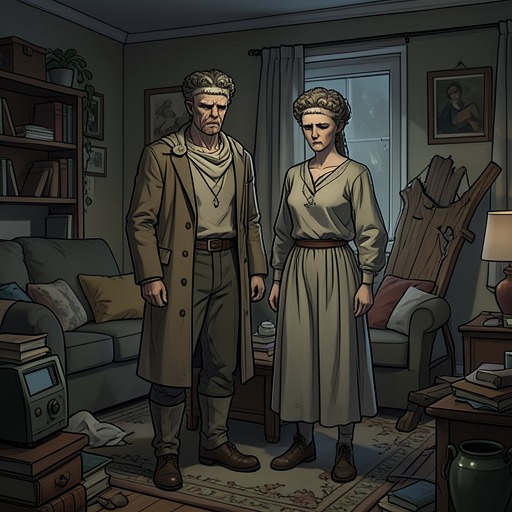
Edison leaves the house in distress, and Cody follows him. Pandora goes after them with their coats. When they return, the Boomerang has been wrapped in yellow packing tape, its temporary bandage making the living-room object look like a crime scene. Fletcher has gone to the basement. Pandora brings him back by arguing that the standoff is unfair to her, then seats him and Edison at opposite ends of the dining table to talk through what happened.
Edison offers a guarded, hypothetical admission: it is barely possible that he sat in the chair by mistake, and he may dimly remember hearing a crack. Fletcher remains unconvinced by the carefully qualified apology. He asks whether Edison understands what that particular piece means to him. Pandora argues that Edison’s fear of telling him about the damage suggests he did understand its importance, though she recognizes that this interpretation is uncertain. Fletcher eventually apologizes for calling Edison fat, but the exchange does not settle whether Edison’s conduct should be treated chiefly as an accident or as an injury to the household.
The argument broadens into a dispute about who is being made responsible for what. Fletcher complains that Edison eats them out of house and home and has smashed the furniture, while Fletcher himself is criticized for exercising too much. Pandora rejects the moral framing of weight and exercise: Edison’s weight has serious social and health consequences, she says, but it is not evil, just as exercise does not make Fletcher morally good. At the same time, she does not deny that Edison’s actions have affected the family. The broken chair gives both sides a concrete object around which to argue about care, limits, and blame.
Fletcher thinks the slats may be repairable, but recreating the upper hoop from a single piece of wood is another matter; he is unsure he has the heart to do it. He distinguishes making the chair once as an act of love from making it again as drudgery. Pandora asks him either to repair it or to dismantle it for other work, but not to leave it in the living room as an accusation. The object’s future is left unresolved: repair remains possible, but the original cannot simply be restored by deciding that it should be.
The Boomerang also remains present in later family conflict. When Edison accuses Pandora of sending a birthday photograph to her father-in-law as payback for the chair, he equates the furniture’s destruction with an attack on his dignity. His accusation shows how completely the chair has become bound up with the painful encounter: for Fletcher it is an irreplaceable expression of skill, while for Edison it recalls being judged and shamed for his body. Its breakage turns a domestic object into a contested measure of value—of craftsmanship, of responsibility, and of the cost of making someone’s weight the explanation for everything that goes wrong.