Cedar River
Big BrotherThe Cedar River gives the 2008 flood-relief episode its physical force and its limit: volunteers stack sandbags along its banks and protect downtown buildings, but the river keeps rising, and much of their work proves ineffective. Through Pandora’s retrospective account, the water becomes both a public catastrophe and the setting for a brief, unexpectedly buoyant period of service in which Edison’s own experience of loss allows him to console others.
Flood and Emergency Response
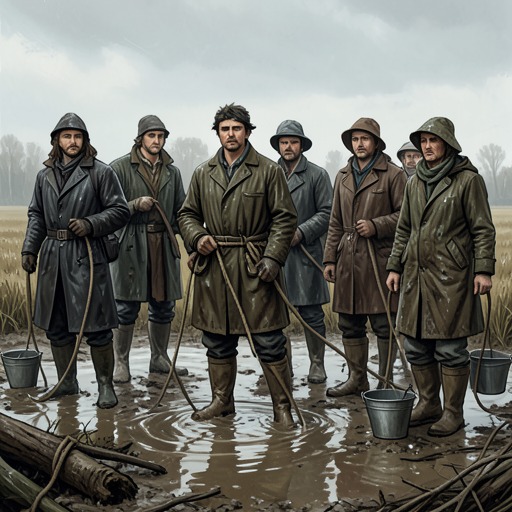
For five solid days, volunteers worked around the clock to pile sandbags along the Cedar River and at the entrances of downtown businesses. They also relayed stacks around the Cedar Rapids Public Library, where another group packed books for transfer to the second story, and fortified Mercy Medical Center’s ground floor to protect generators in its basement. The effort was practical and immediate: keep water out, move what could be saved, and shield essential equipment as the river advanced.
The response soon outgrew the available work. Pandora and Edison were grateful to have joined early; after KCRG called for volunteers, the station had to ask additional would-be helpers to stay away. The episode distinguishes the disappointment of people turned back from the broader spirit of the mobilization: those who had made it through the rain to help generally worked with good humor, and Pandora remembers the collective labor as unusually sociable and energizing.
The River’s Reach
The river’s rise exposed the uneven geography of the flood. New Holland stood on higher ground, though multiple basements filled with water; Pandora and Edison’s apartment at Prague Porches was on the second floor, leaving Edison’s upright piano out of danger. In Cedar Rapids, by contrast, the flooding reached far beyond the volunteers’ immediate work sites. The flood was described as the worst in Iowa on record, a disaster on a scale the state should expect no more than once in five hundred years.
On June 13, the Red Cross and National Guard decided the volunteers had done what they could and that it was time to leave. Pandora and Edison felt crushed by the dismissal and did not want to stop. From home, where they had electricity unlike many residents they had been forced to leave behind, they watched news footage as the river crested. The images registered the scale of the inundation: rooftops appeared like lily pads, the island holding Cedar Rapids City Hall was completely submerged, and the roof of the library they had helped protect barely rose above the water. Street signs protruded just above the surface, making submerged roads look like streets in Atlantis. Pandora concludes that most of the sandbagging had done no good.
Edison Among the Displaced
Flood relief also brings Edison into contact with people whose possessions have been lost. Workers relocated to Prairie High had often managed to rescue photographs and a change of clothes, while furniture, electronics, and wardrobes were written off. Pandora recalls volunteers breaking down in the middle of a sandbag relay at the thought of a particular lost object, such as a quilt inherited from a great-grandmother. Many of those displaced had no flood insurance because the river had reached neighborhoods not previously considered part of the flood plain.
Edison could speak to that loss from experience. He told displaced residents that he had once lost everything he owned except a few ill-fitting clothes and an old computer. Rather than presenting the loss as uncomplicated, he offered a consoling account of its possibility: letting go of possessions could make a person lighter and open the chance to become someone different. The sandbag he hefted as he spoke made the metaphor concrete. The river was destroying people’s homes and belongings, but in this encounter Edison’s history of dispossession became a means of comfort rather than a mark of shame.
Work, Appetite, and Ordinary Pleasure
The flood effort also changes the terms of Edison and Pandora’s weight-loss routine. Edison initially measured smoked turkey for his packed lunches; when the sandwich meat ran out on the third day, a grateful local business brought pizza to the volunteers at the end of their shift. Edison was horrified at the prospect of eating it. Pandora, acting as his coach, told him he had expended fifteen hundred calories shoveling sand and ordered him to eat. The thin-crust pizza differed from the New York-style pizza he usually preferred, yet he later called it the best pizza he had ever eaten. In this setting, eating is not framed as a breach of discipline but as sustenance after strenuous work.
The volunteer work also makes room for an unexpected social encounter. Over the pizza, Edison invited a younger woman who had filled sandbags with him back to the apartment for coffee. Pandora, who had stopped thinking of her brother as sexual since his weight gain, failed to recognize that the invitation was a date and lingered in the living room until she realized the pair wanted privacy. The scene briefly counters the image of Edison as only an object of concern or care: alongside his work and his comforting words, the river brings him into a tentative connection of his own.
Narrative Significance
In Pandora’s account, the Cedar River joins large-scale loss to the intimate calculations of family life. The flood’s material damage cannot be contained by the volunteers’ effort, yet the work offers a temporary experience of usefulness, companionship, and shared purpose. Its ending is deliberately mixed: the river crests after the volunteers are sent away, and most of their sandbags fail, but Pandora remembers the labor as a summer in which she and Edison were glad to have taken part.
That memory also sharpens the book’s recurring uncertainty about what can be controlled. Pandora and Edison can organize their daily routines and exert themselves together, but they cannot command the river’s course; nor can Pandora later reduce her obligations to Edison to a neat limit. The flood does not resolve those tensions. It gives them a vivid landscape in which effort matters even when it cannot guarantee success, and in which Edison’s own losses can make him, briefly, a source of steadiness for people facing losses of their own.