Creation of Baby Monotonous
Big BrotherBaby Monotonous was founded when Pandora Halfdanarson turned a private family joke into a customized pull-string doll business. Its first product, a handmade caricature of her husband Fletcher Feuerbach, joined affectionate mockery to a working voice mechanism; with help from her friend Oliver Allbless and Fletcher’s encouragement, that domestic craft grew into a viral company with a full-time workforce outside New Holland.
From family joke to first product
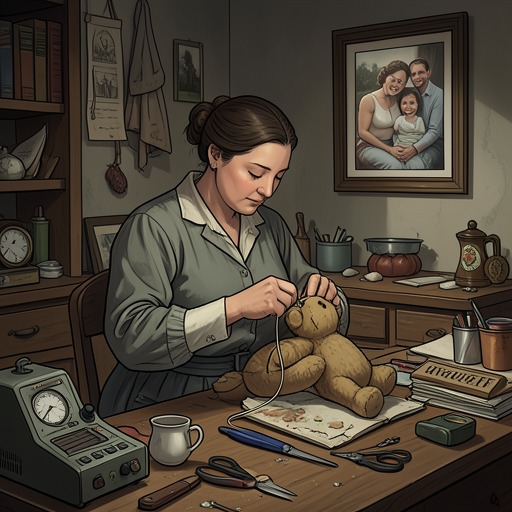
The company’s origin lay in a period when Fletcher had abruptly adopted a health-conscious diet and stopped eating Pandora’s celebrated manicotti. She made a pull-string doll of him as a way to preserve her sense of humor about the change. The first doll was sewn from scratch as a Christmas present four years before the family scene in which their thirteen-year-old daughter Cody played with it. At the outset it was a whimsy, not a business plan.
Its design made the teasing unusually specific. The ragamuffin wore a miniature black fleece like Fletcher’s, with glued-on sawdust standing in for the dust that marked his work. Pandora built its stovepipe jeans and leather boots from salvaged materials, made wire-rim glasses from paperclips, and stitched a disapproving scowl into its forehead. One hand held a chisel represented by a jeweler’s screwdriver; the other clutched foam rubber that Pandora had to explain was tofu. The doll’s fabric began to fray, but its pull-string mechanism remained important enough that keeping it functional became a matter of professional concern.
Voice, affection, and the family audience
The doll’s speech drew on Fletcher’s familiar pronouncements. Pandora had involved Oliver Allbless in the joke from the beginning, and he supplied the recorded voice, skillfully delivering its twenty edicts and exclamations in a fussy, judgmental tone. Fletcher’s familiar authority was thus made audible in miniature, a performance the children could summon by pulling a string.
The children embraced the doll, and its mocking recordings helped make their father’s household decrees a source of amusement and helped endear Pandora to her stepchildren. Fletcher, for his part, took the teasing in good humor and was touched by the effort involved. His response was not simply to tolerate the joke: he engaged Oliver to develop updated digital technology for the doll. That technical improvement mattered because the older mechanisms of Chatty Cathy dolls, driven by governor belts, plastic records, and turntables, were prone to breakage. A handmade object’s durable comic effect depended on keeping its voice alive.
Cody’s piano practice and the doll’s repeated use sit side by side in the family scene: she had abandoned the instrument to pull the string. On its third turn, the doll demanded dry toast in an exalted, sanctimonious voice, and Cody and her brother Tanner collapsed laughing. The joke could be repeated, but it did not depend on exact repetition alone; the family’s recognition of Fletcher’s manner gave each performance its charge.
From commissions to a company
The following year, Pandora’s sister Solstice asked for a similar caricature of her new boyfriend, whose repeated catchphrases were irritating her. Pandora hesitated because she was still running Breadbasket and because a convincing doll would require capturing the boyfriend’s build and clothing as well as his speech. Solstice offered to pay. Pandora named a price high enough that she expected to discourage her sister, but Solstice promptly emailed photographs and a list of the boyfriend’s pet phrases.
That request shifted the doll from a one-off family creation toward a reproducible service: customers could supply the details that made a caricature personal. Word of mouth, amplified by the Internet, carried the customized dolls far beyond family and neighborhood circles. By the end of that year, Pandora had folded Breadbasket and Baby Monotonous had established its headquarters outside New Holland with a full-time workforce.
The brand name itself carried a joke. Fletcher goaded Pandora with a misnomer, and some locals consequently believed the company was really called Baby Moronic. The company’s appeal, however, rested on a clearer formula: ridicule paired with affection. The dolls made mockery marketable without stripping it of intimacy, because their targets were rendered through the particular voices, habits, and appearances that their makers knew.
Price, labor, and significance
Baby Monotonous dolls were expensive to make and more expensive to buy. Their price was compared with the combined cost of a KitchenAid mixer and a top-of-the-line Dyson, and they became status items whose owners considered them more rewarding than an ordinary vacuum cleaner. The high price was part of the product’s social meaning: it was a costly, customized object whose appeal depended on its specific likeness, not merely on its function as a talking toy.
The company’s growth also marked a change in Pandora’s working life. She moved from running Breadbasket to building a full-time operation, turning a domestic craft—sewing a doll, recording familiar sayings, and refining its mechanism—into paid production. The transition contrasts with the assumptions of exceptional success that Pandora later questions in her brother Edison Appaloosa and, by extension, in her son Tanner Feuerbach. Her reflections stress that sustained work, including less celebrated labor, is what achievement often requires; Baby Monotonous’s beginnings make that labor visible in practical terms, from salvaged materials and technical repairs to the workforce that followed the business’s sudden popularity.
The company’s origin therefore preserves the household scale of its invention even as the business expands. Its first doll was not conceived as a neutral toy or a generic novelty: it took shape from a marital dietary change, a wife’s effort to keep her humor, a friend’s performance, and a husband willing to help improve the mechanism. Baby Monotonous’s commercial formula grew out of that close attention to domestic character, making affection and ridicule mutually sustaining rather than opposites.