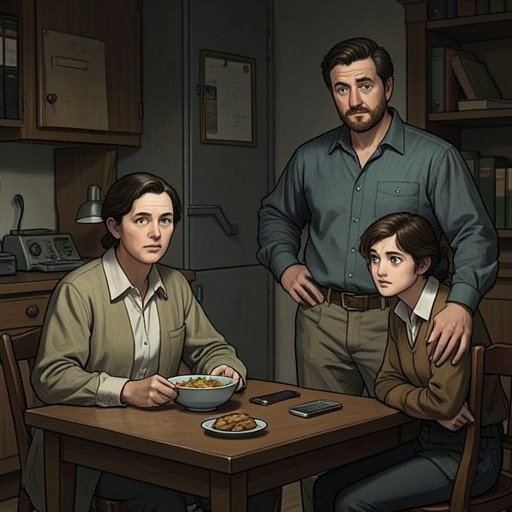
Edison’s depression
Big BrotherEdison’s depression is presented not as a diagnosis but as a recurring condition of diminished pleasure, hopelessness, and isolation that shapes how he eats and how he experiences the effort to change. The narrator fears that his overeating may be more than compensation or concealment: it may be a slow, purposive movement toward death. Later, Edison’s admission that he is unsure anything besides eating can give him pleasure makes that fear part of a broader account of a life in which even ordinary satisfactions seem scarce.
Signs of Despair and Diminished Pleasure
When the narrator asks why Edison has felt compelled to invent stories, he explains that arriving in Cedar Rapids and announcing that he has come to stay for the rest of his life would have been impossible. The exchange turns from his concealment to the reasons behind his eating. The narrator names eating as a possible way to compensate, forget, or hide, and warns that he cannot continue this way. Edison replies that perhaps he does not want to. The answer is left unresolved: the narrator hopes he means he does not want to keep eating himself toward death, but fears instead that the eating is purposive, a slow-motion suicide-by-pie. The passage makes depression legible through uncertainty rather than a settled explanation of his intent.
Another moment identifies the emotional emptiness behind eating without presenting food as a source of lasting happiness. When the narrator asks what else Edison enjoys, he slumps and admits that, at this point, he is not sure there is anything else. The narrator sees this as the heart of the matter: eating may not be especially pleasurable, but it can still outshine everything else that feels decidedly less than pleasurable. Her reflection widens the siblings’ problem into a question about how people live when the available sources of enjoyment have narrowed to a doughnut or a meal.
Weight, Work, and Social Erasure
Edison describes his life as being weighed down by his body and compares his circumstances with the narrator’s apparent success. His account links physical burden to a deeper conviction that other people no longer notice him. The narrator challenges the idea that their worth should depend so heavily on what others think, but Edison answers that people do not think about him at all these days. This sense of social disappearance has a concrete professional counterpart: when he tried performing under the name Caleb Fields, some audience members left, expecting instead to see Sinclair Vanpelt. The anecdote presents lost recognition not as an abstract fear but as a public mismatch between who Edison is now and the performer audiences expected.
The narrator’s own effort to keep him going relies partly on concern for the dangers his weight poses. In the first days of their diet, hunger makes time drag and gives the days a gray quality. She questions whether she needs to lose weight at all, but Edison’s health keeps the stakes before her. She recalls the doctor’s warning that he had no old, fat patients. Their mutual dependence is implicit in the narrator’s conclusion that Edison helped her endure the diet just as she helped him endure it. Depression thus appears within a relationship of care: her concern is not merely an argument for discipline, and his presence is not merely the object of her responsibility.
Restriction, Solidarity, and Strain
The siblings’ liquid-diet project briefly offers Edison a sense of shared purpose. After the narrator recognizes ketosis, they celebrate it as the moment their bodies have resigned themselves to eating at home. Edison becomes less resentful and admits to having more energy than when he was overeating, though he refuses to compare the highs of ketosis with heroin. On walks, he and the narrator imagine themselves set apart from people indulging in fast food, and they pass KFC without temptation. Their feeling of invincibility and special power is real within the experience, but it rests on strict deprivation and a new hierarchy in which resisting food becomes a source of superiority.
The celebratory mood does not establish recovery. The narrator also describes black days when she resents the household mess, her employees, and Edison himself, particularly when his cheerfulness irritates her. The diet is therefore a shared undertaking that can produce solidarity while intensifying strain. Its temporary rewards—energy, resolve, and the feeling of being on the same side—do not erase the underlying question of what either sibling enjoys beyond food or what can sustain them when discipline falters.
Physical Decline and the Limits of Control
As the six-month mark of Edison’s liquid diet approaches, the narrator sees a troubling change. His earlier robustness has ebbed; he becomes shorter of breath, his hands tremble at the piano, and his concentration falters at work. On one occasion he stitches the finished side of the fabric facing out. These signs lead the narrator to wonder whether the all-liquid regimen can continue, even though it has been organized around the hope of weight loss and improved health. The effort to control eating has become another condition that may damage the daily life it was meant to improve.
The narrator’s response is divided between protecting Edison and trying to preserve the household’s fragile arrangement. After weeks of rain, a forecast sunny Sunday gives her reason to worry about leaving him alone. He rarely brings anyone home, in part because his diet is antisocial, and the private refuge the siblings share has become a central feature of their life together. She also recognizes that the long period on four envelopes of powder may be unsustainable. Yet rather than resolve the conflict, she invites him on a bicycle ride that was intended as time with Fletcher. Edison eagerly oils the chains, pumps the tires, and buys picnic ingredients. His enthusiasm sits beside the narrator’s concern that his renewed strength has ebbed, leaving depression entangled with isolation, restrictive eating, physical symptoms, work, and the difficult obligations of family care.