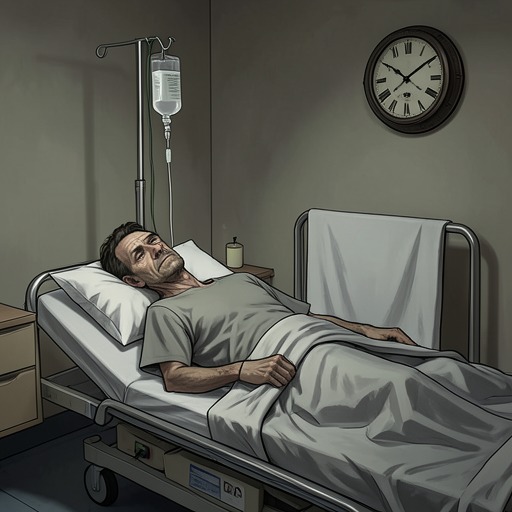
Edison’s prediabetes
Big BrotherEdison’s prediabetes is disclosed during a medical consultation that turns concern about his weight into a discussion of measurable health risks and a severely restrictive diet. The diagnosis helps authorize intervention, but the narrative does not treat it as a single explanation for his condition: Edison’s health, mood, eating, and circumstances remain entangled.
Clinical Disclosure
At a joint appointment with Dr. Corcoran, Edison learns that he is prediabetic. The doctor also reports elevated blood pressure, fluid retention, reduced lung capacity, and heightened risks associated with Edison’s body mass index, which is over fifty-five. The consultation frames prediabetes as one item in a cluster of concerns, rather than an isolated condition.
Pandora interrupts the accumulation of warnings to ask whether Edison is well enough to undertake a severely restrictive diet. Dr. Corcoran says probably, adding that medication can lower his blood pressure and that Edison’s heart is in better shape than expected, though he remains a strong candidate for cardiovascular disease. His answer offers qualified permission, not an assurance that the plan is harmless.
Diagnosis and the Diet Plan
Pandora proposes beginning at five to six hundred calories a day, with a later increase to eight hundred and then twelve hundred. She argues that Edison’s size makes ambition necessary; when she asks his weight, Dr. Corcoran first looks to Edison for permission. Edison responds that it is not a state secret, making the measurement a matter he can consent to disclose rather than merely a number announced by the doctor.
The scene shows how clinical language and measurement help convert worry into a program of action. Yet Pandora had already wondered whether describing obesity as an illness was useful. The diagnosis therefore does not settle what the problem means: medical classification makes risks legible and helps enable treatment, while the narrator remains unsure that a label can explain or resolve the wider predicament.
Risks and Lived Experience
The prediabetes diagnosis sits within a narrative that repeatedly links health concerns to eating and weight without reducing one to the other. Later, during the diet, Edison and Pandora experience a period of increased energy and resolve, but the account also records the strain of severe restriction. Months into the liquid-diet plan, Edison is shorter of breath, his hands tremble at the piano, and his concentration falters at work. These developments complicate any simple equation between discipline and recovery.
The narrative also leaves open the direction of causality between Edison’s emotional state and his body. Pandora cannot determine whether he is fat because he is depressed or depressed because he is fat. Near the end, she describes his life as having moved from excitement and ascent into a discouraging spiral, in which food offered an immediately available gratification. That retrospective account broadens the frame beyond clinical diagnosis, without claiming that prediabetes alone explains his trajectory.