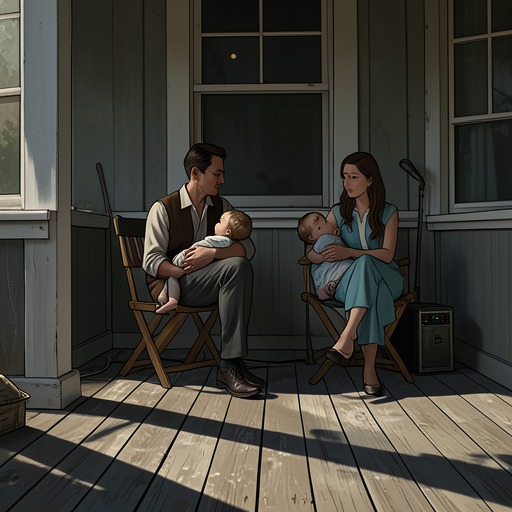
Fletcher and Tanner’s Father–Son Relationship
Big BrotherFletcher and Tanner’s Father–Son Relationship moves between affection, fear, and a struggle over who gets to define Tanner’s future. Fletcher’s alarm at his son’s flight is intensified by the family history Tanner seems to be copying, but the response is not simply to retrieve him: with Pandora’s help, Fletcher accepts that Tanner’s choices are his own and tries to make those choices carry responsibility. The relationship’s eventual turn is modest but consequential: Tanner agrees to finish high school, and Fletcher recognizes that his son saw something clearly about his grandfather that Fletcher himself had not.
Identity and Family Context
Fletcher is Tanner’s father and the parent responsible for him in New Holland. Tanner’s decision to leave does not occur in a vacuum. Fletcher sees it against the example of Travis, whose own departure for California has become part of the family’s inherited story. Tanner has absorbed that history despite failing American History, and he adopts the name Tanner Appaloosa, judging his father’s surname insufficiently commercial. To Fletcher, the gesture makes the escape feel less like an isolated act of adolescent defiance than a repetition of a family script.
The relationship also sits within a household where other attachments compete for attention. Fletcher has already felt displaced by the closeness between Pandora and her brother Edison; during an argument in Edison’s presence, he says that Pandora’s prolonged absence would have consequences for their marriage and accuses her of demonstrating who matters most to her. That conflict does not establish Tanner’s motive for leaving, but it shows the strain around him: parental responsibility and marital intimacy are entangled with the wider family’s demands, and Fletcher is wary of becoming the person left to absorb the cost of someone else’s departure.
School and Flight
Fletcher first tells Pandora that Tanner has quit school, with only two months remaining before graduation. He considers the decision deliberate: Tanner believes he is exceptional and would rather leave just before becoming an ordinary high-school graduate. Two days later, Fletcher reveals that Tanner has left home as well. While Fletcher was downstairs working on a rush commission, Tanner packed his computer and favorite T-shirts but left his cell phone behind, preventing his father from contacting or tracking him. None of Tanner’s friends has heard from him.
The disappearance forces Fletcher into a search for information beyond his immediate household. In desperation, he contacts Cleo, Tanner’s mother, but learns nothing useful beyond the news that she has become born-again. Fletcher’s guess is that Tanner has gone to California, following Travis. He connects that destination to Tanner’s new surname and to the family’s influence: although Tanner has flunked American History, Fletcher believes he has learned the Appaloosa family’s history well enough to repeat it. His worry is thus both practical—his son is gone and unreachable—and interpretive: he fears Tanner is making an identity out of escape.
Fletcher’s Response and Pandora’s Mediation
Pandora proposes a way to redirect Tanner without pretending that his ambition can be dismissed. She suggests that Fletcher give him useful work: organizing Fletcher’s papers and fan mail, arranging scripts, improving the website, and helping with a memoir. Fletcher has wanted to write that memoir, but remains uncertain that Tanner can contribute. He is also under financial pressure. The immediate benefits of Tanner’s arrival in California, he says, have so far gone to Taco Bell and In-N-Out Burger; Fletcher is auctioning Joint Custody memorabilia on eBay, but collectors are offering too little for the props. His concerns about money and his son’s idleness make the proposed work more than a symbolic gesture.
Pandora sends a check in exchange for one favor: Fletcher must put Tanner on the phone. Tanner’s surly response makes clear that he has been made to speak, but Pandora uses the call to frame the opportunity as an internship rather than a rescue. She tells him to take Fletcher’s knowledge of television seriously, learn the ropes, meet his contacts, organize files, and possibly interview Joint Custody actors and producers for the memoir. The terms are deliberately plain: interns work hard and long hours without pay, and the reward is experience. In this way, Pandora does not ask Fletcher to abandon his hopes for Tanner; she helps translate them into work Tanner might accept.
Autonomy, Conflict, and Reconciliation
Tanner asks about his father, anticipating that Fletcher will come to California and drag him back to New Holland. Pandora says she will try to hold Fletcher off, while acknowledging that Tanner would probably leave again if forced home. She then tells Tanner that both parents love him, understand that his life is his to direct, and want him to succeed at what he chooses. Her immediate relief is that he is safe. She leaves the way home open without making it a condition: if California proves wrong for him, returning would carry no shame. Tanner answers that he will not come back, making clear that he intends to stay and try the path he chose.
Fletcher’s eventual response is not presented as a dramatic reunion or a complete settlement of their differences. When he later tells Edison that Tanner has agreed to finish high school, he adds, “You were right.” Edison notes that this is unusual praise, and Fletcher replies that Edison may hear it more often. The exchange records a change in Fletcher’s stance: he can acknowledge that Tanner’s judgment about Travis was sound, even though Tanner’s departure and contempt for conventional milestones have alarmed him. Tanner’s agreement to complete school does not erase his California ambition; it establishes a point of return between that ambition and the responsibility Fletcher has tried to insist upon.
Significance
The father–son relationship is marked by a tension between inheritance and choice. Fletcher sees Tanner’s flight as an echo of Travis’s, while Tanner’s California plan and adopted surname suggest that he is trying to turn family history into a route toward a future of his own. Fletcher’s first instinct is to read the departure as repetition; Pandora’s intervention helps the family respond to it as a choice that can still be shaped by work, advice, and affection.
The account also refuses an easy equation between parental love and control. Fletcher fears that Tanner is throwing away the last two months of school and may be drifting toward a shallow imitation of family legend. Yet he ultimately allows Pandora to speak to Tanner on his terms, and the prospect of Fletcher’s memoir gives the estranged father and son a possible shared task. Tanner’s decision to finish high school, together with Fletcher’s admission that he was right about Travis, marks a limited reconciliation: neither father nor son wholly yields, but each makes room for the other’s understanding.