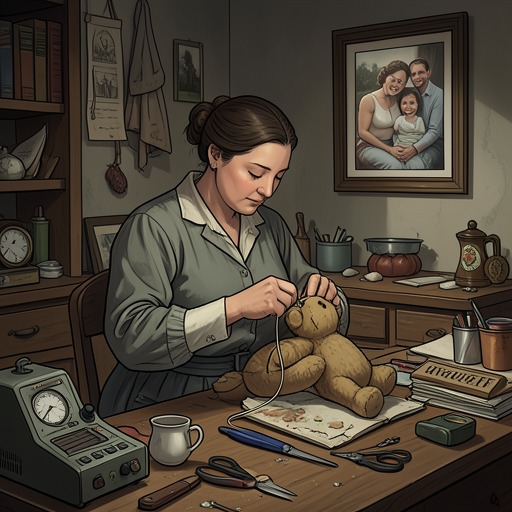
Fletcher doll
Big BrotherThe Fletcher doll begins as a private joke about Fletcher’s sudden health kick and becomes a family fixture, a customized commercial product, and a compact portrait of affection expressed through ridicule. Sewn by the narrator and voiced by her friend Oliver Allbless, it gives Fletcher’s familiar scolding a portable, repeatable form; the same joke that amuses the children and dinner guests eventually helps transform the narrator’s work from Breadbasket into Baby Monotonous.
Design and First Use
The narrator made the first Fletcher doll from scratch four years before the scene in which thirteen-year-old Cody pulls its string. At the time, it was simply a whimsy of a Christmas present, created after Fletcher abruptly embraced a health-conscious diet and stopped eating the narrator’s celebrated manicotti. The joke helped the narrator keep her humor about that domestic change. Cody abandoned her piano practice to tug the doll from its place on the dining area’s middle shelf, where it stood ready to be used to razz her father.
The doll’s appearance translates Fletcher’s habits into a meticulous miniature. It wears a small version of his standard black fleece, decorated with glued-on sawdust to reproduce the dandruff-like dust associated with his work. Its stovepipe black jeans, nearly bald head, and calf-high leather boots echo his usual clothes; the boots were made from the tongues of a worn-out pair of Fletcher’s full-size boots and soled with a strip of retread that had fallen from a truck on Highway E36. Paperclips became wire-rim glasses, a stitched scowl fixed his expression, and a jeweler’s screwdriver stood in for a chisel. The other hand holds a square of foam rubber that the narrator had to explain was tofu. Although the fabric began to fray, keeping the mechanism working remained a point of professional importance.
Voice and Family Performance
The pull-string recordings make the doll more than a visual caricature. The narrator had involved her best friend, Oliver Allbless, in the joke from the beginning, and recorded Oliver’s voice; he proved adept at delivering the lines in a huffy, judgmental tone. Twenty edicts and exclamations were stored in the electronic device inside the doll’s torso. The recorded voice allows the family to replay Fletcher’s familiar pronouncements as comedy, making the doll a crafted imitation of his authority rather than simply a portrait of his clothes.
The children took to the doll immediately. Its mockery of their father’s oppressive decrees helped endear their stepmother to them, while Fletcher himself accepted the teasing in good humor and was touched by the scale of her effort. He even engaged Oliver to help design an updated digital mechanism. The practical engineering behind the joke matters: the narrator contrasts it with the governor belts that powered the plastic records and turntables in old Chatty Cathys, which were prone to snapping. The doll’s electronic voice was meant to keep the performance going, and the narrator’s later insistence that the mechanism still worked shows how its function had become part of the object’s value.
From Household Joke to Business
The Fletcher doll also provides the model for the narrator’s later business. The following year, her sister Solstice asked her to make a similar caricature of Solstice’s new boyfriend, whose repeated use of fashionable expressions irritated her. The narrator hesitated: she was still running Breadbasket, and capturing a person’s build and dressing habits well enough to reproduce them would take work. Solstice offered to pay; the narrator named a price high enough to discourage her, but Solstice sent photographs and a list of the boyfriend’s habitual phrases that same day.
That request helped set a larger process in motion. As word of mouth moved online, the customized pull-string dolls went viral. By the end of that year, the narrator had closed Breadbasket, and Baby Monotonous had established headquarters outside New Holland with a full-time workforce. Fletcher’s goading misnomer led some locals to believe the company was actually called Baby Moronic. The business rested on the same pairing embodied in the original doll: ridicule joined to affection. The dolls were expensive to make and even more expensive to buy, costing about as much as a KitchenAid mixer and a top-of-the-line Dyson. Their high price helped make them status items, regarded by popular acclaim as more rewarding than an average vacuum cleaner.
Recurrence and Significance
The doll’s repeat use keeps its humor rooted in family life rather than in a single punch line. Dinner guests never tired of pulling its string, and Cody’s third pull in the scene yields the doll’s sanctimonious demand for dry toast. Both children collapse laughing. Fletcher, still amused by the object’s persistence, asks why it never stops being funny. The ending returns the doll to the role it first served: a durable instrument for turning his dietary rules into shared amusement.
Its construction also makes the family joke tangible. Sawdust, worn boot leather, paperclips, foam rubber, and a working electronic mechanism convert observations of Fletcher into an object that can be handled, heard, and passed around. The doll’s material wear does not erase its effectiveness; the fraying fabric stands beside the narrator’s concern that its mechanism remain operational. That combination of handmade detail and repeatable performance helps explain how a domestic caricature could become both a cherished family prop and the prototype for a business. The joke succeeds not by separating affection from mockery, but by making the two inseparable.