Prague Porches
Big BrotherPrague Porches is the apartment where Pandora and Edison attempt to reshape their lives through a closely supervised weight-loss plan. Its meaning changes with their effort: what begins as a sparse, clinic-like environment designed to limit temptation becomes a furnished home and record of their shared progress, before the arrangement falters and Edison retreats into isolation.
Setting and Initial Arrangement
Pandora and Edison find the development while seeking a place for Edison to undertake the plan. The landlord, Dennis Novacek, is seriously overweight and quickly bonds with Edison over food. He points out nearby Dunkin’ Donuts and an all-you-can-eat buffet, and the two men discuss Pizza Hut’s garlic-butter stuffed crust. Edison allows Novacek to assume that he and Pandora are married. For Pandora, the apartment’s location and the landlord’s assumptions are part of the awkwardness surrounding a plan that is already becoming a serious commitment.
The two-bedroom apartment is unexpectedly appealing inside its generic exterior. A large picture window looks onto oak trees, and the freshly renovated rooms have white walls and beige carpet. Its kitchen contains no syrup or confectioner’s sugar, while the clean, spare rooms suggest a place stripped of other people’s habits. Pandora reads that spareness as useful: the apartment feels like a rehabilitation clinic, and she intends it to function as one.
Moving In and Establishing the Regimen
Pandora and Edison move in two days after the initial visit. By then Novacek has searched Pandora’s name on the check and treats her with conspicuous deference, offering to lease appliances and other items. The recognition frustrates Pandora, who would rather remain anonymous during the undertaking. Their belongings amount to three bags; with no table and little furniture, they make piles on the carpet and spend hours assembling beds. The bare rooms make the plan tangible: this is to be a shared life organized around not eating meals.
On the fourth day, they unpack the old-fashioned scale, with its broad white face and red needle, and set it beside the picture window. Their first weigh-in is meant to provide an objective measure of progress, but the number carries emotional weight beyond its practical purpose. Edison needs a visible achievement, while Pandora has avoided weighing herself and recognizes how readily a measurement can become a judgment about character. The scale thus makes the apartment’s disciplinary purpose explicit: it is a place where bodily change will be monitored, though the measure cannot be separated from shame and self-evaluation.
From Clinic to Home
The apartment’s routine expands beyond restriction. Pandora insists that Edison take walks, even in cold weather, and finds that moving through snow can produce pleasure and warmth distinct from food. She also brings him into work at Baby Monotonous. There he learns to sew, makes miniature denim jackets, and records lines in his booming voice. The work gives structure to his days and takes him out of the apartment; colleagues come to appreciate him, while Pandora notices that he has maintained the diet and that pizza boxes have stopped appearing in their trash.
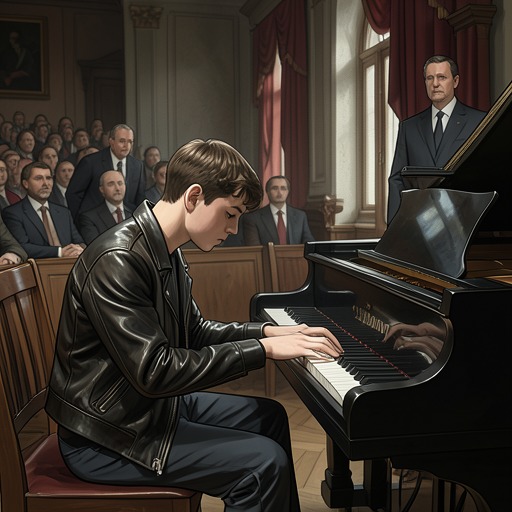
Over time, the rooms accumulate objects and memories that counter their original blankness. Framed photographs of Edison’s musical icons—Bud Powell, Art Tatum, Herbie Nichols, and Earl Hines—hang on the walls. A barn-plank dining table and rough-hewn chairs arrive, joined by an umbrella stand, an antique milk crate filled with old issues of Jazz Times, and begonias. The scale remains in view, but a yard-sale Stetson gives it an incongruously jaunty look; a Pandora doll sits atop the piano. Photographs chart the undertaking, from Edison’s earlier birthday image to scenes at work and during flood-relief efforts, and finally to his recorded weight dropping below two hundred pounds. When Pandora sees the furnished apartment through her friend Oliver’s eyes, she recognizes that it no longer resembles a clinic. It has become a home.
The Plan’s Limits and the Apartment’s Afterlife
At the six-month mark, Pandora ends the liquid-diet period. She says it is time to eat, while Edison objects that he has not reached his target weight. The apartment’s role therefore shifts from enforcing the original regimen to confronting the difficult transition away from it. Pandora had been considering whether she could step back and help from a distance, but finding a discarded box of forbidden food convinces her that an arm’s-length arrangement will not work. The shared residence has made close supervision possible, yet proximity does not guarantee honesty or lasting change.
After the effort breaks down, Pandora continues paying the rent, and Cody visits Edison there. Pandora finds her own visits painful and spaces them out; Edison regains weight rapidly, gives up biking, and becomes increasingly shut in. The once-sparse apartment deteriorates into a rat hole, while the domestic life they had built gives way to renewed silence about his weight. What had served first as a controlled setting for transformation and then as a home becomes the place where the limits of their pact are hardest to ignore. Prague Porches holds both sides of the undertaking: the real routines and attachments they created there, and the failure of those routines to secure a lasting outcome.