Sibling loyalty versus marital obligation
Big BrotherSibling loyalty versus marital obligation is the moral and emotional conflict at the center of Pandora’s attempt to help Edison: care for a brother in serious difficulty becomes a choice with consequences for a spouse and children. The narrative ultimately reveals that the dramatic plan in which Pandora leaves home to rescue Edison was largely imagined. That disclosure changes the status of the conflict, but not its real pressures: Edison’s visit and precarious circumstances, the family’s competing claims, and Pandora’s recognition that she did not act on the rescue she later pictured.
A conflict formed by divided loyalties
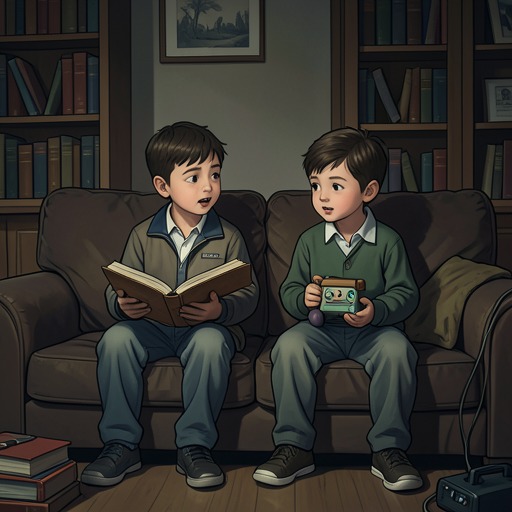
The conflict begins in the household’s everyday arrangements. When Fletcher comes downstairs and asks Pandora to come to bed, she recognizes that she has reproduced a childhood pattern: as children, she and Edison would fall quiet when their father, Travis, entered the room. Now Fletcher is the husband left waiting while Pandora and her brother talk. Edison’s long visit makes this tension recurrent, not merely a matter of one late night. Pandora feels caught between time with Edison and contact with Fletcher, whose work in the basement and limited exchanges with her leave the siblings together in the kitchen while he remains apart.
Pandora’s protection of Edison also depends on keeping family information contained. She has not told Travis that Edison has changed physically or disclosed his financial problems, describing him only as between apartments. When Fletcher sends Travis a photograph, Pandora objects that the information should not have come from him. She regards silence about a sibling’s troubles as a form of loyalty, extending even to a brother-in-law. Fletcher counters that the principal issue is Edison’s condition, not who learns of it, and accuses Pandora of returning to the childhood alliance in which she and Edison acted as a team. His question—what Pandora herself gets from the arrangement—makes visible the imbalance he sees: Edison receives access to her home, family, patience, and money, while she assumes the burden of defending him.
The dispute extends to Solstice, who learns from the photograph that Edison has been staying with Pandora for two months. Solstice interprets Pandora’s silence as exclusion and says she, too, is Edison’s sister and might have offered help. Pandora answers that Edison deserves privacy and that his weight should not be broadcast. The disagreement reveals that sibling loyalty is not a single, shared code: for Pandora, it means protecting Edison from exposure; for Solstice, the same protection looks like interference that keeps her from having a relationship with him.
The marriage becomes a boundary
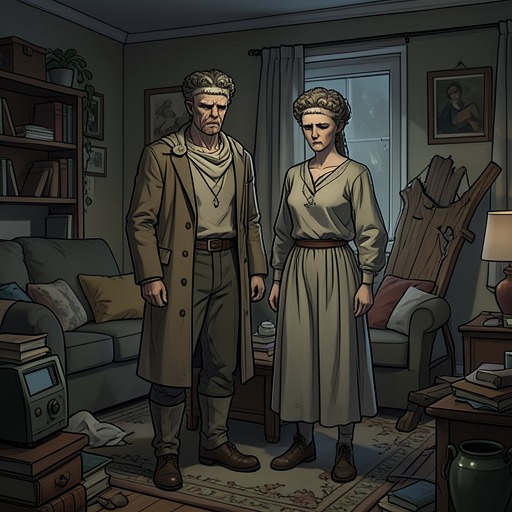
Fletcher objects not only to Edison’s presence but to the strain it places on Pandora’s marriage and household. Pandora admits that perhaps she has been a coward, using temporary hospitality to postpone the harder work of helping. Fletcher responds that she has already asked a great deal of him by hosting Edison for two months, and sets a firm deadline: Edison must leave by the afternoon before his flight. He says he did not marry Edison and has reached his limit. Their exchange makes the competing obligations concrete: Pandora sees a brother with nowhere to go; Fletcher sees a husband and family being asked to absorb an open-ended commitment.
After Edison reveals that the promised tour of Spain and Portugal is fictitious, Pandora tells Fletcher that her brother has no work and nowhere to go. Fletcher insists this changes nothing about the deadline and warns that she cannot ask Edison to stay longer without jeopardizing their marriage. Pandora invokes the family she acquired through marriage, including Fletcher’s children, Tanner and Cody, as evidence that marriage joins people to one another’s wider families. Fletcher distinguishes that general obligation from an unlimited duty to house and support a brother-in-law; he argues that two months of tolerance do not require him to accept more.
Pandora makes the choice explicit by proposing that Edison remain in New Holland while she finds an apartment, moves in with him, and supports him financially, on the condition that he lose weight. The imagined arrangement would separate her daily life from Fletcher and the children even as she promises that any apartment would be within walking distance of their home. Fletcher says he cannot promise to welcome her back. He describes the likely damage not as punishment but as consequence: her willingness to leave makes him feel expendable. Pandora insists that she is taking time from one family to attend to another, while Fletcher sees her choice as abandoning the family she has made with him for a plan he doubts will work.
Care as a wager on the future
Pandora’s proposed intervention grows out of fear that Edison may die if nobody helps him. She says she believes that, if no one acts—and she is the only person who can—her brother will die. She imagines the alternative as leaving him alone to face ostracism and continued overeating, with a possible fatal consequence. In this account, care is not simply affection: it means taking responsibility for housing and financial support and undertaking the difficult work of helping him change. Fletcher, by contrast, sees the plan as a grand scheme that lets Edison avoid confronting his circumstances and that may collapse as soon as he has to give up a favored food.
The narrative sets the urgency of Pandora’s conviction against its uncertainty. At work, she tells Oliver that Edison has nothing to look forward to; Oliver points out that the weight-loss goal is his one exception, and that achieving it would remove the goal itself. Pandora recognizes that the task has become larger than managing a weight-loss project: she wants to give her brother a reason to live. Oliver answers that no one can do that for another person. Pandora retreats to a more limited formulation, saying she can nudge Edison in the right direction. The exchange exposes the difference between helping someone and claiming power over the grounds of his continued life.
Fletcher’s boundary does not turn the marriage into an uncomplicated priority for Pandora. He asks whether she is also walking out on his children, and she answers that they will be able to visit. He says he does not want a wife who is half in and half out, or a succession of small departures; if she leaves, he would rather face one decisive separation. They embrace, and Pandora admits that she does not want to go and enjoys Fletcher’s company more than Edison’s. Her resolve therefore does not rest on preferring her brother as a companion. It rests on the belief that leaving him without help would be morally unbearable, even as she recognizes the cost to the family she would leave.
The revelation and the unrealized choice
The novel later revises this dramatic decision. In the closing account, Pandora says that the story is almost entirely a lie. Edison really did stay with her family for two long months, and he and Fletcher did not get along. Pandora really did consider proposing that she and Edison live separately together so that she could coach him and help her understand why he had gained weight. But she did not make the offer. She anticipated Fletcher’s objection and did not want to test a still-young marriage; she also told herself that the children she had adopted came first. She acknowledges a less noble reason too: she did not want to resume the exhausting, intensive life with Edison that the imagined rescue entailed.
This correction distinguishes the conflict’s actual history from the alternative life Pandora constructs. There was no apartment arranged for Edison, no move out of the family home, and no weight-loss pact enacted as she had described it. The story of a shared rescue and Edison’s transformation belongs to the imagined account, not to the events Pandora finally identifies as true. Her admission does not settle what she ought to have done. Instead, it makes the unchosen possibility the conflict’s lasting form: she can still imagine a future in which intervention might have helped, without being able to establish that it would have succeeded.
Pandora also concedes that her portrait of her brother was shaped by distance and admiration. She had never known him as well as she imagined; up close, he could be difficult, and she preferred his company in small doses. Her imagined power to change him therefore sits beside her recognition that she had exaggerated both her importance to him and her influence over him. Sibling loyalty remains real, but it cannot guarantee intimacy, control, or a successful rescue.
Afterlife of the imagined rescue
After Edison’s death at forty-nine, Pandora describes the unrealized plan as a parallel universe that has become hauntingly alive to her. She pictures scenes of shared effort and celebration, ending with Edison reaching a triumphant weight at a public weigh-in. These are not recovered memories of events that occurred; they are imagined alternatives made vivid by grief. The contrast between the imagined success and the actual decision not to propose the arrangement gives the conflict its retrospective force: Pandora’s later account allows her to dwell on what might have been while explicitly refusing to present it as fact.
That distinction also governs the novel’s treatment of responsibility. Pandora’s silence about Edison’s hardship, her dispute with Fletcher over the limits of family duty, and her eventual decision not to leave her household all belong to the real history she recounts. The rescue that might have reconciled her sense of sibling obligation with her fear of losing her marriage belongs to the story she tells herself. The conflict does not end with a demonstrated answer about which family duty was right; it ends with Pandora confronting the distance between care she imagined offering and care she actually chose to provide.